


With antimony prices almost doubling since the start of this year, Great Divide Mining (ASX:GDM) will expedite its strategy for the metal at the Coonambula Project in Queensland over the coming months.
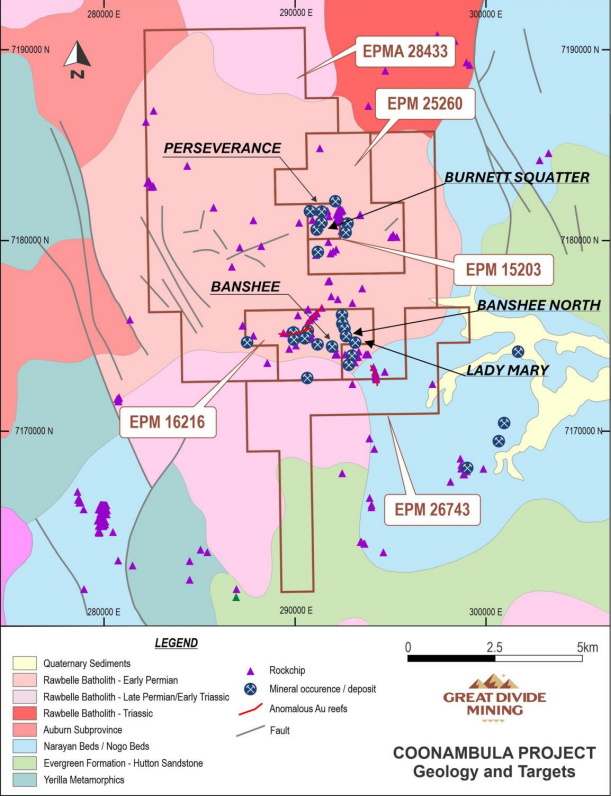
Located 25km southwest of Eidsvold, Coonambula covers around 288km2 and is host to a number of historical antimony and gold mines at the Banshee, Banshee North, Lady Mary, Perseverance, and Burnett Squatter prospects.
The largest is the Banshee antimony-gold mine, which Great Divide says has geological similarities to Larvotto Resources’ (ASX:LRV) Hillgrove mine in New South Wales.
“The recent rise in antimony prices and forecast longer-term demand for this strategic metal, listed at (sic) critical by many Western countries, provides GDM with a great opportunity to expand its exploration work at Coonambula,” CEO Justin Haines says.
“The high-grade antimony mineralisation at the old Banshee mine has only been mined to shallow depths and is open along strike and at depth. GDM’s planned work programs aim to unlock the full potential of this prospective area over the coming months.”
That work is expected to be rolled out in three stages. The first will include the re-sampling of antimony-gold surface workings and tranches, the rehabilitation of old trenches, and initial resource modelling based on existing surface and drilling data.
The second stage will involve a geophysical survey to define new drilling targets at depth and along strike, while stage three will include reverse circulation drilling, updated resource modelling and estimation work, and Scoping Studies.
Exploration is due to begin in the next few weeks, once the region has recovered from recent heavy rainfall.
“The Banshee mine is one of the biggest historical antimony-gold mines in this region of Queensland,” adds Haines.
“With increasing demand for this critical mineral, the Coonambula Project presents the potential for GDM to quickly advance an antimony-gold mine towards mining in the near term.”
The price of antimony has been on a run for several months now as demand oustrips supply, and was further boosted after China — which accounted for 48% of global antimony production last year — said it would restrict exports of the metal from mid-September.
By the end of May this year, antimony ingots in China had climbed to 127,500 yuan ($26,807) per tonne — a 56% increase since the start of 2024 — according to data from the Shanghai Metals Exchange. European prices, meanwhile, rose to $31,689 — a 75% increase.
Many antimony operations in Russia — which accounted for 24% of global supply in 2023 — have also been disrupted by Western sanctions following Moscow’s invasion of Ukraine.
Write to Oliver Gray at Mining.com.au
Images: Great Divide Mining