



As many Americans sit down at their Thanksgiving tables this week, the rest of the world waits for the major global retail events that follow, with Black Friday and Cyber Monday deals triggering massive surges in electronics sales. For the mining industry, this shopping rush offers a clear read on the raw materials required to keep modern electronics, high-tech manufacturing, and electric vehicles (EVs) moving.
On Black Friday, 27 November, sales in the US are expected to reach US$12.9 billion ($19.4 billion), representing year-on-year growth of 9.2%, with online spending from 26–30 November — covering Black Friday and Cyber Monday — projected to reach US$47.5 billion.
Even outside the US, strong sales are expected, with a record $7.2 billion forecast in Australia during the Black Friday–Cyber Monday weekend, up 5.5% year-on-year. Technology is expected to account for 30% of spending, with smartphones, laptops, televisions, and gaming consoles among the popular purchases.
US retail sales are expected to exceed US$85 billion over the sales period.
Yet behind every discounted device sits a complex global supply chain of mined elements, including lithium, cobalt, rare earths, and more.
These minerals are categorised as critical on official national lists because they’re economically strategic, required for advanced manufacturing and modern technologies, and vulnerable to supply disruptions.
The supply chain behind the discounts
When you look into your in-person or virtual shopping cart this weekend, consider what’s actually in it.
The global spotlight on the much-anticipated release of Grand Theft Auto VI (GTA 6), as previously reported, highlights the key metals powering the electronics industry today. Graphics processing units (GPUs) rely on a range of minerals, including quartz, silica sand, copper, tantalum, gallium, germanium, palladium, cobalt, tungsten, and rare earths.
Semiconductors are another key source of demand, not only in electronics, from gaming consoles to smartphones and laptops, but also in renewable energy technologies. Their performance and lifespan depend on specific critical minerals.
Ultra-pure silicon wafers form the base for chips and are treated with boron, phosphorus, and arsenic to control electrical currents, while gallium, indium, and germanium power high-speed and light-based signals.
Tantalum, tungsten, and cobalt are also used in chip wiring, alongside copper, silver, and gold, which allow power and data to flow.
Rare earth elements (REEs) like neodymium and dysprosium are used for precision lasers and heavy-duty magnets as well.
Lithium-ion batteries are a staple of many electronics, with the global market currently valued at more than US$150 billion. These batteries rely on a key set of metals, including lithium, nickel, cobalt, and manganese or iron, in addition to copper and aluminium.
Geopolitics is affecting the flow of critical minerals, with China having long dominated midstream and downstream processing for many metals.
Demand is growing, fuelled not only by electronics sales but also by global high-tech manufacturing, AI data centres, EVs, defence, and the broader clean energy transition. As a result, supply chains for these critical minerals remain under pressure.
A November 2026 report by the McKinsey Global Institute highlights electronics as a major source of global trade vulnerabilities, with products such as smartphones, laptops, memory chips, lithium-ion batteries, and data processing units most exposed to supply concentration and disruption.
McKinsey’s report notes that while all economies are relying on similar products, imports are largely dependent on the country’s core industries.
“China and other Asian economies including Vietnam and South Korea exhibit above-average exposure, with half or more of their imports being critical, due to their need for imported energy, raw commodities such as copper and aluminium as well as intermediate machinery to power their manufacturing capacity,” the report states.
“In contrast, the US and Europe-30 face lower exposure (at around 40%), reflecting less reliance on imported upstream inputs, even while remaining reliant on finished critical products such as smartphones and laptops.”
China will continue to control critical minerals refining capacity through to 2030, according to Benchmark Mineral Intelligence.
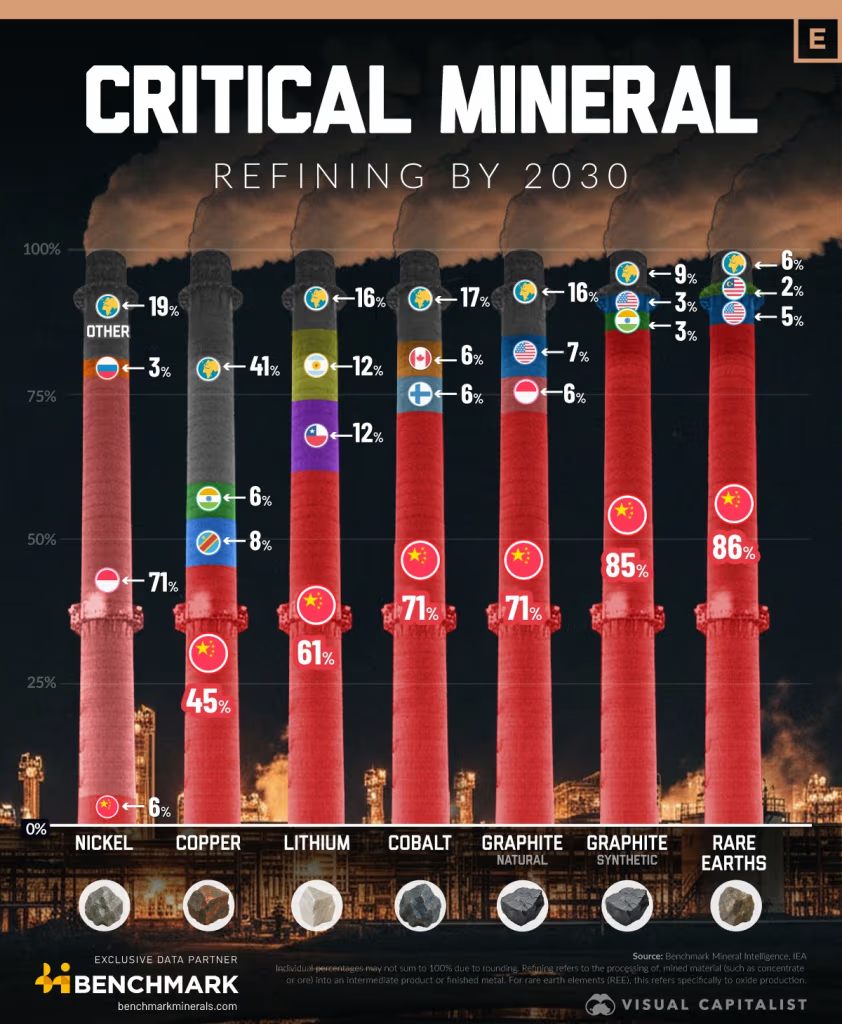
Apart from nickel and copper, critical minerals supply chains remain heavily concentrated in China, particularly in refining and processing. Indonesia is the world’s leading nickel refiner, though Chinese companies own around 80% of its refined nickel production.
In the US, EU, Canada, and Australia, greater attention is being placed on growing domestic refining and processing industries. Trade agreements between allied countries are also increasing to support the supply of critical minerals and the growth of these industries.
Building out independent processing and refining capacity takes years of capital investment and permitting, meaning Western governments and electronics makers still face an uphill race to derisk their supply chains as demand from high-tech industries continues to grow.
As holiday sales put millions of new devices into circulation, those allied supply partnerships highlight a broader reality: balancing the push to keep modern consumer technology affordable and available while nations increasingly compete for supply at every level.
The urban mine at the other end of the cart
While Black Friday and Cyber Monday sales allow consumers to upgrade to the latest electronics on the market, the old devices being replaced also offer a potential source of critical minerals.
The Ellen MacArthur Foundation, an organisation focused on the circular economy, highlights the millions of smartphones that sit in household drawers or are sent to landfills once they’re no longer in use, taking the critical minerals they contain out of the supply chain.
The foundation highlights that while parts of the industry are looking to grow the circular economy for critical minerals, 50–70% of phones that leave first use go on to be reused through passdown, repair, refurbishment, and resale.
Circularity is also extending to the metals in these products, with 1,000kg of end-of-life mobile phones containing up to 53kg of copper, 3.3kg of REEs, 270g of silver, 141g of gold, 10g of platinum, and 18g of palladium. These metals represent a contained commodity value of around US$20,000 at current prices.
The Ellen MacArthur Foundation suggests that implementing a strong circular economy by 2040 would have wide-ranging impacts on material security and environmental outcomes, and could recover an estimated US$2.2 billion worth of critical minerals from end-of-life mobile phones.
As shoppers hunt for bargains this weekend, the rush for new electronics serves as a timely reminder that these industries rely on both resilient new mines, exploration, and a more complete system for recovering the minerals already sitting in our homes.
Write to Amy Rotman at Mining.com.au
Main image: Mining.com.au


