Nothing shifts investor sentiment quite like market volatility, and lithium has experienced plenty of it in recent years. But the uncertainty surrounding the metal is being driven by two distinct market forces.
The months leading up to September illustrated this volatility, with lithium carbonate prices slumping in the final week of the third quarter and continuing to fall into October.
China’s large lithium inventories give it significant influence over the market, while Western markets have a different outlook for the metal. This is creating a divide in expectations for lithium’s future.
The great lithium bull run of 2021–23 made the metal appear invincible, as the global energy transition remained a key priority.
Lithium carbonate prices peaked in November 2022 at ¥597,500 ($127,312) per tonne, according to BloombergNEF.
The peak coincided with global investment in the low-carbon energy transition reaching a record US$1.1 trillion ($1.56 trillion) in 2022.
By 2025, global investment in the energy transition had more than doubled to reach a record US$2.3 trillion.
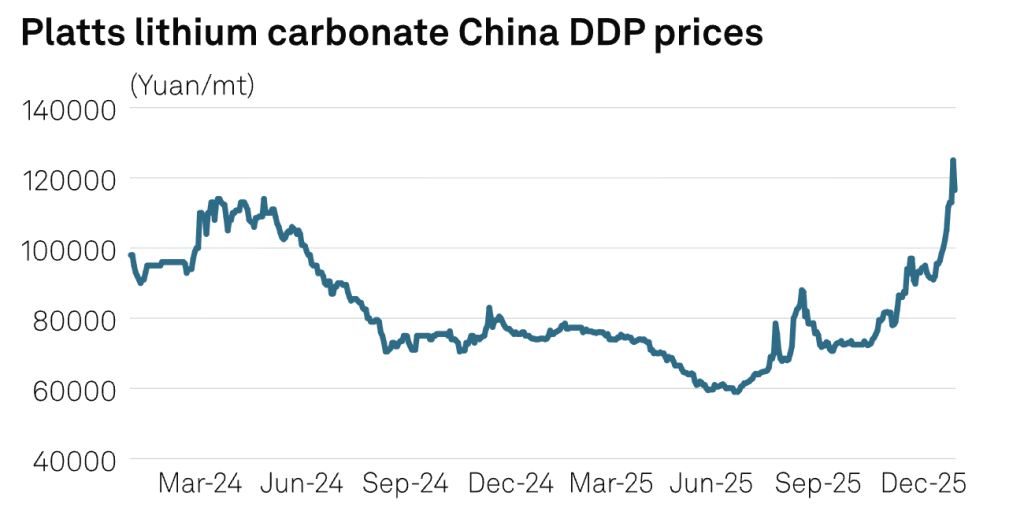
Yet, this investment growth was not reflected in lithium prices, with battery-grade lithium carbonate reaching ¥125,000 per tonne in China on 26 December 2025, its highest level that year, according to S&P Global.
Speaking to Mining.com.au, RK Equity Partner Matt Fernley explains that the market is in a difficult position this quarter.
The market began showing signs of stronger Chinese demand around September 2025, helping to support lithium prices towards the end of the year.
“This year we actually see similar signs, but I think there’s been very much of a bifurcation this year between what’s going on domestically in China and what’s going on in the rest of the world,” Fernley says.
“In China this year, demand has been pretty weak. For instance, EV [electric vehicle] sales in China were down 17% year-on-year in the year to July, while BESS [battery energy storage system] installations were down about 7% in the year to June. The rest of the world has really been the engine of demand.”
“In the rest of the world, EV sales are up around 35–40%, I think, and BESS installations are up 60% or more for the year. But the lithium exchanges we follow are in China.”
The International Energy Agency (IEA) reported that global EV sales were up 4% year-on-year and 35% higher than in the first quarter of 2026, according to its ‘Global EV Outlook 2026’ report.
On top of this, EVs are expected to account for more than 60% of global car sales by 2030.
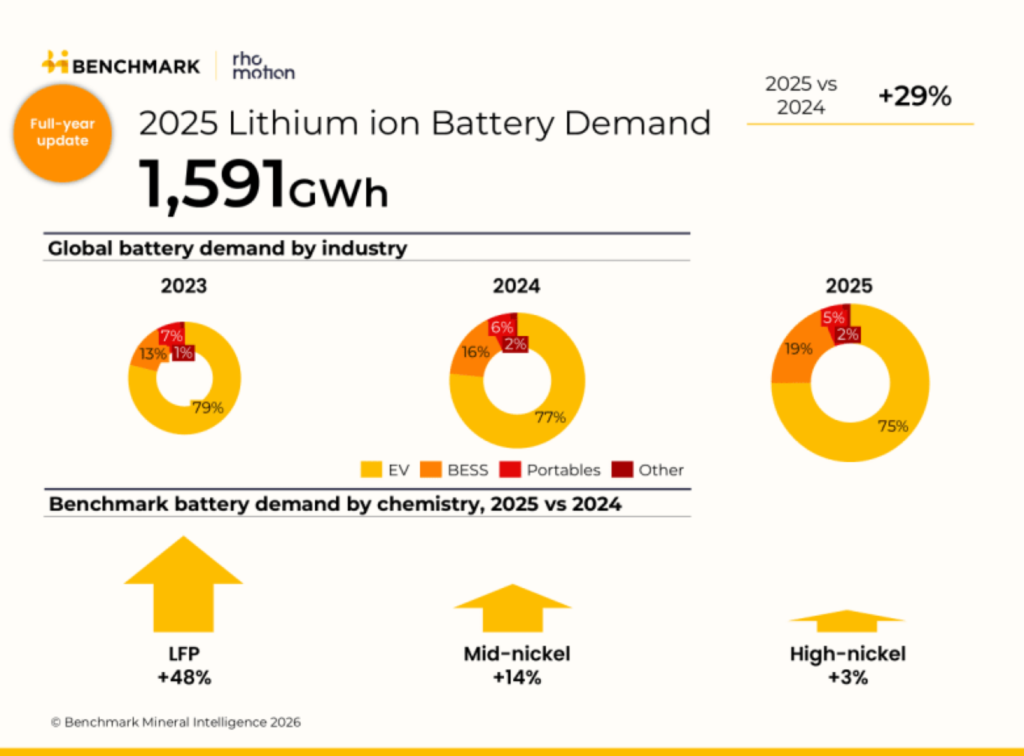
As for BESS, global demand grew 51% in 2025, outpacing the 29% growth in total lithium-ion battery demand, according to Benchmark Mineral Intelligence.
The US energy storage industry installed a record 57.6 gigawatt-hours (GWh) of new capacity in 2025, up 30% from the previous year. China’s reported growth in battery storage further highlights the scale of the global expansion.
Benchmark estimates that around 65GWh of grid-scale BESS capacity entered operation in China in December 2025 alone, exceeding the US’s total installations for the entire year.
With market attention still focused on China’s EV and BESS output, lithium prices fell around 15.19% in September, according to Trading Economics.
As at 26 October 2026, lithium was trading at around ¥97,000 per tonne, down 27.15% over the past month.
Narratives changing
The energy transition has historically been a key driver of lithium market sentiment, helping fuel the bull market earlier this decade.
The global shift towards cleaner energy is continuing, with many countries pursuing renewable energy targets and seeking to reduce their reliance on fossil fuels.
Lithium is a key material in the energy transition, a role that is increasingly being recognised.
Lithium became a major part of the energy transition between 2010 and 2015, although its use in energy-related applications dates back to the 1970s oil crisis, according to the International Lithium Association.
Lithium was combined with titanium to create a rechargeable battery in the 1970s, before advances in 1980 doubled its operating voltage and increased energy density through the use of lithium and cobalt.
A further breakthrough came in 1985, when carbon-based anodes and non-aqueous electrolytes helped pave the way for stable, reliable, high-powered lithium-ion batteries.
Lithium-ion batteries were initially used mainly in lightweight, portable electronics, but today, around 85% of extracted lithium is used in batteries, driven by the global shift towards net zero.
Hyperscalers drive US investment
While lithium is widely recognised for its role in supporting renewable energy grids and powering EVs, its significance differs across markets.
Although the US EV and BESS markets continue to grow, lithium’s role in the energy transition is less prominent in the country.
Fernley says the previous lithium bull market attracted investors from outside the sector, but interest from non-specialists is now limited as the market narrative splits into distinct themes.
“We’re not really seeing non-specialists coming into the space and looking at the space, and I think a lot of that’s down to the fact that a lot of commentators are still pretty bearish on the space, particularly in the US,” Fernley explains.
“We’re not seeing the sort of excitement in the space that we saw last time around, which is a shame because I think we’re going to have a strong event.
“I was in a hedge fund up until about 18 months ago and one of the things that became very clear was that in the US, the energy transition as a thematic doesn’t really exist.
“So, in the US, the energy transition theme got gobbled up by the hyperscaler theme.”
The hyperscaler theme refers to large technology companies that provide cloud computing, networking, and data storage services through global networks of data centres.
Fernley says the narrative is shifting, but the energy transition remains a key global driver of lithium demand.
“Within the US, which of course is one of the biggest pools of capital in the world, lithium is in the hyperscaler debate,” Fernley tells this news service.
“And obviously with the concerns at the moment about how well the hyperscalers can hyperscale, that’s impacting North American sentiment around lithium, I think.”
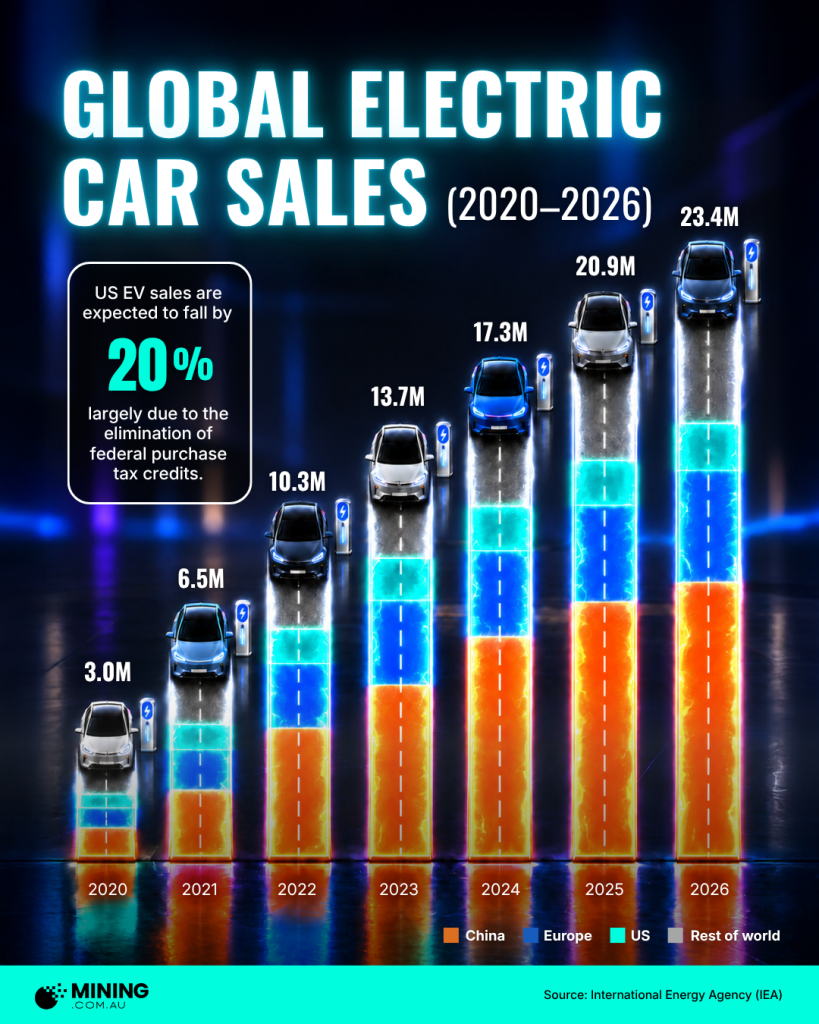
The IEA forecasts that EV sales in the US will decline this year.
US EV sales reached 1.5 million in 2024, following an increase of 400,000 in 2023.
They then plateaued in 2025 and are now projected to fall to 1.2 million in 2026, according to the IEA.
This bearish outlook for the US does not extend to China, where EV sales are forecast to reach a record 14.3 million in 2026, up from 13.2 million in 2025.
Meanwhile, annual EV sales in Europe are forecast to increase by 800,000 in 2026, while sales across the rest of the world are expected to rise by 900,000.
Lithium’s growth story continues
Over the past couple of months, Fernley says lithium prices have not broken out as strongly as many in the market expected, reflecting differing expectations in Western and Chinese markets.
China has driven lithium demand over the past five years, making its market a key indicator of global trends. However, demand in China has declined this year.
Although, futures contracts are not necessarily negative. Fernley says he expects a significant supply increase from China next year, potentially following the restart of Contemporary Amperex Technology (SHE:300750), the world’s largest manufacturer of lithium-ion batteries for EVs and large-scale energy storage systems.
“I see brine startups, I see more recycling because prices are higher,” Fernley forecasts for next year.
“So, in China, I see pretty weak demand and pretty substantial supply growth, whereas in the rest of the world, I see pretty strong demand and supply growth in control.
“That’s why we’re having this big bifurcation between what people are expecting: expectations in the West compared to expectations in China. And as a result, the price hasn’t really broken out the way that many of us were expecting over the last couple of months. I think it will still do so.”
Fernley says the market will need to work through persistent negative sentiment in China before prices can rise, even amid limited inventories.
At the start of the fourth quarter on 1 October, Trading Economics reported lithium prices at ¥122,800 per tonne, following a week of declines.
Lithium prices fell 22.52% in September.
Trading Economics reports that lithium prices fell to their lowest level of the year, as an upward revision to stockpiles prompted markets to price in a more comfortable supply outlook.
There is still potential for a rebound in the final months of the year, with lithium carbonate futures forecast to reach ¥133,327 per tonne, offering a possible recovery after an uncertain year.
Despite the lithium market’s turbulence this year, prices remained up 16.42% for the year as at 6 November.
The tale of two lithium markets will eventually need to converge, and the energy transition could be what brings them together.
Without lithium and its role in lithium-ion batteries, achieving net zero emissions by 2050 would be a much tougher task.
And without progress towards net zero, lithium market volatility may be the least of the world’s concerns.
Write to Maddison Elliott at Mining.com.au
Main Image: Mining.com.au