


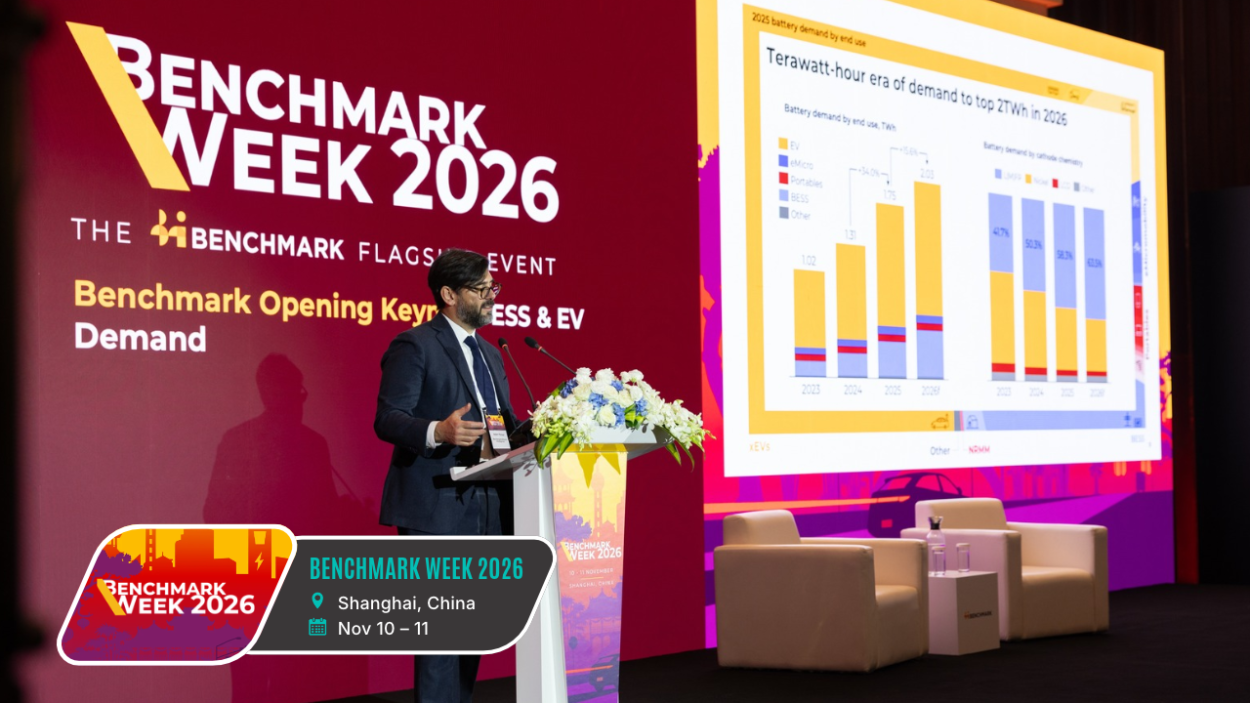
Benchmark Week 2026 in Shanghai, China, has underscored the rising importance of battery energy storage systems (BESS), with the sector becoming an increasingly significant driver of raw materials demand alongside electric vehicles (EVs).
Opening the second day of the event, Benchmark Mineral Intelligence Chief Research Officer Adam Panayi explains the significance of the industry’s transition into the terawatt-hour (TWh) era, reflecting the scale of battery demand from EVs and BESS industries.
The battery demand continues to grow across both applications, despite some market headwinds this year. Panayi expects the market demand to top 2TWh by the end of 2026.
EVs continue to dominate battery demand, with BESS growing rapidly as a share of the market. Electric scooters and portable devices account for smaller shares. That said, Panayi noted that 2026 has seen the slowest percentage of growth in the EV market in the industry’s history.
Panayi explains that, as expected, on the BESS side, the principal driver has been data centres and AI, though he expects that growth to ease over the next 12–18 months.
Looking at the demand metrics, Panayi also notes that 2026 has seen China’s market contract as well for the first time, down 13% year to date. He attributed the slowdown in part to the removal of key subsidies.
North American EV sales are also down, by 29% year to date, following the end of the US federal purchase credit in September 2025. Panayi notes that since the change in the US administration, the sector has seen little to no government support.
The European and UK markets have seen stronger growth, up 34% year to date, supported by policies encouraging EV adoption.
Panayi also highlighted growth across the rest of the world, including Africa, the Middle East, South and Central America, and Asia-Pacific excluding China. EV sales in those markets are up 68% year to date, much of it without the level of government support that previously helped drive adoption in China and the US.
What is interesting to note is that while China’s EV market is wholly produced using domestic cell supply, North America is also seeing significant growth in this regard, driven by US President Trump’s critical minerals drive and push for domestic supply chains and resource nationalism. Additionally, the US market is mostly dominated by Tesla (NASDAQ:TSLA), which is domestically produced.
On the other hand, Europe is seeing a backslide in locally produced battery supply. Having reached highs around 2021, its share is now on a downward trajectory, with expectations it will hit a low of 50% around 2027 before levelling off around the 60% mark.
Much of Europe’s battery cell supply will come from imports from China and Chinese-owned production within the EU.
As battery demand heads farther into the TWh era, the industry is evolving beyond a story of EV adoption alone. While EVs remain the dominant source of demand, the rapid emergence of BESS is creating a second major growth engine for the supply chain, with implications stretching from critical raw materials and refining capacity through to cell manufacturing.
The message from the market, and from Benchmark Week 2026 is that the energy transition is broadening in scope, and the scale of future demand will increasingly be a joint story across mobility and energy storage.
Write to Amy Rotman at Mining.com.au
Main image: Benchmark Mineral Intelligence


