


Forget the Golden Age, welcome to the Silver Age of the energy transition.
Silver has emerged as a critical metal at the crossroads of industrial demand, investor appetite, and constrained supply. A structural market deficit and the metal’s growing importance across industrial applications are keeping it firmly on investors’ radars.
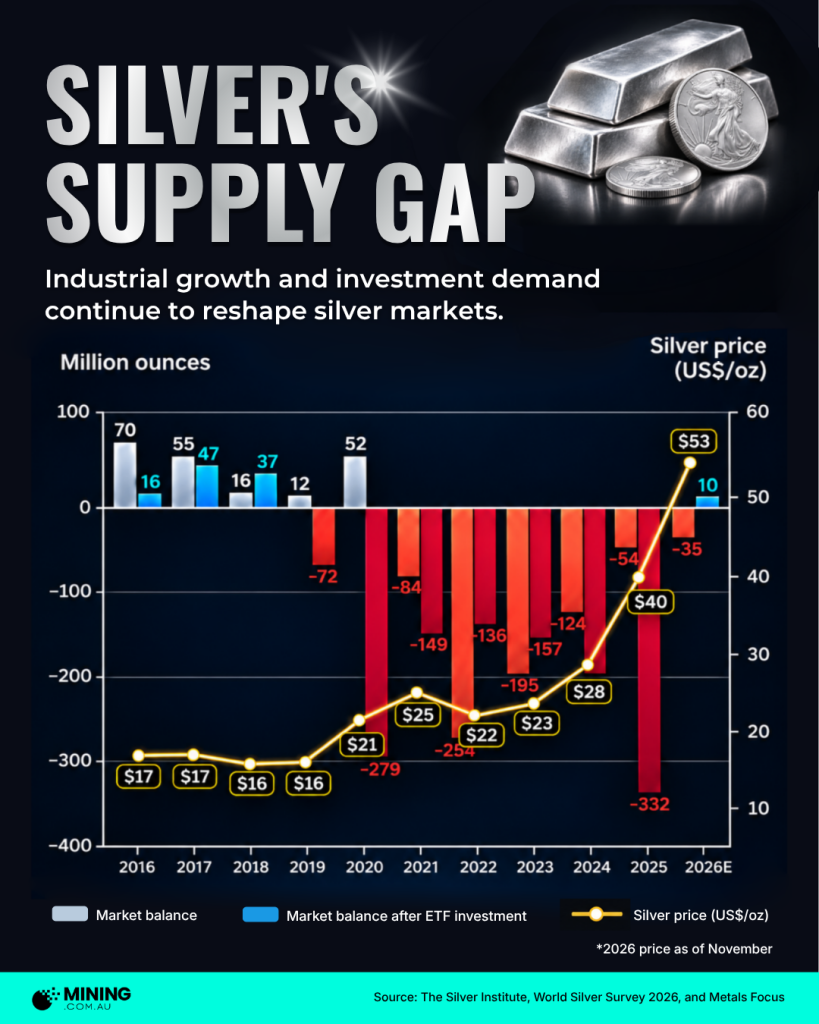
Silver reached a record high of US$121.65 ($176.90) per ounce in January 2026 before retreating sharply. Prices fell to a monthly average of approximately US$66 per ounce in June, closing the month at US$58.43. Silver rebounded in August, gaining nearly 16% to close at US$66.58 per ounce, before falling again to around US$52 per ounce in November.
Peter Krauth, editor of Silver Stock Investor and Silver Advisor, believes the volatility and price gains seen over the past 18 months have established a new price floor for silver.
“I think, technically, US$50 per ounce is going to be the new floor, despite having been the prior ceiling for decades,” Krauth says.
That volatility follows a year of extremes in 2025, when silver recorded multiple all-time highs, marked its fifth consecutive year of market deficit, and experienced a dramatic liquidity squeeze that reshaped investor sentiment.
The Silver Institute’s World Silver Survey 2026 examines how tight inventories, surging bar and coin demand, and shifting industrial dynamics contributed to silver’s volatile performance and growing strategic importance in the energy transition.
The metal has recorded a cumulative market deficit of 762 million ounces over the past five years, equivalent to a full year of global mine production, leaving supply under significant pressure. While the deficit has narrowed, the market remains undersupplied, a trend expected to persist for the foreseeable future.
Demand drivers: Clean tech, AI, and physical hedges
Demand comes from a variety of sources, with silver straddling the line between a precious and an industrial metal.
President and CEO of The Silver Institute Michael DiRienzo notes that silver continues to serve as a hedge against geopolitical risks and inflation, as well as a means of diversifying investment portfolios. He says these investment drivers have been reinforced by the strong price gains seen this year.
While silver is trading comfortably in the US$60s at the moment, DiRienzo notes that many banks and analysts are projecting a year-end price of around US$80 an ounce.
On the industrial side, silver’s high electrical conductivity and durability make it essential for coating electrical contacts, using silver ink on non-metallic surfaces to create electrical pathways, and producing slender silver wires that can be used as feedstock for 3D printers, among other applications.
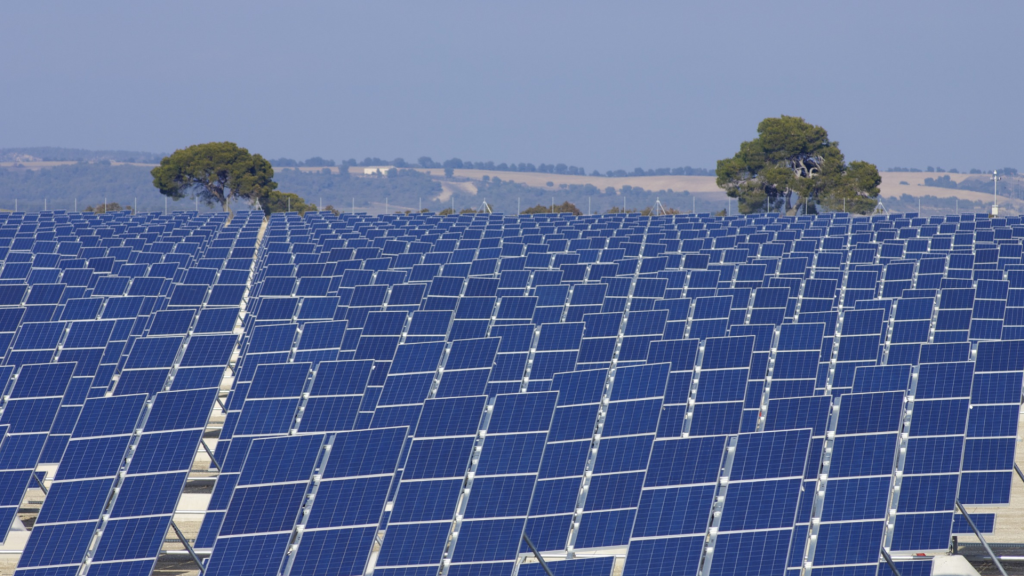
More notably, silver is the primary conductive element in photovoltaic (PV) solar cells, applied as a paste to form the fine conductive grid lines on the surface that collect and carry the generated electricity.
DiRienzo highlights total silver demand of 1.1 billion ounces in 2026, with 640 million ounces expected to go towards industrial applications. Demand is being driven not only by solar, but also by data centres and artificial intelligence (AI).
DiRienzo says jewellery accounts for about 159 million ounces of silver demand in 2026, with India leading consumption.
Pure investment demand is forecast at about 258 million ounces, including physical investment in coins and bars, slightly higher than in 2025.
The remaining 640 million ounces is expected to be used in industrial applications.
Krauth expects 2026 to record the third-highest level of historical demand for silver coins and bars, reinforcing the metal’s role as an investment hedge.
Industrial demand fell 3% in 2025 and is down again slightly in 2026, driven primarily by a downturn in PV demand due to thrifting and substitution in solar cells.
DiRienzo notes that, while solar installations are growing worldwide, manufacturers are looking to alternatives, as the price of silver currently makes it the highest input cost per solar panel.
Silver was added to the US critical minerals list in November 2025, opening the door to strategic government support for domestic production and investment in the metal.
The designation can help projects access federal funding, streamlined permitting, and other policy support.
According to Incrementum AG’s In Gold We Trust (IGWT) 2026 report, the designation brings greater focus to stockpiling initiatives aimed at securing domestic supply, tax incentives and investment support for producers, streamlined permitting for new mines, and the potential establishment of a strategic silver reserve.
“This move boosts both demand visibility and financial incentives for miners, laying the groundwork for a powerful re-rating of silver-related equities,” according to the IGWT report.
“With silver’s new critical status, capital is set to flow into the sector. Investors who position early stand to benefit from this structural tailwind.”
The supply crunch: Depleted reserves and long lead times
Even with demand slightly contracted this year, the silver market still expects a supply deficit, with mine output not satisfying demand expectations.
The Silver Institute forecasts a 2.5-million-ounce decline in global mine production in 2026, with gains in countries such as Mexico and Morocco more than offset by weaker output elsewhere.
DiRienzo notes that part of this crunch comes from the lack of new major silver deposits.
Silver mining is concentrated in Latin America, with Mexico remaining the world’s largest silver-producing country. In 2025, the country produced 172.9 million ounces, down 5% year-on-year.
Other top-producing countries by volume include Peru, China, Russia, Bolivia, Chile, Poland, the US, and Australia.
Part of the supply issue stems from the mining of silver, with only around 25–30% of all supply coming from primary silver mines, and the remaining 70–75% produced as a by-product of lead, zinc, copper, and gold mining.
Silver’s main production as a by-product of other metals means that it is increasingly dependent on the prices of gold and base metals to spur exploration and production drives.
Higher silver prices, such as what we saw in early 2026, are often insufficient to drive new supply if the economics of other metals are lagging.
Krauth notes that the new price floor has made for a very positive environment for miners. He highlights that in 2025, the average all-in cost to produce 1 ounce of silver fell to just US$12.21.
“If you’re producing gold, copper, or zinc, then you use the revenues from those other metals to credit your overall cost to produce silver,” Krauth says.
“And if the prices of those metals rise, then you get even bigger credits, and that’s exactly what happened in the last couple of years, not only in gold, but copper, zinc, and lead have all also risen.”
With production costs easing and silver establishing a potential new price floor of US$50 per ounce, profit margins for miners are looking increasingly favourable.
Scrap silver fills gaps
Secondary supply, derived from recycling, accounts for about 15–20% of total annual silver supply. Recycling increased by 2% in 2025 to 197.6 million ounces, its highest level in 13 years.
The Silver Institute forecasts a further 7% increase in 2026, taking recycled silver supply to a record 211.3 million ounces. This growth is expected to be driven by higher volumes of industrial scrap, as well as jewellery and silverware scrap, particularly from India.
Looking ahead, Krauth expects silver to continue trading sideways over the next few months, although further macroeconomic or geopolitical developments could provide a tailwind for both silver and gold.
He expects the consolidation phase to eventually give way to a recovery, with silver potentially rising above US$80 per ounce towards the end of 2026 and approaching US$100 in 2027.
Write to Amy Rotman at Mining.com.au
Main image: Mining.com.au


