



This article is a sponsored feature from Mining.com.au partner Opawica Explorations. It is not financial advice. Talk to a registered financial expert before making investment decisions.
Artificial intelligence (AI) is giving Opawica Explorations (TSX-V:OPW) a leg up on the exploration front, enabling the company to generate vast datasets and unlock potential new discoveries more quickly.
The junior gold explorer is hunting for the next big discovery in Quèbec’s famed Abitibi Greenstone Belt.
Couloir Capital analyst Tim Wright describes the Abitibi as a “remarkable geological setting” given it is the largest mineral-rich greenstone belt on the planet, formed 2.6 billion years ago.
“The region hosts numerous multi-million-ounce gold deposits and operating mine sites and represents one of the most fertile geological domains for gold worldwide,” Wright notes in a recent research report on Opawica.
Couloir Capital initiated coverage on Opawica in May with a share price target of C$0.33 ($0.37), which was more than double Opawica’s share price at the time the report was released.
Opawica has three exploration-stage projects – Bazooka, Arrowhead and McWatters – located along the Cadillac-Larder Lake Fault Zone.
The Cadillac-Larder Lake Fault Zone, also known as the Cadillac Break, is a 150m wide structure that controls the location of major gold deposits within the Abitibi Greenstone Belt, which extends from Quèbec into neighbouring Ontario and has produced over 200 million ounces of gold since the early 1900s.
Opawica’s main focus is the Bazooka and Arrowhead projects, where traditional exploration methods and modern-day technology have converged to create a large pipeline of targets across both projects.
“Currently, around 16,000m of drill-ready targets on both projects and already tested targets have yielded fantastic results, validating the firm’s approach to exploration,” Wright says.
Old rocks, new tools, big upside
Opawica Explorations CEO Blake Morgan says AI and machine learning gives the company’s geological team “another tool in the belt”.
“The large amounts of data we have produced over the past four or five years is astronomical,” he tells Mining.com.au.
“AI lets us put that all together which gives us a clear understanding of the rocks and saves on man hours.”
Opawica has drilled around 4km of targets so far at the Bazooka Project and intersected multiple mineralised zones over broad widths and with visible gold in parts, for which the company is waiting on assays.
Around 11,000m of drilling has so far been completed at the Bazooka and Arrowhead projects by Opawica and there is also about 45,000m of historical drilling on the projects.
This historical drilling returned notable intercepts of 5.79m @ 77.18 grams per ton gold and 20m @ 7.7g/t gold.
Opawica plans to keep drilling at both projects to pave the way for a maiden resource.
“We will know more as we go deep into 2025,” Morgan says.
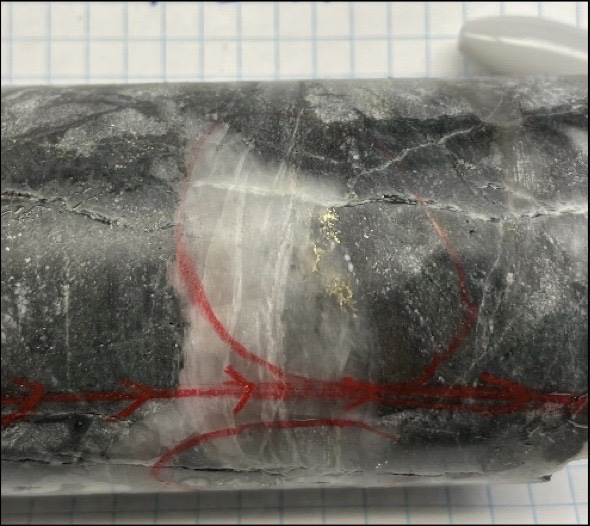
Just 1km of a 7km fault zone has been explored so far at the Bazooka Project, which Opawica sees as providing plenty of upside potential.
In mid-April this year, the company intersected a 60m mineralised zone between 190m and 250m. At around 249m, X-ray fluorescence (XRF) readings show up to 234 grams per ton gold.
XRF is a non-destructive analytical technique used to determine the elemental composition of materials such as drill cores. This process determines the chemistry of a sample by measuring the fluorescent (or secondary) X-ray emitted from a sample when it is excited by a primary X-ray source.
Same rocks as ‘billion-dollar deposits’
Morgan says Opawica’s projects have the same geology and similar high-grade intercepts to the “billion-dollar deposits right next door”.
There are seven active producing mines within a 10km radius of the company’s landholding.
These large deposits belong to the likes of IAMGOLD (NYSE:IAG), Agnico Eagle (NYSE:AEM), Pan American Silver (NYSE:PAAS) and Newmont (NYSE:NEM), among others.
IAMGOLD’s Mouska mine sits 8km east of the Arrowhead project and Agnico’s landholding fully surrounds the project.
While the Arrowhead Project has not been drilled to the same extent as the Bazooka Project, a seismic survey completed over the property highlighted three steeply dipping structures extending for 300m, 500m and 1km and running parallel to Agnico’s operational underground La Ronde Mine.
Agnico is exploring a patch of ground adjacent to Arrowhead and has undertaken significant drilling to the west and north, all the way to the project’s boundary.
The La Ronde Complex, which comprises two underground mines and a processing plant, produced 306,750 ounces of gold in 2024 and is expected to deliver around 310,000 ounces this year.
The project has proven and probable gold reserves of 2.74 million ounces and measured and indicated resources of 1.52 million ounces. A further 1.24 million ounces of resources sit in the inferred category.
“We have only explored 20% of our properties, so we are still in the early stage with plenty of upside,” Morgan explains.
“The good news is we are seeing the similarities which gives us extra data to pull from.”
Opawica has completed three drilling programs since 2022 and expects to continue delivering a steady flow of news from the Bazooka and Arrowhead projects.

Exploration, interest, and share price rising
Morgan says the company has seen a slight uptick in investor interest, which has been consistent over the past few weeks.
This appears to be a trend among the junior gold explorers, with investors starting to respond more positively to good announcements.
Canaccord Genuity Mining Analyst Tim McCormack told Mining.com.au in June that following a “pretty long and lonely period” for the junior gold players, things appear to have turned a corner over the past six to 12 months.
Companies putting out good news are now seeing a rise in share price and trading volume, according to McCormack.
Gold stocks now account for between 20% and 40% of Canaccord’s daily trading turnover.
While Opawica’s share price has come back a bit since Couloir Capital initiated coverage in May, the current price of C$0.095 represents 247% upside to hit the investment firm’s $0.33 target.
Since the start of July, the company’s shares have resumed an upward trajectory, advancing over 9%.
One key factor investors look out for when choosing where to put their money is whether management has “skin in the game”.
In the past 12 months, Quote Media estimates there have been 33 share purchases, totalling 455,500 shares, by “insiders” of Opawica.
Morgan is a frequent buyer of his company’s shares and has a roughly 9% stake, or 3.5 million shares, valued at over C$416,000 at the current share price of C$0.12.
“I am the largest shareholder in Opawica which shows I believe in what we are doing and where we are going,” he says.
“I am the largest shareholder in Opawica which shows I believe in what we are doing and where we are going”
Morgan says Opawica is just beginning its journey of awareness.
“So we expect things to pick up as time goes on and more discoveries are made,” he says.
Couloir Capital’s Wright notes in the May research report that Opawica has demonstrated its ability to generate drill targets and obtain the necessary permitting and financing to pursue its exploration strategy.
Write to Angela East at Mining.com.au
Images: Mining.com.au & Opawica Explorations


