



This article is a sponsored feature from Mining.com.au partner Pivotal Metals. It is not financial advice. Talk to a registered financial expert before making investment decisions.
Pivotal Metals’ (ASX:PVT) copper-dominant Horden Lake Project in Québec appears to have struck a chord with North American investors – even before the most recent resource upgrade.
Last week, the small cap explorer delivered a 30% larger resource of 407,000 contained copper-equivalent tonnes within 37 million tonnes @ 1.1% copper equivalent.
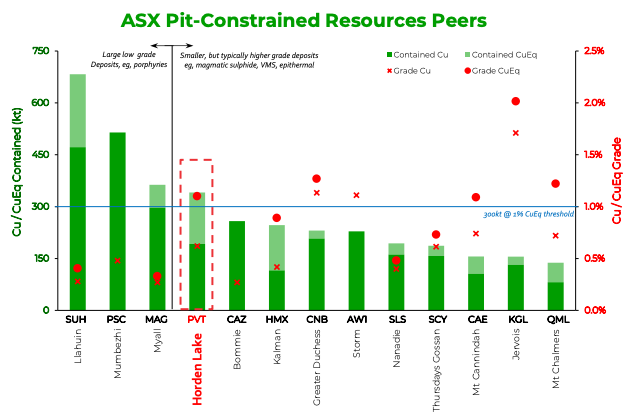
Over 340,000 tonnes of the updated resource exists in a single pit shell, also referred to as a pit-constrained resource, which are resources that are defined with realistic metallurgical and cost factors in mind, and provide a good indication of what may be extracted from an open pit mining scenario.
Open pits are more favourable than underground mines given their lower capital and operating costs and much greater ability to be scaled up.
There are very few shallow projects with scale held by companies listed on the Australian Securities Exchange (ASX), according to Managing Director Ivan Fairhall.
“Horden Lake is one of the largest high-grade shallow deposits on the ASX – 300,000 tonnes at over 1% copper equivalent is considered a key threshold as it demonstrates both scale, and grade, to support a potential standalone operation,” Fairhall tells Mining.com.au.
“Many other projects’ resources get deep quickly, so higher grades are needed to justify the extra cost. Not to say they’re bad, but they have very different cost and risk profiles associated with them.”
For context, Horden Lake’s 407,000-tonne copper equivalent resource at the current grade is the equivalent of about 1.1 million ounces of gold at between 1.1 and 1.2 grams per tonne.
Horden Lake is one of the largest of the ‘higher grade’ shallow copper projects on the ASX. There are larger shallow projects, but they have much lower grades and require major investment to realise the necessary economies of scale.
Realistic, scalable mining potential
Fairhall says reporting pit-constrained resources is a key differentiator of quality resources reported in the junior sector.
This is why Pivotal has reported a resource that splits out a pit-constrained portion. This ensures commodity price, mining costs, processing costs, recoveries and payabilities are factored into a pit optimisation process to determine the economic viability of the minerals for extraction.
“A lot of people just declare what they call an unconstrained resource,” Fairhall explains.
“They pick normally a pretty low cutoff grade, and they just say, ‘well those are all the blocks that are above that cutoff grade’. They could be 500m deep.
“So you get really blurred lines between what is mineable in an open pit, which is really what the cutoff grades are designed around – 0.3% copper pays the bills for open pit, but it doesn’t for underground.”
But Pivotal’s recent resource upgrade that averages 1.1% copper equivalent is calculated by taking the copper grade, and grossing it up by the expected recovered grade of the byproduct metals, which have increased from four to seven in the latest estimate. These secondary metals include nickel, gold, silver and platinum group metals.
Those recoveries have been derisked by recent metallurgical testwork, that proved Horden Lake can achieve high recoveries of the suite of metals to produce high-grade clean concentrates.
Fairhall says the metals are real byproducts and Pivotal has a robust basis to demonstrate they add meaningful value to the project.
“This resource shows a major increase in minor metal byproducts,” Fairhall notes.
“Copper equivalent is a way of simplifying the economic potential of the deposit. Copper is the overwhelming value driver, but these other products are valuable and coveted and are expected to contribute meaningful cashflows.”
Scale potential of the project
Based on the pit shell shown in the update, Horden Lake could produce 25,000 to 30,000 tonnes of copper equivalent for eight to 10 years from the open pit.
“We think we have a real project here and this resource clearly opens up the pathway to a long-life open pit project with a meaningful copper production profile,” he says.
“We also believe there is a lot more to find on the property. There’s multiple targets that have never seen a drill hole and have good credibility.”
The updated resource is based on the results of 2024 step-out and infill drilling but earlier in 2025 Pivotal completed a diamond drilling program and is continuing to drill its pipeline of targets, which demonstrate the exploration upside.
It also could position the company for another resource update in the second half of this year.
“We have already drilled out our next shallow target, which could extend the strike of the deposit by another 20%,” Fairhall tells this news service.
“We have purposely focused as a priority on areas which could be converted into open pit resources, as we see a pathway to continue to bulk up what is already a large shallow deposit. We are waiting for assays.”
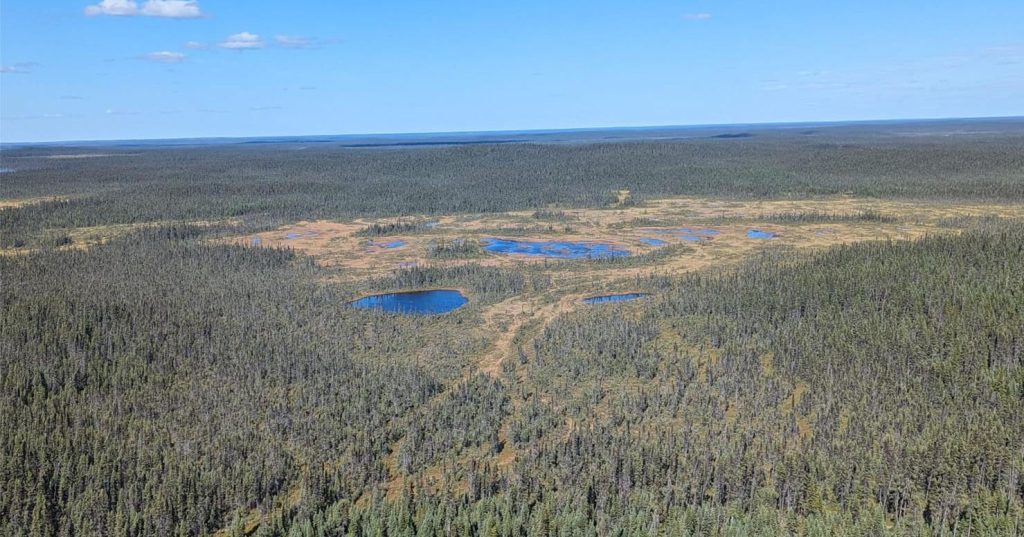
Horden Lake so far spans 2.2km, which for the ‘Perthites’ equates to the full length of St Georges Terrace plus half of Adelaide Terrace, while for the east coasters it is the distance from Sydney’s Circular Quay to Central Station.
The deposit is long and shallow and sits on a very productive gabbro-sediment contact zone, which extends across the full extent of Pivotal’s landholding.
Government, North American investors take notice
While drilling is continuing, Pivotal is also focused on further de-risking the project after recently receiving a $120,000 grant from the Québec Government to support additional metallurgical testwork.
The grant was awarded under a government program specifically aimed at supporting high-quality critical metals deposits to move up the development curve.
Fairhall says the Québec and Canadian governments recognise the huge importance of developing a pipeline of these projects if they want to continue to be a leading production base for critical metals like copper.
Further de-risking work will include assessment of preliminary mine scenarios and optimisation of the metallurgical results.
All of this has culminated in increased interest from potential strategic investors, with Pivotal mulling its options for a potential project-level or company-level investment.
In parallel to its aggressive exploration program, Pivotal is engaging in talks with North America-based investors open to some kind of strategic investment.
“There’s been groups that are just absolute Québec experts, have operated there for a long time and they’re like, ‘we didn’t even know this project existed, it looks really interesting’, and so we’ve really got their attention,” Fairhall explains.
“This is even before the resource update. There’s definitely interest from outside groups.
“The North Americans really understand it given its location, they have a very good appreciation for Québec.”
Exploring broader Québec potential
Pivotal also holds a large land position further south in Québec, which is a group of projects it collectively calls BAGB (Belleterre-Angliers Greenstone Belt). The company is looking to ramp up exploration on these properties, with the objective of finding new high-grade discoveries in a camp which shows considerable promise based on existing work.
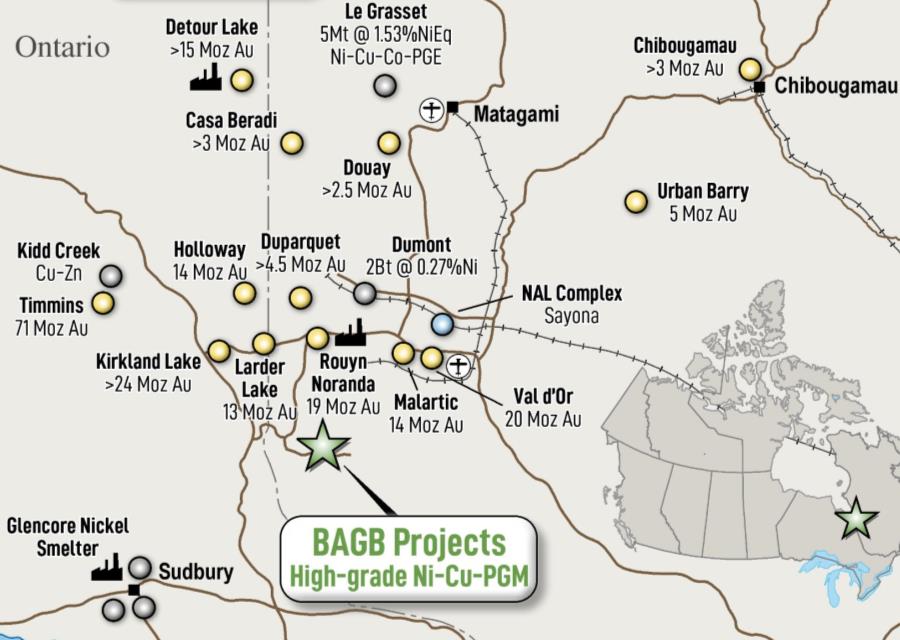
“BAGB is a really exciting project area. It’s earlier stage, but it’s a large land position with brownfield exploration characteristics, being anchored with bonanza grade discoveries of copper-nickel magmatic-type deposits across multiple project areas, including areas which have been historically mined,” Fairhall explains.
Pivotal is also evaluating the gold prospectivity, noting in its recently quarterly report that it has identified vein-hosted, “very high-grade gold” mineralisation that was encountered in underground development headings. Further investigation of this exploration target will be a priority over the spring-summer field season.
It would seem Pivotal is not alone in its strong interest of the area. Neighbour, TSX-V listed Vior (TSX-V:VIO) recently raised C$39 million ($44.1 million) to expedite drilling at its flagship past-producing high-grade Belleterre Gold Project, which is contiguous to two of Pivotal’s BAGB project areas.
“The Belleterre region is really heating up,” Fairhall says. “There are a lot of eyes on Vior, as they’re backed by some very prominent Canadian industry players. It’s exciting to see them aggressively exploring along strike from us.”
Write to Angela East at Mining.com.au
Images: Mining.com.au & Pivotal Metals


