

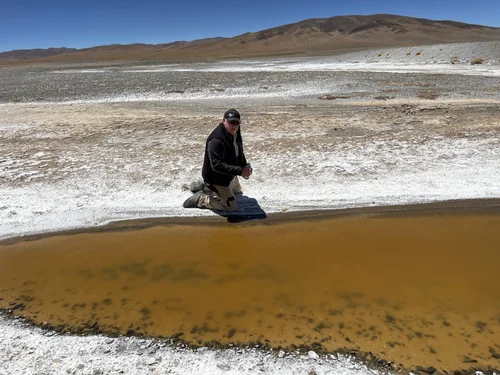
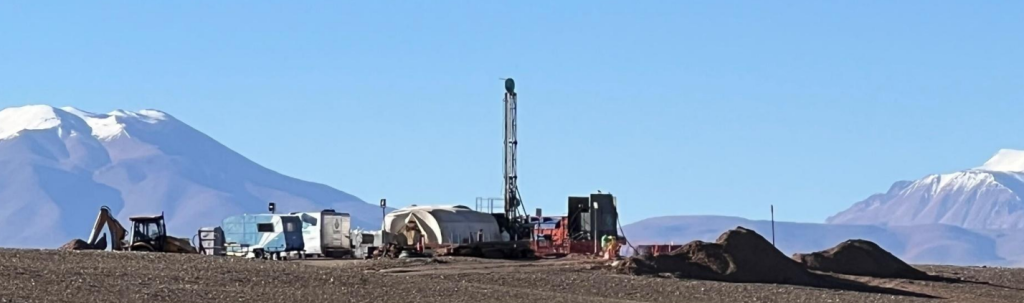
Patagonia Lithium (ASX:PL3) is set to begin drilling the JAM 2025-5 well later this month at the Cilon Project in Argentina, which aims to increase the resource if the brines assay lithium and high porosity continues as it has in other wells.
Executive Chairman Phillip Thomas says geophysics has already indicated this 600m well has a depth of low resistivity down to 1,000m.
“This well is 300m and 1,000m from our other wells in the southern section of the concessions enabling us to increase the confidence of the resource,” Thomas says.
“This will also go towards satisfying our work commitment on Cilon concessions. We were not able to drill the ‘eye’ of the geophysics target where resistivity is below 0.3 ohm.m but we expect brines to flow when we do the packer test from locally around the well due to the exceptionally high porosities encountered with other wells.”
As Mining.com.au reported, well 5 is just the beginning as Patagonia will then move immediately into drilling an additional well to convert its resource to measured and indicated status. This is a key de-risking milestone that will underpin a Scoping Study.
Ongoing demand growth and temporary production curtailments in China has seen lithium prices improve during the September 2025 quarter.
According to Trading Economics, lithium fell to ¥73,000 ($15,863) per tonne on 14 October 2025, down 0.14% from the previous day. Over the past month, lithium’s price has risen 0.76%, but it is still 2.01% lower than a year ago, according to trading on a contract for difference (CFD) that tracks the benchmark market for this commodity.
Thomas notes the North American lithium carbonate price index in the US averaged US$9,357 per tonne in Q2 2025, continuing a downward trajectory from earlier in the year as battery producers reduced spot purchases.
“This lithium carbonate spot price reflected subdued and slower downstream electric vehicle rollout kept procurement soft despite modest stabilisation in production,” he says.
Better targeting rare earths
Meanwhile, the company has uncovered 11 targets for auger and aircore drilling at the Goiás state concessions adjacent to the CMOC Niobium Mine in Brazil.
Detailed geological, mineralogical, and geochemical studies are underway to characterise these distributions accurately and to assess the potential for economic rare earths extraction.
The studies for the Goiás areas were based on the ratio between the Araxá carbonatite, silicate rocks, and fenitisation.
Thomas adds that Patagonia is “delighted” with initial investigations of the total light and heavy rare earth oxides.
“As a generalisation, enrichment of light rare earth oxides occurs in fenites by metasomatism,” he says.
“These new geophysics techniques visible and near infrared + SWIR short wave infrared will assist us better target rare earths.”
Patagonia Lithium is a lithium and rare earths-focused company that owns projects in Argentina and Brazil.
Write to Aaliyah Rogan at Mining.com.au
Images: Patagonia Lithium