


Metro Mining (ASX:MMI) non-Executive Chair Douglas Ritchie revisited some of the challenges faced by the bauxite producer over the past few years at today’s (21 May) annual general meeting, but pointed to 2023 as a “pivotal year for the transformation of the company”.
He says it is no secret that during the last few years Metro has endured significant challenges and setbacks which has threatened the company’s financial viability and continued operations.
“COVID-19, unprecedented ocean freight rates, cyclones, and massive rainfall events to name just a few,” Ritchie says.
“Most recently, in December, Tropical Cyclone Jasper and its aftermath resulted in the suspension of transhipping operations for 10 days at a time when we were otherwise on-track to ship 5 million tonnes for the production year.”
Despite these challenges, Metro hit its production guidance target last year, shipping around 4.6 million wet metric tonnes of bauxite from its Bauxite Hills Mine north of Weipa in Queensland to customers.
This was a production record for the company.
Metro also witnessed a 33% year-over-year increase in revenue to $235 million and shifted from a $31 million loss in 2022 to a $13 million profit in 2023.
However, the company was not immune to the inflationary cost pressures, reporting higher year-over-year costs in 2023.
But Ritchie says a 6% increase in costs is only marginally higher than the inflation rate and provides reassurance that economies of scale can be realised as Metro increases our production output.
In March this year, Metro set a production goal for 2024 of between 6.3 million and 6.8 million wet tonnes, as it works to expand its production to 7 million tonnes.
Ritchie says significant progress was made last year with the company securing funding through a debt facility with Nebari to cover the acquisition of a 50% interest in a large offshore floating terminal, Ikamba.
Metro began cargo operations at the terminal in late April.
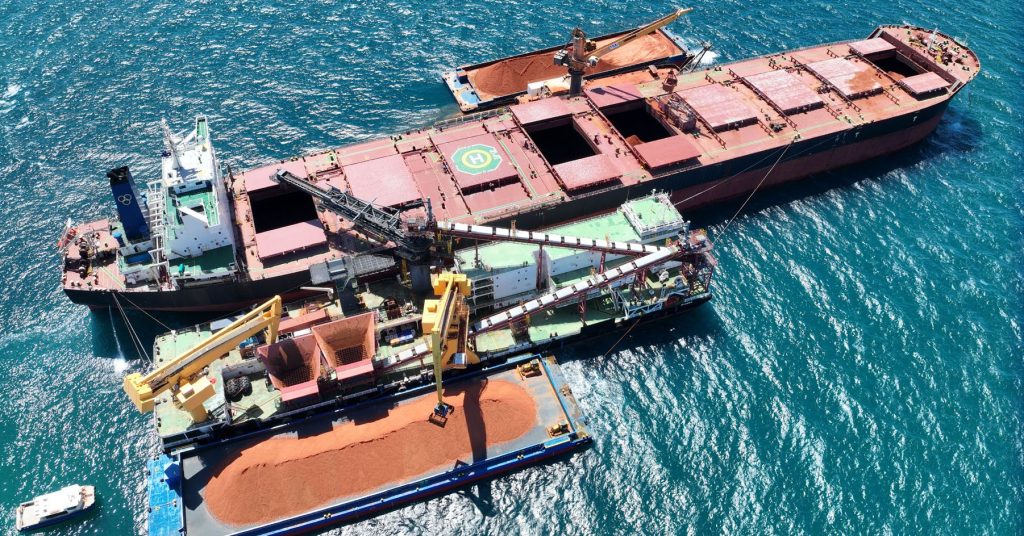
“Ikamba has now been commissioned and operating in tandem with TSA’s single floating crane,” Ritchie says.
“A revised concept for the expansion of screening capacity was approved by the board in conjunction with our final investment decision on the expansion.”
The expansion will take screening nameplate capacity to 2,500 tonnes per hour, providing increased throughput for production.
Ritchie says the increased screening capacity will also provide for greater resiliency in Metro’s operations due to its ability to handle wet product.
Meanwhile, upgrade works at the barge loading facility has delivered an 80% improvement in loading rates compared to the final quarter of 2022.
Metro is also transporting 40% more material from pit to port, with the implementation of quad trailer configuration trials allowing the movement of up to 230 tonnes per cycle.
In early May, the company raised $40 million from a placement to domestic and international institutional investors to repay debt.
Write to Angela East at Mining.com.au
Images: Metro Mining