


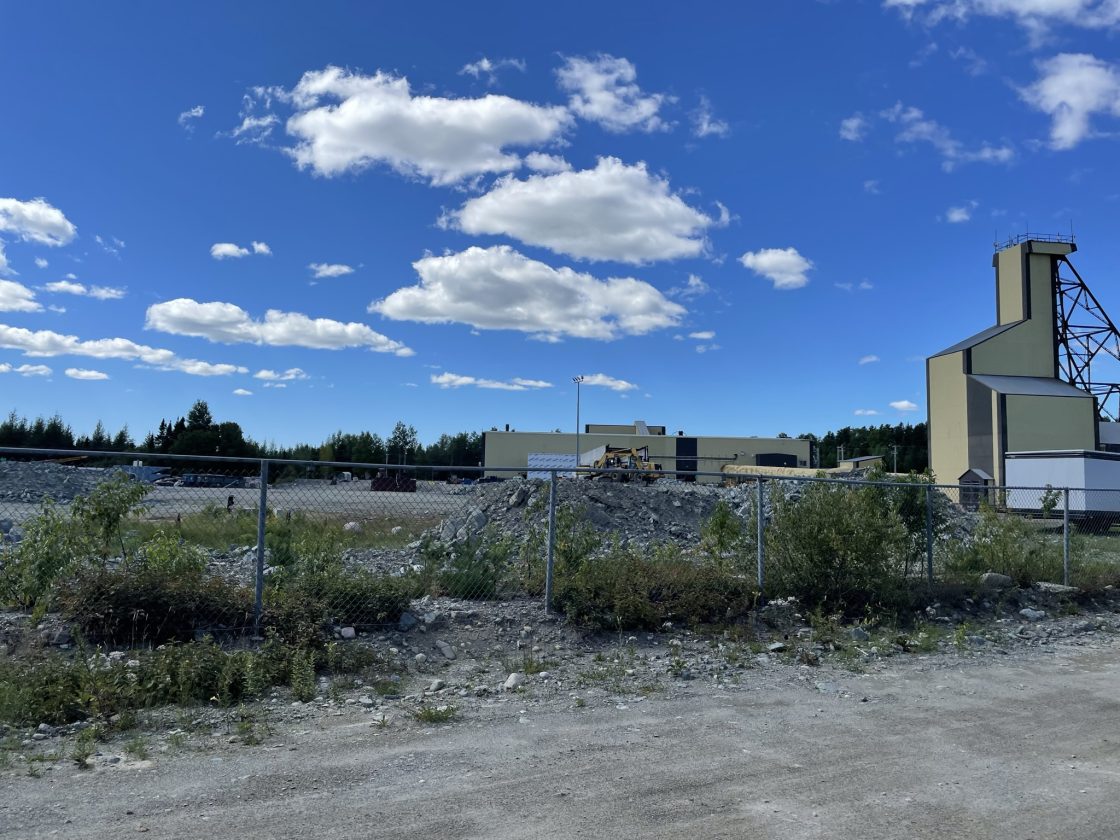
LaFleur Minerals (CSE:LFLR) is shifting its focus to the next phase of growth and progress toward restarting the Beacon Mill, in Canada, in 2026, after completing a preliminary economic assessment (PEA) of the Swanson gold deposit.
The PEA study confirms a robust business case that is cost-effective, low-complexity and highlights a streamlined path to production, leveraging LaFleur Minerals’ fully permitted Beacon Mill.
Initial capital costs of C$31 million ($32.32 million) at the Swanson deposit and Beacon Mill, including ongoing restart and recommissioning work. Post-tax internal rate of return (IRR) of 65% and C$101 million net present value and a 1.8-year payback.
LaFleur Minerals says the study delineated strong free cash flow generation through a staged mill expansion to 1,250 tonnes per day, expected to materially lower operating costs through economies of scale.
With a strategic rail-linked mine-to-mill model over the long-term, the project shows a low-capex, rapid payback, high return profile, which combined with a meaningful increase in the Swanson deposit’s resource estimate that supports a seven-year mine life, further bolstering operational resilience.
CEO Paul Ténière says the results of the PEA indicate a capital-efficient development pathway for the Swanson deposit that leverages the nearby Beacon Mill and established infrastructure Val-d’Or mining district.
“With a modest initial capital requirement and mill upgrades and strong projected returns at a US$2,750 per ounce base-case gold price, we believe Swanson has the potential to evolve into a competitive and short-term gold development project within the Abitibi Gold Belt,” Ténière says.
“Our focus now shifts to continued technical optimization, metallurgical and bulk sample validation, and permitting advancement as we evaluate the next phase of growth and progress toward restarting the Beacon Mill in 2026.“
Additional capital estimated at C$175 million could bring the mill from 1,250 tonnes per day to 3,000 tonnes per day or higher.
ERM recommends that if additional mill feed is secured by LaFleur Minerals, a parallel mineral processing circuit of 3,000 tonnes per day or higher could be added to the Beacon Mill to match the secured additional feed from other mining projects.
These expansion scenarios have not been evaluated in the current PEA and would be subject to separate technical and economic studies.
Equipment suppliers, such as Bumigene and others have already been engaged to support flowsheet optimisation and finalise the upgraded plant design to 1,250 tonnes per day. While the expanded configuration will require minimal additional labour, the higher throughput equipment is expected to improve productivity and reduce operating costs.
Swanson’s indicated resource totals 2.96 million tonnes at 1.69 grams per tonne gold for a total of 160,00 0 ounces of contained gold, comprising 2.74 million tonnes at 1.62g/t gold in open-pit configuration and 221,000 tonnes at 2.5 g/t gold.
The inferred resource contains 1.08 million tonnes at 1.93g/t gold for a total of 66,800 ounces of contained gold, including 854,000 tonnes t at 1.75g/t gold in open-pit areas and 225,000 tonnes at 2.60g/t gold in underground extensions
LaFleur Minerals is a gold-focused explorer and developer with assets in the Abitibi Gold Belt near Val-d’Or Québec, Canada.
Write to Aaliyah Rogan at Mining.com.au
Images: LaFleur Minerals


