


Australian inflation in February has come in lower than expected, lifting investor confidence.
The February Consumer Price Index edged down to 2.4% year over year, from 2.5% in January and came in below market expectations of 2.5%.
Monthly trimmed mean inflation is back at 2.7% year over year after climbing to 2.8% in January.
ANZ Senior Economist Adelaide Timbrell says volatility of electricity prices, including a fall of 2.5% month over month after a rise of 8.9% month over month in January, is key to the lower than expected result.
“The Budget 2025-26 $1.8 billion extension of the energy bill relief fund to the end of 2025 will put a small amount of downward pressure on inflation in the second half of the year if implemented,” she says.
With respect to potential rate cuts, Timbrell notes the Reserve Bank of Australia is likely to look through the slight drop in the headline inflation data and may find the monthly trimmed mean result encouraging for disinflation progress.
This downward shift in inflation helped sustain the positive momentum of the Australian Securities Exchange (ASX) for the remainder of the session on Wednesday (26 March).
The S&P/ASX 200 closed up 56.5 points, or 0.71%, at 7,999 points, which saw it cross above its 20-day moving average. The index is up 2.18% over the past five days.
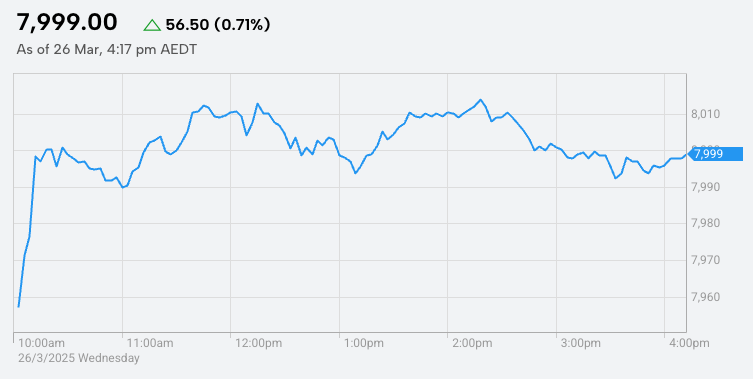
Ten of the 11 sectors rallied, with financial the strongest on a 1.16% advance. Industrials climbed 0.93%, utilities rose 0.61% and energy lifted 0.39%.
Gold miner Ramelius Resources (ASX:RMS) held onto the top spot, ending the session 6.05% higher at $2.28, while fellow gold play Spartan Resources (ASX:SPR) jumped 4.94% to $1.81 by the closing bell.
Lithium miner Liontown Resources (ASX:LTR) also edged its way into the top movers with a 4% rise to $0.65.
However, uranium miners Paladin Energy (ASX:PDN) and Deep Yellow (ASX:DYL) were on the opposite side of investor sentiment, sliding 11.58% and 4.51%, respectively.
Paladin today announced it has resumed operations at the Langer Heinrich Mine (LHM) in Namibia following a temporary suspension due to unseasonal heavy rainfall.
The company says it is a “one-in-50-year” rainfall event that impacted plans to accelerate the start of mining and resulted in short-term disruptions to operations.
“Whilst there appears to be no significant damage to the processing plant and our people are safe, there was damage to the access roads and minor civil infrastructure on the LHM site, and to the haul roads
to the mine,” Paladin says.
The S&P/ASX200 is Australia’s leading share market index and contains the top 200 ASX-listed companies in terms of market capitalisation, and accounts for about 80% of the country’s equity market. The index is designed to measure the performance of the 200 largest index-eligible stocks listed on the ASX by float-adjusted market capitalisation.
It is recognised as the institutional investable benchmark in the country.
Write to Angela East at Mining.com.au
Images: ASX & iStock