


This article is a sponsored feature from Mining.com.au partner Iltani Resources. It is not financial advice. Talk to a registered financial expert before making investment decisions.
Iltani Resources (ASX:ILT) believes its Orient Silver-Lead-Zinc-Indium Project in Queensland has the potential to deliver a larger ore reserve than Silver Mines’ (ASX:SVL) Bowdens Project in NSW.
This follows the release of an exploration target for the company’s Orient East prospect of 25 to 35 million tonnes @ 77 to 95g/t silver equivalent.
The target includes a high-grade component of 12 to 18 million tonnes @ 110 to 130g/t silver equivalent.
This increases the total Orient exploration target to 99 to 135 million tonnes @ 61 to 73g/t silver equivalent, including a high-grade core of 32 to 42 million tonnes @ 110 to 124g/t silver equivalent.
Meanwhile, Silver Mines’ Bowdens Project – which is considered one of the largest undeveloped silver projects in Australia – hosts a resource of 179 million tonnes @ 58g/t silver equivalent and a reserve of 32.8 million tonnes @ 68g/t silver.
Iltani Managing Director Donald Garner tells Mining.com.au that the company is on track to deliver a reserve of greater tonnage and grade than Bowdens.
“All our exploration targets are open along strike and at depth and we believe there is the potential to substantially increase these in terms of tonnes and grade,” he says.
“We know our grade will improve as we infill west and east, plus we are going to drill more tonnes to the north, south and undercover between east and west.”
While Silver Mines previously ran into some legal issues in New South Wales after the state’s Supreme Court allowed a challenge to the development of the Bowdens Project, the company’s market value at one point reached nearly $400 million.
The company’s peak market capitalisation in 2024 before the challenge to the development was $324 million.
By comparison, Iltani has a market capitalisation of just $11.5 million, which demonstrates the potential share price upside if the Orient Project surpasses Bowdens in size.
At the same time, silver is becoming an increasingly important commodity in the renewable energy sector, particularly for its role in solar panel manufacturing.
The precious metal’s high conductivity and durability make it an ideal component for the electrical contacts within solar (also known as photovoltaic) cells, where it is used in the form of silver paste to facilitate the flow of electricity generated by sunlight, optimising the performance of the panels.
The demand for silver is surging, driven largely by its use in solar cells. This demand, coupled with a structural deficit, pushed silver prices to nearly US$35 ($55) per ounce in October 2024.
Garner says the silver market outlook remains strong.
“With the silver price underpinned by the structural deficit plus materially increasing demand from the photovoltaic (PV) sector – demand from the PV sector could grow to be as much as 50% of global silver demand by 2050 – it appears that the silver price will stay buoyant for the foreseeable future,” he notes.
“The ever increasing investment in renewable energy, in particular solar, has resulted in the International Energy Agency forecasting that it is likely that solar energy will become the largest source of primary energy by the 2040s.
“Solar energy installed capacity is currently doubling every three years, and this will drive the demand of specific critical minerals used in solar photovoltaic cells.”
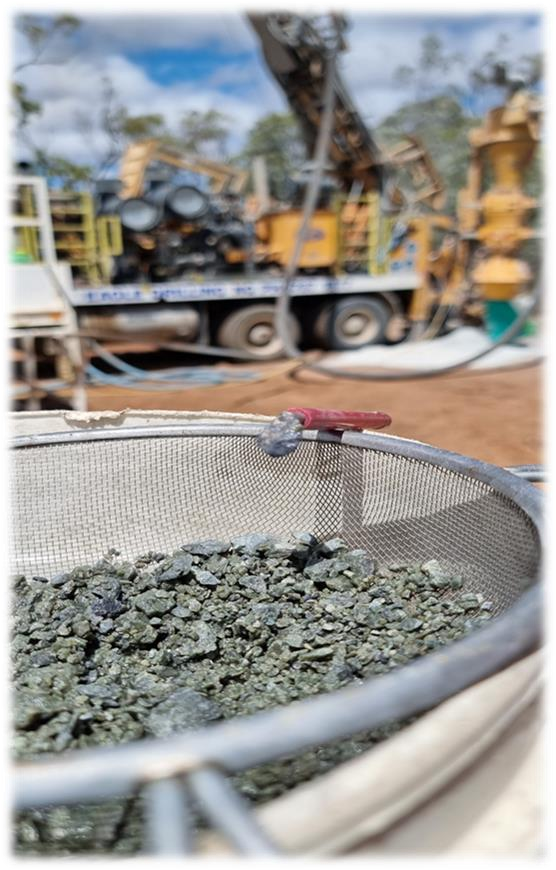
Iltani’s plan for 2025 is to convert the exploration targets for Orient West and Orient East to JORC-compliant resources as well as continue exploration within the broader Orient Project.
“There is material potential to add more resources in multiple areas,” Garner notes.
Orient East delivered the highest-grades intersected to date at Orient, with ORR055 delivering a peak result of 1m @ 2066.3g/t silver equivalent from 77m (676g/t silver, 251g/t indium, 16.75% lead and 13.5% zinc) within a wider intercept of 4m @ 921.8g/t silver equivalent from 77m (305.1g/t silver, 102.7g/t indium, 7.72% lead and 5.86% zinc) downhole.
Not to be outdone, one of the first infill holes drilled at Orient West recently returned a peak intercept grading 1,933.4g/t silver equivalent, with ORR068 intersecting 9m @ 391.9g/t silver equivalent (151g/t silver, 26.5g/t indium, 3.51% lead and 2.07% zinc) from 90m.
This intercept also featured 3m @ 916.3g/t silver equivalent (389.3g/t silver, 67.8g/t indium, 8.02% lead and 4.19% zinc) from 91m, including 1m @ 1933.4g/t silver equivalent (762g/t silver, 183.5g/t indium, 18.15% lead and 10.55% zinc) from 93m downhole.
Iltani also previously discovered Orient, which forms part of the larger 340km2 Herberton land package in northern Queensland, hosts indium.
Indium is considered critical by several countries including Australia and the US. But, like many critical minerals, it is found as a byproduct of other primary minerals.
Geoscience Australia says around 50% of the critical minerals on Australia’s Critical Minerals List are byproducts of major commodities such as zinc, copper, lead, nickel and aluminium.

“Critical mineral byproducts such as gallium, germanium, and indium are commonly found in zinc deposits and are strategically important minerals essential to modern technologies and national security that have small markets and highly concentrated supply chains,” Geoscience Australia notes.
Garner says if Iltani is successful in bringing Orient into production, the operation will produce a lead-silver concentrate and a zinc-silver-indium concentrate.
“This is similar to a great majority of the silver mines globally, where the silver produced is contained in lead and silver concentrates, for example South32’s (ASX:S32) Cannington Silver mine – Australia’s largest producer of silver – located in the Mt Isa region in Queensland,” he says.
“So when in production, Orient will produce and get paid for silver, lead, zinc and indium.”
Garner says indium tin oxide (ITO) continues to account for most global indium consumption.
“ITO thin film coatings are used for electrically conductive purposes (touch screens) in a variety of flat panel displays, and it is also used in night vision equipment, aerospace alloys, solders and solar cells,” he explains.
The United States Geological Survey reports global indium production at around 990 tonnes in 2023, with 65% of this output originating from China.
Opening doors to non-dilutive funding
With indium considered critical by not just the Australian Government but also the Queensland Government, this strengthens the case for Iltani to unlock non-dilutive funding for the project.
The state government announced in September 2024 an $8 million initiative to drive identification, discovery and development of critical minerals.
Under its Critical Minerals Strategy, the Queensland Government has allocated $245 million to a range of initiatives to fast track discoveries of critical minerals.
Garner says the Orient Project is already “Australia’s largest silver-indium project”, extending for over 6km2.
“Our goal is to create shareholder value and the best way to do this is to define an economically viable project at Orient,” he says.
“We believe that we are on track to do this.”
Write to Angela East at Mining.com.au
Images: Iltani Resources