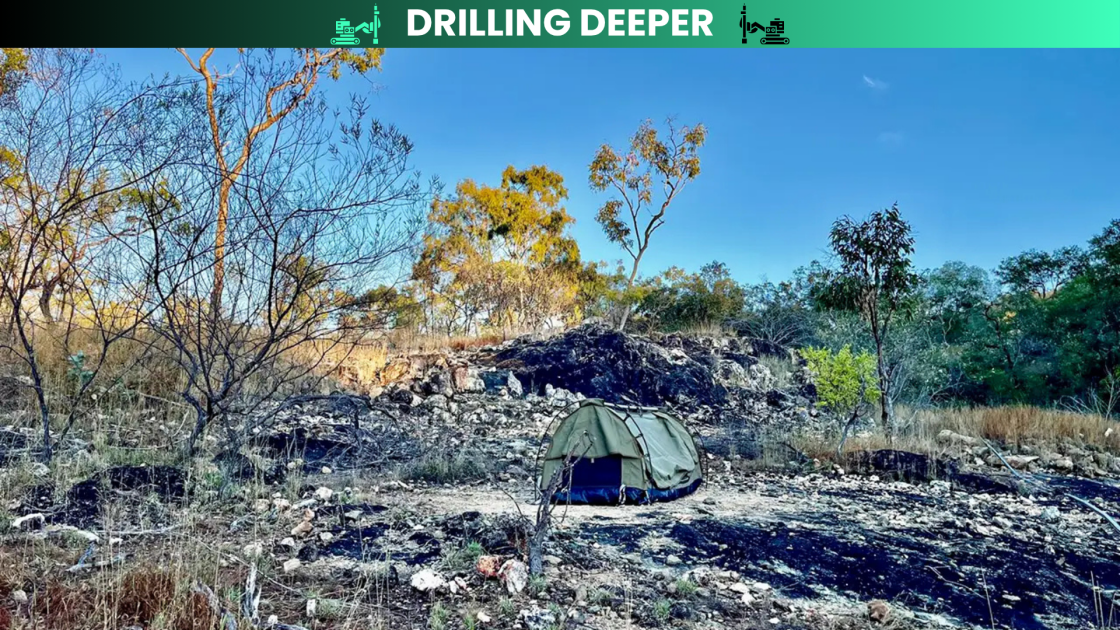
A number of resources companies have announced drilling results to begin the week (17 November), including Sunshine Metals (ASX:SHN), which has returned final assays from a recent campaign at the Sybil Project in North Queensland.
The assays received include 4.5m @ 17.23 grams per tonne gold from 82.5m; 1.5m @ 2.91g/t gold from 19m; and 2.4m @ 3.55g/t from 36.46m.
The company conducted 1,177.4m of drilling across 14 holes between August to October 2025 to target low-sulphidation epithermal gold mineralisation within the A and Main Veins.
Previously announced assays include 4.4m @ 57.51g/t gold from 23.6m, including 1.1m @ 148g/t gold; 5.2m @ 9.01g/t gold from 52m; 3.8m @ 6.12g/t gold from 22.6m; and 2.8m @ 15.15g/t gold from 37m.
Sunshine intends to collect early stage data sets remotely, including a heli-borne magnetic survey which will begin in November-December 2025, and Native Title clearance surveys for the Francis Creek, Francis Creek East and Blue Range prospects.
Attending the Noosa Mining Investor Conference last week, in which this news service was again official media partner, Managing Director Damien Keys explains to Mining.com.au that the company is shifting its focus back to the Liontown Project to bring the resource area to a measured status.
“The drilling has confirmed the tenor of the shallow high-grade gold mineralisation and the potential of the system to host further high grade zones,” Keys says.
“Gold-focused drilling is set to recommence at Liontown to bring shallow mineralisation to mining readiness.”
Located near Charter Towers in north Queensland, the Sybil Project is positioned within the Ravenswood Consolidated Project.

Tungsten treks Hillgrove
Larvotto Resources (ASX:LRV) has received assays from a maiden drilling program at the Freehold prospect within the Hillgrove Antimony-Gold Project in New South Wales.
Diamond drilling returned assays featuring 14m @ 4.25g/t gold-equivalent from 89m, including 2.6m @ 19.09g/t gold-equivalent from 99.4m; 3.5m @ 12.46g/t gold-equivalent from 136m; and 7m @ 5.03g/t gold-equivalent from 122m, including 3.2m @ 8.38g/t gold-equivalent from 124.6m.
Tungsten assays associated with antimony-gold mineralisation include 0.6m @ 2.23% tungsten trioxide from 76.7m and 0.5m @ 3.43% tungsten trioxide from 154.8m.
Larvotto will continue drilling at the Freehold prospect, as well as the Metz and Swamp Creek prospects.
Managing Director Ron Heeks says drilling at Freehold confirms the “significant upside potential of this historic mine area”.
“The results demonstrate consistent gold and antimony grades within and beyond the known lodes, and the presence of high-grade tungsten associated with the same structures, reinforce the multi-commodity potential of the Hillgrove system,” Heeks says.
“These results continue to strengthen our understanding of the area and with prices for antimony, gold and tungsten hitting record highs in 2025, we believe there is a significant opportunity to create a new underground mining centre at Freehold, adjacent to the current processing plant.”
Located 1.2km east of the Hillgrove processing plant, drilling at Freehold intended to test the depth, strike, and near-surface extensions to historically mined areas, reporting “high-grades” of antimony, tungsten, and gold mineralisation.
Larvotto also intends to validate results from recent induced polarisation and resistivity surveys conducted at the northern area of the prospect.
Lithium scales Red Mountain
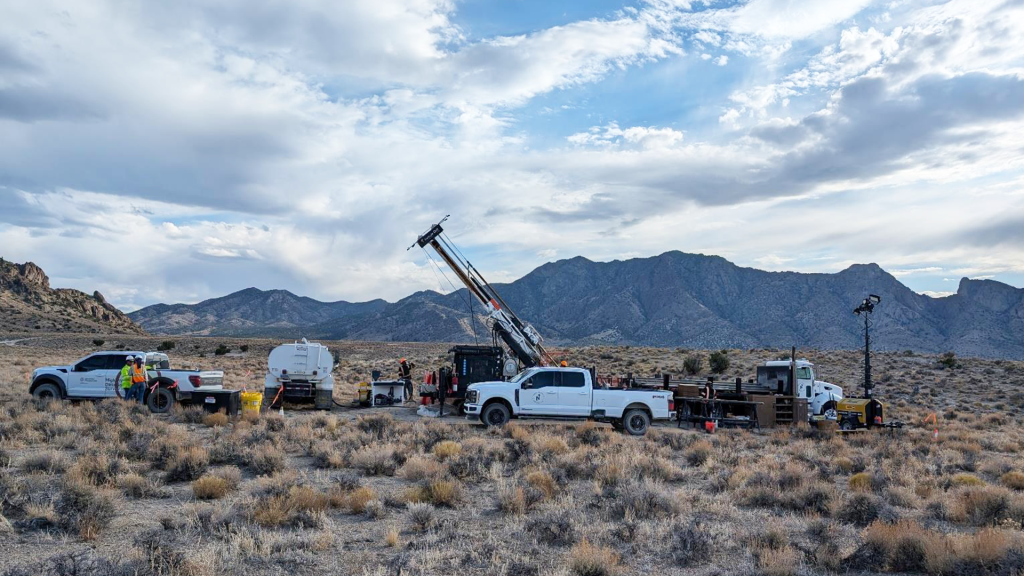
Venari Minerals (ASX:VMS) has received “thick, high-grade” lithium intersections from the Red Mountain Project, located in Nevada, US.
The company conducted reverse circulation drilling across 13 holes in October 2025, returning multiple zones of mineralisation at holes RMRC022 and RMRC023.
Hole RMRC022 intersected a combined length of 161.5m of lithium mineralisation, with assays returning 22.9m @ 1,510 parts per million (ppm) lithium from 36.6m; 7.6m @ 1,480ppm lithium from 71.6m; 9.1m @ 1,370ppm lithium from 97.5m; and 25.9m @ 1,400ppm lithium from 149.4m.
Meanwhile, hole RMRC032 intersected a combined 164.7m of lithium mineralisation, with assays returning 30.5m @ 1,400ppm lithium from 67.1m; 18.3m @ 1,360ppm lithium from 128m; and 6.1m @ 2,660ppm lithium from 176.8m.
Chairman Tony Leibowitz says the results are an “excellent start” to incoming results for the recent drilling campaign, increasing the company’s understanding of the project ahead of a maiden resource next month.
“These two holes in-fill the mid-project zones and provide us with increased confidence in the continuity and robustness of the deposit in the central part of the project,” Leibowitz says.
“This puts us firmly on track to deliver a maiden mineral resource estimate for Red Mountain in December, and we look forward to reporting additional results in the coming weeks.”
Muckanippie unveils potential
PTR Minerals (ASX:PTR) has received assays from the Muckanippie Heavy Mineral Sands Project in South Australia, creating a preliminary mineralogical assessment of drilling at the Duke and Nardoo targets.

Previously called Petratherm, the company completed 65 holes across 2,578m of drilling, confirming the presence of titanium in all holes assayed, including six of the seven holes to return at least 15m @ more than 20% titanium dioxide.
The Duke prospect features 60m @ 39.3% heavy minerals (HM) from surface, including 6m @ 61.6% HM from 25m; 24m @ 26.1% HM from surface; 31m @ 21.5% HM from surface; and 37m @ 21% HM from surface.
Meanwhile, the Nardoo prospect returned 35m @ 31.5% HM from 18m; 44m @ 23.9% HM from 1m; 60m @ 16.3% HM from surface; 36m @ 25.7% HM from surface; and 30m @ 30.4% HM from surface.
CEO Peter Reid says the two prospects build on the “outstanding potential of the larger Muckanippie HM Project as an emerging camp-style titanium province”.
“The Duke and Nardoo Prospect mineralisation is associated with a prominent magnetic trend that extends approximately 16km on our tenement area and which we believe to be mineralised along most of its length offering significant potential for the identification of large tonnages,” Reid says.
“Whilst the Rosewood Project is the main focus for the Company, the mineralisation at Duke and Nardoo continues to expand the high-grade mineralisation of the larger Muckanippie HM Project.
“The Company will now undertake bench scale separation testing to assess the economics of producing a HMC using standard wet separation techniques.”
PTR underwent a name change last week to match its Australian Securities Exchange (ASX) ticker code, as reported by Mining.com.au.
Write to Maddison Elliott at Mining.com.au
Images: Sunshine, Larvotto, Venari & PTR