


The clock has already started ticking towards the next ‘boom’ with deals being cut regarding certain rocks and a time for emerging paper deals on the horizon, M&A industry sources say.
“We’ve seen the top of the last cycle in 2022 (boom ended) and we’re now wondering how far it is to the next boom making a fledgling beginning,” Lion Selection Group (ASX:LSX) CEO Hedley Widdup tells Mining.com.au.
Just how far is the market to the next boom?
Commenting on the next wave of M&A transactions, Widdup explains to this news service that the major miners ended that last cycle in the best financial condition they have collectively been in for some time.
“We have seen most mineral commodity prices soften, which has led equity prices of many producers lower,” Lion’s CEO explains.
“In 2011 they were highly leveraged, had made a string of poor investments (and) capital deployments and were being caned by the market for this. Here they are with numerous genuine ways that they could make deals and if they can show they are acquiring cheaply (acting on a target’s weakened share price is an easy sell) then it makes M&A far easier for them.
“Paper deals, cash deals, or extending balance sheets to fund something all appear possible to me from this backing so I can see opportunistic M&A a high likelihood in my mind.”
Transactions ticking along
In Ansarada’s Australia and New Zealand M&A Outlook for 2024-25, this coming year might be one of strategic growth, where adaptability and clear vision will unlock the vast potential in the M&A market.
Kate Koidl, Partner and M&A lawyer at MinterEllison, says in the report that along with that of investment bankers, MinterEllison is typically cautiously optimistic of deal activity heading into 2025.
Recent data indicates for Q1 2024 M&A was at a three-year low but Koidl thinks one’s perspective is often coloured by their own experience.
“Some market segments have been relatively strong. We’re currently seeing some stability and an uptick in M&A activity globally and locally in pockets,” she says.
“The construction sector has seen an exponential increase in aggregate transaction value. Energy, mining, and utilities have also been strong and will continue to be so, as will industrials and chemicals. We’ve also seen very large transactions in the transportation space with Keppel and Ventura.
“Energy, mining, and utilities have also been strong and will continue to be so, as will industrials and chemicals”
“So, there’s beginning to be less uncertainty, which has helped increase confidence in getting deals across the line.”
However, across many commodities, and especially the critical and strategic minerals space, the industry remains extremely under-invested in meeting future demand, especially if demand increases, says Widdup.
“This underpins willingness to acquire, to prepare themselves. Clearly it does nothing for the broader industry being able to meet demand,” he explains.
Partner and Head of Corporate Finance at William Buck, Mark Calvetti, notes in the report that deal activity over the past few years has been a mixed bag, depending on market segment.
Over the past few years some sectors have performed poorly, such as retail and consumer products – and the valuations of technology companies has come down to more realistic levels, Calvetti notes.
At the top end, the large deals over $200 million dollars have been “very soft”, because they need more funding, he adds.
“If you’re looking at a $200 million deal, you’re probably going to seek equity funding of around 50%, leaving about $100 million in debt financing. That money’s not as readily available as it was two or more years ago when money was cheap and interest rates were virtually zero,” he explains.
“The risk-appetites of the banks and investors have evolved, with both requiring significantly higher risk-adjusted rates of return, given the healthy 4-5% per annum returns they can access in the bond markets.
“However, smaller transactions make up the bulk of the market – about 80% of transactions in Australia are smaller transactions under $100 million. In this space, it’s much easier to do the due diligence, to get the funding and to transition to business.”
The firm William Buck deals in the SME market – a diverse mix of owner operators, entrepreneurs, and unlisted companies, with varying needs and levels of sophistication.
Calvetti says the SME sector is very active because it covers many companies, most wanting to grow their businesses and many thinking about succession and exit planning. The SME market provides a good hunting ground for larger companies, as well as private equity.
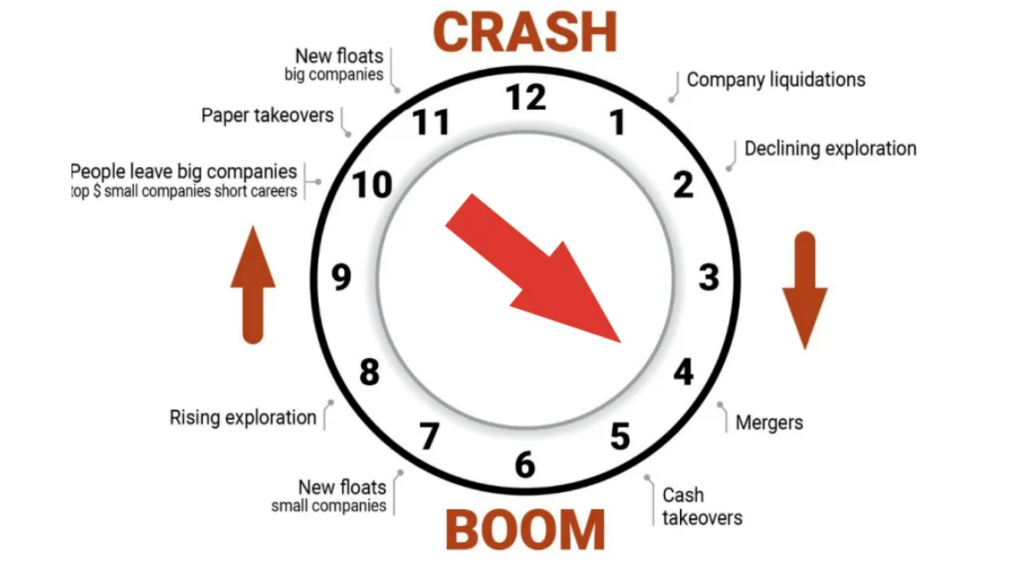
The Lion Investment Clock has been adjusted to place the mining cycle smack bang on the ‘mergers’ phase with the clock ticking towards ‘cash takeovers’ and ‘boom’ just on the horizon, as reported by Mining.com.au.
The cycle tracker is Lion’s patented mining clock and is central to the firm’s investment strategy.
The mining sector has now ticked past ‘declining exploration’ and is in a period of mergers before Lion flags it ticking towards cash takeovers, and eventually new floats with a boom time also on the cards, Lion reports in its August 2024 clock update.
Write to Adam Orlando at Mining.com.au
Images: Saxo & Lion Selection Group