



Ramelius Resources (ASX:RMS) announced this morning that it’s selling its Edna May gold mine in Western Australia, which includes processing infrastructure and satellite tenements.
Ramelius will receive $200 million in upfront cash and $100 million in equity from the acquiring firm.
RMS told the market this morning:
“With Edna May now in care and maintenance, the transaction provides Ramelius with an opportunity to crystallise value from a non-core asset and further focus resources on its core business.”
Here’s something else notable.
This type of deal confirms the general mining upswing as depicted via the Lion Selection Group Mining Clock.
By way of background, this is a theoretical framework that describes how the mining cycle moves from boom to bust. Mining is a very cyclical industry.
When it enters a boom phase, investors can do very well in resource-related stocks. When it moves into a bust phase, investors need to be careful.
Lion has the clock to guide its allocation decisions.
Lion’s Chief Investment Officer is Hedley Widdup.
Back in 2022, Widdup was warning caution around the resource sector because the clock was in the ‘crash’ phase.
The sector later collapsed just as the clock indicated.
Around 2024, the clock began to move towards the period where it was time to start accumulating resource exposure.
Here’s how it looks today:
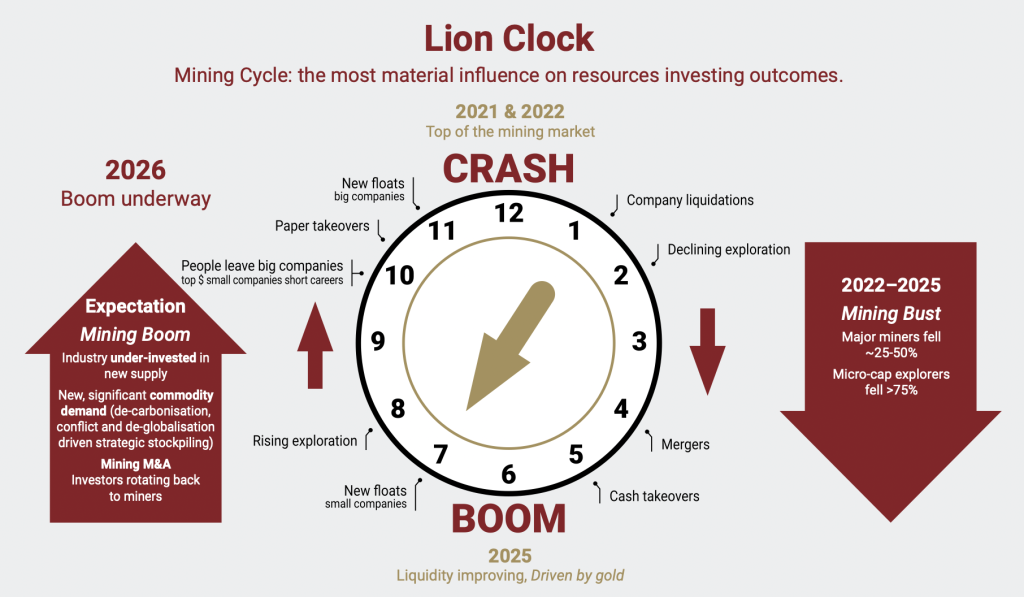
At the bottom is the following comment:
“Liquidity improves. Driven by gold.”
The Australian gold sector has been awash in profits and cash flow over the last couple of years.
Gold was the original breakout metal for the natural resource industry. Lithium and copper came after.
Even after the recent drawdown, gold in Aussie dollars remains a very healthy $5,897.
This means investor interest remains high.
A company like Ramelius is able to take advantage of this and sell a non-core asset into a strong buying market.
The market will support this because the current gold price means it should prove a profitable strategy for the buyer and a strong selling price for Ramelius.
Number five on the Lion Mining Clock is marked by “cash takeovers”.
There is considerable scope for this trend to continue as smaller resource companies become takeover targets for acquisitive firms.
It was only last year that Ramelius was doing its own wheeling and dealing when it acquired its junior peer Spartan Resources, valuing it at $2.4 billion. That was a big move at the time.
All this is indicative of what the Lion Mining Clock is saying. The mining cycle is still in a structural upswing.
Two things should drive it: a lack of investment over the last 15 years, and a return of increasing Chinese liquidity.
That means investors can expect more mergers, acquisitions, and deals for the foreseeable future.
Write to Callum Newman at Mining.com.au
Images: Ramelius Resources & Lion Selection Group


