

Although a country can possess significant mineral resources, it can still fail to translate that potential into sustained production growth.
Bolivia is a prime example of this, as the South American nation lacks a reliable route to convert resources into reserves, reserves into financeable projects, and projects into production.
Speaking to Mining.com.au, GEM Mining Consulting CEO Juan Ignacio Guzmán says the barriers to turning mineral wealth into successful mining projects are not only geological or technical.
“Bolivia has a diversified mineral base — lithium salars, silver-zinc-lead-tin belts, gold districts, antimony, tungsten, borates, potash, iron and industrial minerals,” Guzmán tells this news service.
“The harder problem is converting that endowment into investable assets.”
According to GEM Mining Consulting, Bolivia can expand its mineral supply, but the path must be orderly, transparent, and sustained.
Bolivia is a mineral-rich country, ranking among the top global producers for silver, antimony, and tin.
For instance, Bolivia is home to the Cerro Rico mountain mine, which was first discovered in the 16th century. Identec Solutions reports that for a long period the mine was the most important supplier of silver in the world, with an estimated 60,000 tonnes extracted between the 16th and 18th centuries.
Other minerals produced in the country include arsenic, bismuth, cement, copper, gold, lead, tantalum, tungsten, and zinc, as reported by the US Geological Survey.
The US Geological Survey reports that in 2019, Bolivia had significant antimony reserves, representing 21% of the estimated global total of 1.5 million tonnes. The nation also hosts 21 million tonnes of lithium.
Economic growth slowdown
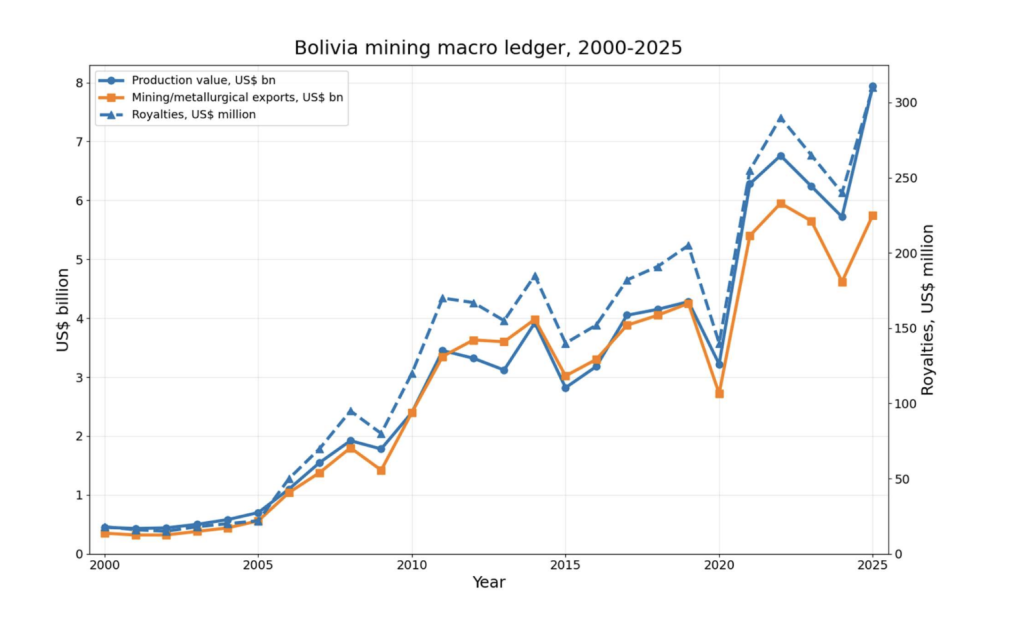
Despite its mineral wealth, Bolivia’s economic growth has slowed in recent years, with the performance of the mining industry being heavily impacted.
Identec Solutions reports that the mining sector consists of large and small state-owned enterprises, private foreign and domestic companies, cooperative miners, and a multitude of small-scale informal miners.
National mining corporation COMIBOL plays a key role in Bolivia’s mining industry, although its influence is much less than at its peak in the mid-20th century. COMIBOL operates numerous mines, including the Huanuni tin mine — one of the largest of its kind in the country.
However, over recent decades, COMIBOL has struggled with inefficiencies, corruption, and a lack of access to capital to invest in modern mine technology and exploration.
GEM Mining’s Guzmán explains that reform agendas to unlock Bolivia’s mineral potential should be staged, rather than improvised.
“Bolivia should not promise immediate supply growth,” the CEO says.
“It should promise a credible pathway. The right sequence is to build confidence and data first, then bankable contracts and permits, then construction decisions and sustained production.
“This will take time, but it is the only way to avoid stranded assets, weak contracts, and recurrent conflict.”
Guzmán adds that, in practice, investor confidence will rise when Bolivia can show five things consistently. These five things include: verified geological data, secure rights, bankable contracts, operational reliability, and a consultation system that communities regard as credible.
“Community benefits should be designed at the same time as project economics, not after conflict appears,” Guzmán explains.
“The objective is not to weaken the role of the state; it is to make the state a more predictable, technically capable, and legitimate partner.”
Beyond roads and power
GEM Mining highlights that infrastructure extends beyond roads and power to include legal certainty, foreign exchange, and community consultation.
Guzmán explains that physical infrastructure moves ore, institutional infrastructure makes investment possible, and roads, power, and ports matter, but they do not create a bankable mine by themselves.
“A lender or strategic partner must know whether a mining right is secure, whether permits can be obtained, whether revenues can be converted and repatriated, whether fuel and equipment can be imported, and whether local communities can trust the project governance system,” he says.
“Legal certainty is therefore a productive input. It defines the life of the asset, the value of exploration work, the enforceability of contracts, and the ability to finance construction. Foreign-exchange reliability is equally practical: without currency access and payment certainty, a mine cannot buy equipment, service debt, pay suppliers, or attract long-term partners.
“Consultation is not a social formality. It is risk management. It helps define water, land, benefit-sharing, and monitoring rules before capital is sunk, reducing the probability of stoppages, litigation, and reputation damage.”
For Bolivia, this is especially important because the mining economy is socially embedded. State companies, private operators, cooperatives, Indigenous and rural communities, departments, and municipalities all influence project success.
The investment proposition improves when the rules are transparent enough for investors and legitimate enough for communities.
Write to Aaliyah Rogan at Mining.com.au
Images: GEM Mining Consulting & Unsplash