With the eighth month of 2026 dawning upon us, August represents many things.
For history buffs, August is named after the Roman emperor Augustus Caesar. For the finance world, it represents the middle of Q3. And for Taylor Swift fans, the month is notable for salt air and rusted doors.
However, for jewellers and crystal enthusiasts, the month is all about peridot — often referred to as the “gem of the sun” by the Egyptians.
Known for its luminous green glow that made the stone easier to mine at night in ancient times, peridot is often sought in jewellery as a gift for those born in August. The stone is also a traditional gift for 16th wedding anniversaries.
An ancient gem from the mineral olivine, peridot holds a chemical composition of iron and magnesium. Olivine is commonly found in the Earth’s upper mantle and is also found in volcanic rocks.
From a spiritual perspective, the gemstone holds key themes of renewal, positive energy, and protection.
Early records tie peridot mining to the ancient Egyptians as early as 1500 BCE, when the gemstone was found on the island of Topazios in the Red Sea, now known as Zabargad (St John’s) Island.
The gem was considered highly valuable in ancient times, appearing frequently in Egyptian royal jewellery.
The peridot renewal: From Egypt to worldwide
In modern times, the US is home to one of the largest peridot sources in the world: Peridot Mesa, located within the San Carlos Apache Indian Reservation in southeastern Arizona.
Peridot Mesa is the most productive locality for peridot in the world, where the gem occurs as individual grains and aggregates of grains in a basalt.
The basalt is about 3–35m thick, forming the top and sides of Peridot Mesa. The stone can be recovered either in places within the basalt or from weathered material in the gullies and canyons running down the sides of the Mesa.
Recovery in place in the basalt requires drilling and blasting, with commercially recovered peridot grains typically sitting between 6–13mm in size.
The faceted stones are often produced at one carat in size, though stones between 2 and 3 carats are not uncommon for peridot. From the San Carlos Reservation, in particular, stones ranging from 15–22 carats have been cut.
The San Carlos Reservation is estimated to produce 80–95% of the world’s peridot production, according to the US Geological Survey.
Around 16km north of Fort Defiance sits a second Arizona location where peridot is frequently recovered — Buell Park in Apache County.
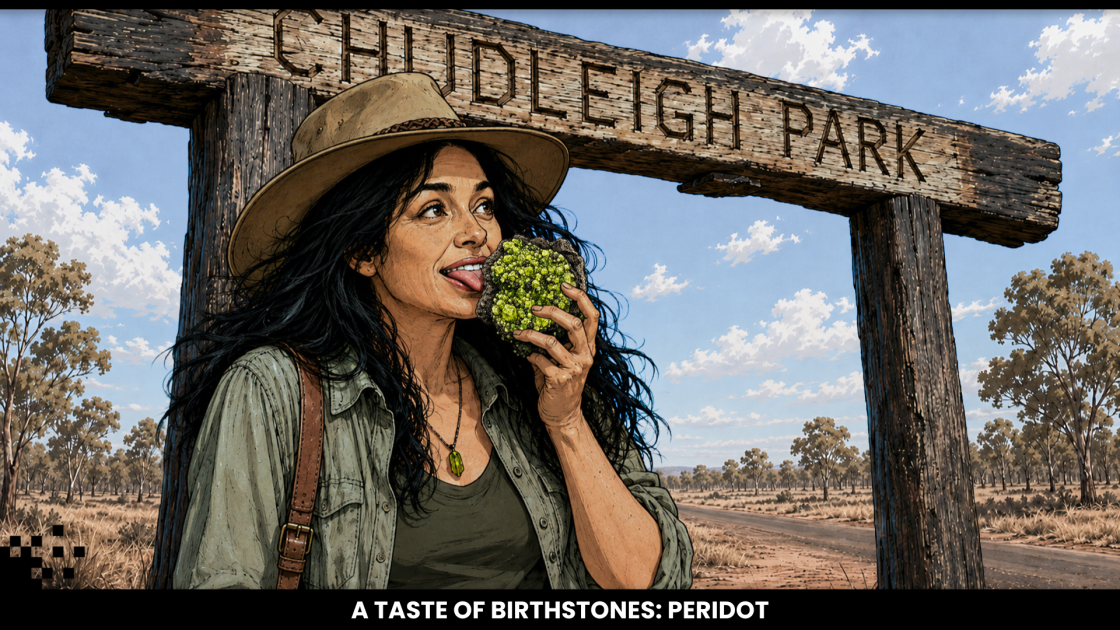
On this side of the globe, peridot is often faceted from material found in the Cheviot Hills and Chudleigh Park area of northeastern Queensland, the Australian Museum reports.
Further south in Australia, peridotite bombs from volcanic areas in western Victoria and northern Tasmania sometimes yield crystals of faceting quality.
Other significant sources for the gemstone include China, Pakistan, and Myanmar.
Peridot radiating positivity
In comparison to some birthstones, peridot is one of the more affordable gems to acquire.
US-based stone supplier Pala International reports that peridot ranges from US$50–80 per carat for well-cut gems in the 1–2 carat size, and can command up to US$450 ($641) per carat for large, fine gems of top colour.

The gemstone comes only in green, distinguishing it from other birthstones that come in a rainbow of varieties due to external impurities. Peridot’s green hue remains vibrant because the stone owes its colour to iron in its crystal structure.
While the shade can range from yellow-based green to olive or deep green, the gemstone retains its green hue in low-light conditions.
On the Mohs Hardness Scale, peridot has a hardness of 6.7–7, placing it in the moderate hardness range. The Mohs scale ranks minerals according to their resistance to scratching, ranging from 1 to 10.
Peridot is harder than household glass and common metals but softer than precious stones such as diamond and sapphire.
Protecting August
Though the August birthstone is not as well-known or as expensive as other birthstones, its history is what makes the gemstone stand out.
As mentioned, peridot mining dates back to ancient times, linking the gemstone to royalty from its earliest history.
Many historians argue that Cleopatra’s famous jewels were likely peridot, not emeralds. This belief stems from the fact that the stone has been so often mistaken for emerald over the centuries — a confusion that ties in nicely to the gem’s ancient origins.
If Cleopatra’s connection to the stone isn’t enough for the August-born, the first edition of Mining.com.au’s “A Taste of Birthstones” series has barely scratched the surface of peridot’s deep lore.
Peridot has stood the test of time, making it the perfect feature stone to kick off this news service’s monthly series. Pop in each month to read about the different birthstones.
Write to Maddison Elliott at Mining.com.au
Images: Mining.com.au & Unsplash