


This article is a sponsored feature from Mining.com.au partner Black Canyon Limited. It is not financial advice. Talk to a registered financial expert before making investment decisions.
Australia has the potential to play a much larger role in the supply of manganese, particularly as grades continue to decline and the world’s largest sources face transport and logistics challenges.
Traditionally, manganese has been used as an additive to strengthen and harden steel, with around 90% of supply dedicated to this purpose. However, in today’s modern world, the commodity is increasingly vital in the batteries that power electric vehicles.
Currently, Australia has just one operational manganese mine, but the east Pilbara region hosts some of the largest onshore deposits in the country.
Brendan Cummins, Managing Director of Australian manganese explorer Black Canyon (ASX:BCA), tells Mining.com.au this is why the company has been able to efficiently grow the global Balfour Manganese Field resource from 15 million tonnes in 2021 to over 300 million tonnes in 2023 through just three drill programs totalling 20,064m.
“The intention was clear from listing to assemble a strategic landholding in the region that provided the platform to make multiple discoveries,” Cummins explains.
“The prospectivity of the Pilbara region for manganese is considered high.
“In Australia we have the resource scale to potentially develop long mine life reserves, there is a proven pathway to production, all from a geopolitically stable environment.
“These factors bode well to establish a reliable supply of manganese with the added advantage of being located close to significant markets that include China, ASEAN and India.”
Most of the manganese products Black Canyon aims to produce will be best suited to the silicomanganese alloy market, which is the largest consumer of globally traded manganese ores.
Pilbara rising as global manganese supply declining
The Balfour Manganese Field hosts a resource of 314 million tonnes at 10.5%, translating to 33.1 million tonnes of contained manganese. Black Canyon says this makes it the largest manganese project in Western Australia and the second largest in Australia.
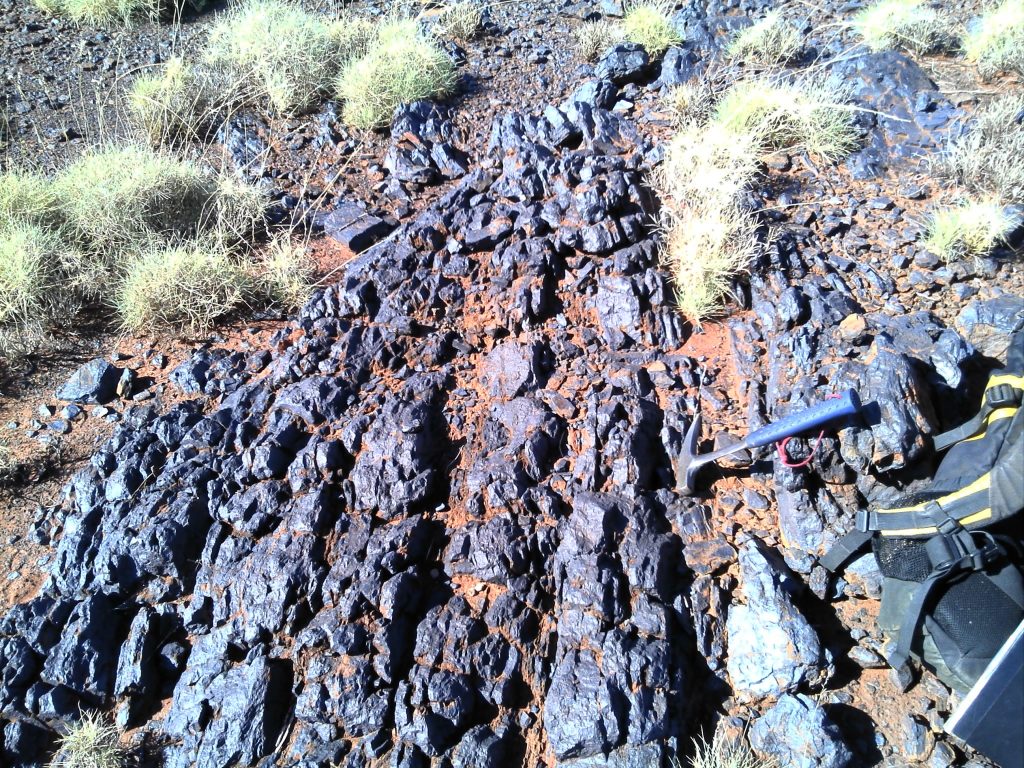
Recently, the company completed a Scoping Study for the KR1 and KR2 deposits, part of the broader Balfour Manganese Field. The study confirmed a 16-year mine life attracting a pre-tax net present value of $340 million and a pre-tax internal rate of return of 70%, with a modest development capital expenditure of $84 million.
Cummins says Black Canyon is well positioned to address the looming supply gap in the global manganese market over the next decade, driven by declining grades and logistical challenges in South Africa.
Although China and India have domestic manganese supplies, their final product grades fall below 30%, placing them in the low-grade segment of the manganese market. Black Canyon hopes to deliver a 30 to 33% manganese ore using simple beneficiation techniques.
Further complicating the supply landscape are the planned closures of older, higher-grade operations over the next decade, which will significantly impact global supply.
South32’s 60%-owned Groote Eylandt Mine, which has produced 147 million tonnes since 1964, is scheduled to close in 2030, potentially removing up to 15% of the world’s manganese supply.
Cummins says the current closure of the Groote operation may be a preview in the future where pricing of the high-grade oxide manganese ores remains elevated.
He says alternative high-grade manganese sources at this stage are limited, with the Moanda Mine in Gabon the only other significant operation that can deliver a high-grade manganese product in large quantities.
“Significantly, the loss of total manganese units associated with the decline in high-grade ore supply will mean more tonnes of lower grade ores will be required to make up the shortfall in manganese units,” Cummins explains.
“South Africa remains the largest supplier of 37% manganese product, but ramping up supply to fill the shortfall is constrained by access to rail and port unless substantial capital is committed to increase train capacity.
“Alternatively, more manganese will be transported using higher cost 30 to 40-tonne trucks, which increases the operating costs of the South African mines.”

EVs to drive manganese demand
Nickel-manganese-cobalt (NMC) batteries contain 10-30% manganese which equates to about 10-60kg depending on battery chemistry and size. Additionally, lithium-manganese-iron-phosphate (LMFP) batteries are gaining traction, further increasing manganese demand.
Maximilian Court, product director – battery chemicals for Benchmark Mineral Intelligence, says currently less than 1% of the 20 million tonnes of manganese produced each year is used in batteries, but the battery industry is disrupting the manganese market as increases to demand from the ferrous sector slows.
“Increased battery uptake in NMC categories is driving this change in demand though innovations in the LMFP battery market could create more change at an even faster rate,” he says.
Then there is the emergence of high-purity manganese sulphate monohydrate (HPMSM), which is used to make the precursor material for cathode active material and is the main input for manganese in batteries, according to Court.
“An increase in the demand for batteries is a key driver for growth in manganese demand as battery raw materials offer HPMSM producers a new, rapidly growing, and valuable line of business,” he says.
“Large-scale increases to expected HPMSM demand will pose a significant challenge for the supply-side of the manganese industry before 2030. Benchmark’s base case demand expectation is for HPMSM demand in 2030 to be 3.5 times that estimated for 2023.”
Court says passenger vehicle demand is expected to account for 80% of that increase, though other battery use-cases are still evolving, and consumer uptake is increasing.
Black Canyon is investigating the viability of establishing a HPMSM operation in Australia. Testwork has proven the company can produce battery grade 32% manganese with over 99% manganese sulphate purity from KR1 feedstock.
“Going forward, the company is looking at potential sites within Australia that have access to renewable energy, reagents and facilities to support the transport or manganese ore,” Cummins tells this news service.
“There are a number of locations that can potentially fulfil these key criteria, and we continue to assess these options.”
Once Black Canyon has firmed up its preferred site, it will then look to undertake further detailed hydrometallurgical testwork to pave the way for a Scoping Study assessing the economics of the project.
Images: Black Canyon