


This article is a sponsored feature from Mining.com.au partner Black Canyon Limited. It is not financial advice. Talk to a registered financial expert before making investment decisions.
It is rare to make one high-grade discovery let alone two, but Black Canyon (ASX:BCA) has found itself in the fortunate position of having done just that and is now funded to follow-up these targets.
The junior explorer was initially chasing manganese across the Balfour Manganese Field in Western Australia’s Pilbara region, when it discovered it also has ‘high-grade’ iron ore within its 2,100km2 landholding.
Prior to the festive break, Black Canyon secured an additional $2.5 million in funding, supported in an oversubscribed placement by existing institutional shareholders like Lowell Resource Fund and new investor Nero Resource Fund, which cornerstoned the placement.
Managing Director Brendan Cummins says the company now has cash in the bank to get cracking on following up these new targets.
“We are fortunate to have a strong and supportive institutional following, and we now welcome additional institutional investors who share our belief in the fundamentals of manganese, the strength of our assets and the exploration upside for high-grade manganese and iron at Wandanya,” he said on completion of the raising.
Just before receiving this fresh capital injection, Black Canyon revealed that mapping and rock chip sampling along a 5km long ridge at the Wandanya Project returned grades of between 57.6% and 64.3% hematite, which is within the typical grade range of direct shipping ore (DSO).
DSO describes minerals that can be dug up, transported to port and loaded straight onto a ship without the need for processing. This keeps costs down and improves the economic potential of a project.
At the same time, Black Canyon found the iron ore rock chip samples were low in deleterious elements such as phosphorus, silica and alumina, which is also a cost benefit.
Cummins said at the time of the discovery that the exploration potential was significant, particularly to the south where the explorer had identified multiple outcrops where rock chips exceeded 60% iron along 2km of strike, with widths from 50m up to 300m.
“There are multiple sample points with plus 55% Fe grades and the new iron trend we have discovered warrants further investigation,” he tells Mining.com.au.
“Typically, 58% Fe to 60% plus Fe with low penalty elements represent a direct shipping ore opportunity.
“Over a decade ago I was involved in a small iron discovery that had a mineral resource of around 10 million tonnes @ 58% Fe, which was enough to establish a five-year mine life producing around 1 million tonnes per annum of ore.”
Potential Woodie Woodie lookalike
Wandanya has also demonstrated strong potential for high-grade hydrothermal manganese mineralisation similar to the operating 1.6-million-tonne-per-annum Woodie Woodie Mine further north.
Woodie Woodie has been mined since the early 1950s and historically produced a high-grade manganese ore with a high manganese content, high manganese to iron ratio, low phosphorus and hard, competent nature.
The Wandanya discovery could possibly be the result of the same mineralising and structural events but affecting younger rocks.
“Manganese mineralisation has now been traced for about 3km and a rock chip sampling program has demonstrated exceptionally high results between 40% and 60% manganese,” Cummins says.
“We have only drilled 240m of the mapped 3km strike and announced several consistent intersects ranging between 5 to 7m thickness at approximately 30% manganese.
“The mineralisation is stratabound and seems to be focused within a particular horizon with the basal 3m assaying quite consistently at 40% manganese and is open to the east. This is significant because at these high grades the mineralisation probably has a hydrothermal origin which is similar to Woodie Woodie in style that is located about 80km to the north.”
A first pass reverse circulation drilling program at Wandanya’s W2 prospect, completed in September 2024, returned intercepts of 5m @ 31.1% manganese from surface, including 2m @ 42% manganese.
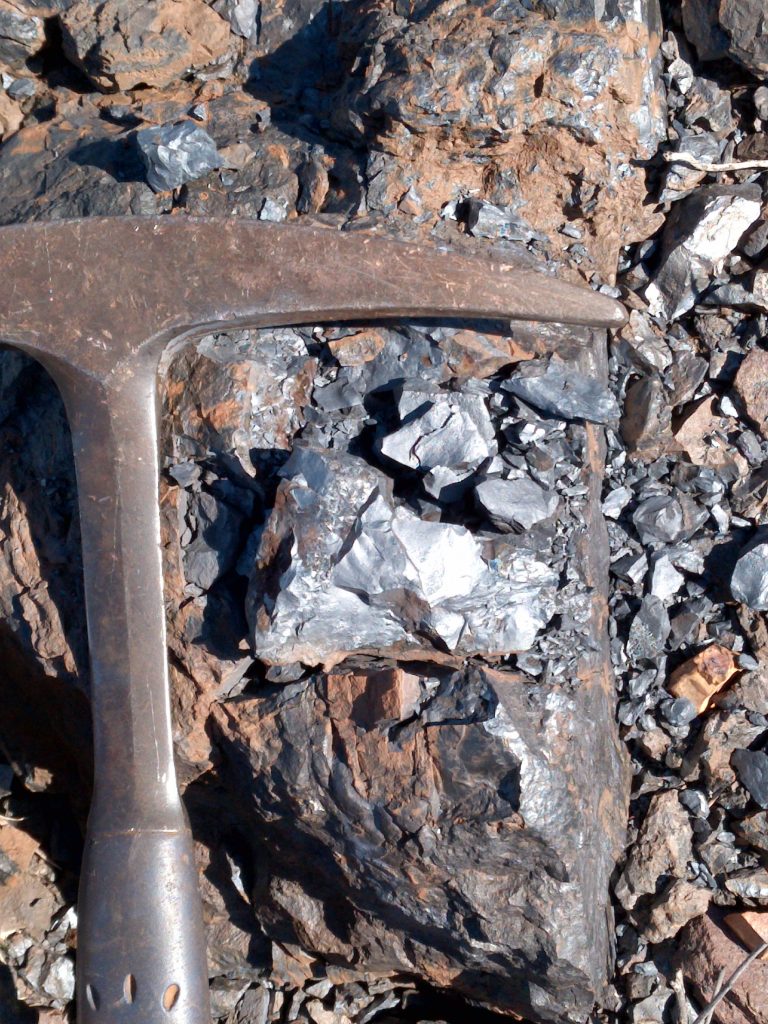
Cummins says the most appealing aspect of the Wandanya Project is its simplicity.
“To date it has been quite predictable in terms of grade and thickness and now with surface mapping completed that shows 3km of strike there is potential to demonstrate scale to this discovery,” he says.
“Even at this early stage, with the recent drill results, we are now beginning to appreciate the significant potential of the W2 Prospect.
“We have mapped the mineral system at Wandanya for over 3,000m and the RC assay results have tested only 240m, or less than 10%, so the lion’s share of potential remains both along strike and significantly down dip.”
The W2 Prospect represents a shallow and potentially open pittable target, with all of the manganese drill intersections encountered so far within 15m of surface, and most within 10m.
Cummins adds that the flat-dipping stratabound mineralisation will benefit follow-up drill programs by reducing exploration risk and, importantly, minimising drill costs to keep Black Canyon’s discovery costs low.
The company has already defined the largest manganese resource in Western Australia within the Balfour Manganese Field, which currently sits at around 314 million tonnes @ 10.5% for 33.1 million tonnes of contained manganese.
Nearly 80%, or 250 million tonnes, of the total resource is in the higher confidence measured and indicated categories.
A Scoping Study completed in 2024 demonstrates the KR1 and KR2 deposits could sustain a 16-year mining operation estimated to have a pre-tax net present value of $340 million and a pre-tax internal rate of return of 70%, with a modest development capital expenditure of $84 million.
This was based on a mine production rate of 3 million tonnes per annum producing around 760,000 tonnes each year of manganese concentrate, generating average annual cash flow of $46 million.
Black Canyon has also outlined an exploration target of 160 to 215 million tonnes @ 11 to 12% for 18 to 23 million tonnes of contained manganese, indicating the exploration upside for expanding the existing resource.
Two bulk commodities, one promising project
2024 was a productive year for the junior, with the delivery of the exploration target, continued beneficiation testwork that upgraded the manganese from 10-15% in ground to between 30 and 33% and up to 35%, completion of a Scoping Study and the discovery and drilling of the manganese and iron targets at Wandanya.
Cummins says the company is now keen to drill the Wandanya iron and manganese targets which may lead to the delineation of resources that can be estimated to classifications suitable for Scoping Study level assessments.
Metallurgical testwork is also continuing in 2025 and is focused on applying simple and reliable processing techniques such as crushing, scrubbing and washing followed by gravity based separation such as a dense media separator.
“Further testwork is required but we are confident that we can deliver a consistent 32% Mn product and have ambitions to improve our knowledge to produce a higher grade concentrate over time,” Cummins explains.
The higher grade 35% manganese product produced in testwork last year has potential as a downstream feedstock for high purity manganese sulphate (HPMSM) processing.
HPMSM is used to make the precursor material for cathode active material and is the main input for manganese in batteries.
The rising demand for electric vehicles is fuelling the surge in demand for lithium-ion batteries, in which HPMSM plays a key role.
Its use and demand are increasing rapidly, particularly in Europe, China, and the US.
Europe, North America, Japan, Korea and many other countries import 100% of their manganese requirements, including high purity electrolytic manganese metal and HPMSM.
Previous hydrometallurgical testwork on manganese oxide samples from the KR1 deposit have shown Black Canyon can produce HPMSM that meets battery grade specification of >99% purity and within specification impurity levels.
The testwork is important in further developing and advancing flowsheet design to extract maximum value from Black Canyon’s manganese assets.
“So now BCA is in the fortunate position of chasing two bulk commodities with promising grade profiles at our 100% owned Wandanya project,” Cummins concludes. “Both of these require RC drilling to determine the potential to delineate a mineral resource and if positive then follow up studies to move towards development.”
Write to Angela East at Mining.com.au
Images: Black Canyon