

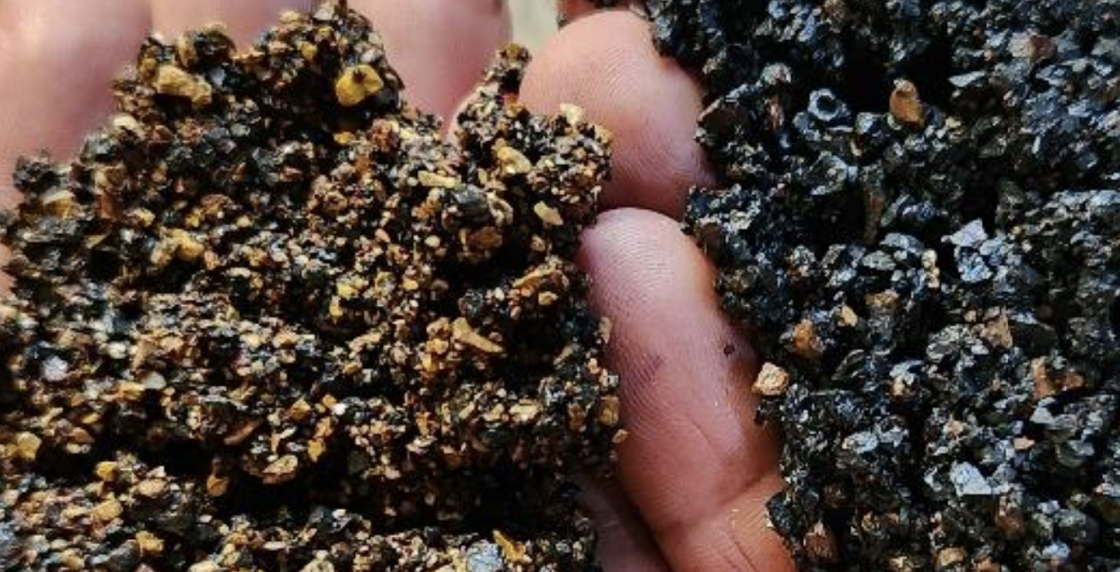
Black Canyon (ASX:BCA) in mid-November expects to receive the remainder of assays from reverse circulation drilling at the W2 prospect after expediting recent laboratory-based results.
The Australian manganese explorer and developer says the maiden drill program identified highgrade hydrothermal related stratabound manganese mineralisation with these assays confirming the initial pXRF results.
Managing Director Brendan Cummins says he is impressed by the consistency of the results with the assays confirming significant intercepts and thickness of the manganese horizon discovered and the higher grade intervals over 40% manganese.
“What is really appealing about this target from an exploration and resource delineation perspective is the benefit of a consistent mineralised horizon that is also associated with hydrothermal grades,” says Cummins.
“I am excited by the upside of this new style of mineralisation as we plan our follow-up exploration programs to assess 1.75km of strike to the north and the potential of the manganese horizon to extend to the east.”
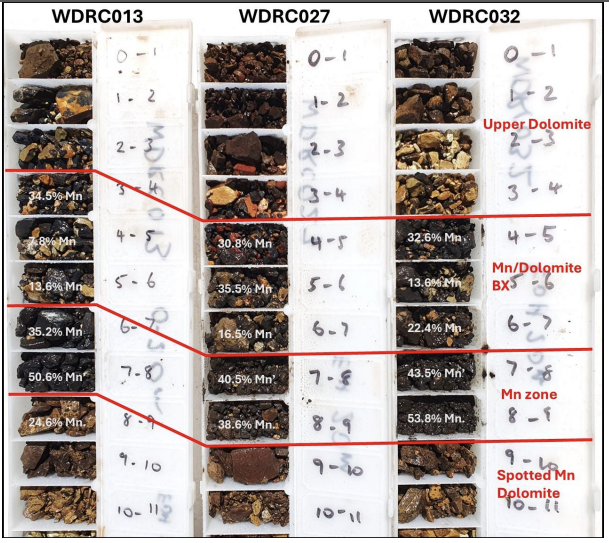
Comprising 35 holes for 642m, the W2 prospect was drilled on an approximate 40m x 40m grid testing a 240m long x 200m wide target.
Initially, six RC holes were sampled for expedited assays, generating 38 one metre interval samples that were gathered along the eastern boundary of the stratabound mineralisation.
Representative holes were sampled from every second line along the drilled strike of 240m. On each drill line, the last two eastern holes were sampled from depths between 4m and 9m, which included stratabound mineralisation and portions of the lower grade footwall and hanging wall.
Black Canyon says results show consistent zones of mineralisation with the bottom 2m for each intersection typically returning “high-grade mineralisation potentially suitable for direct shipping (DSO)”.
The remainder of the RC assay results from the W2 drill program are expected next month.
Manganese mineralisation was logged on the second and last holes on the eastern boundary of the drill pattern and remains open to the north, south and east.
The company says sufficient samples have also been collected to undertake benchtop heavy liquid separation testwork to beneficiate lower grade manganese intervals, to determine if a 35 to 40% Mn product can be produced.
This is particularly relevant for the mixed Mn/Dolomite breccia zone. Beneficiated ores could be sold to smelters for manganese alloying or as a high grade feedstock for HPMSM, according to the company.
On 27 September, Mining.com.au reported Black Canyon intersected “high-grade” mineralisation at the W2 Prospect, with pXRF) analysis showing grade ranges of between 15% and 55% manganese.
The company has completed a maiden reverse circulation drilling program at the W2 and KR2 prospects.
W2 is part of the Wandanya Project within the company’s flagship Balfour Manganese Field in the Pilbara region of Western Australia, which hosts a resource of 314 million tonnes @ 10.5% for 33.1 million tonnes of contained manganese.
Write to Adam Orlando at Mining.com.au
Images: Black Canyon