

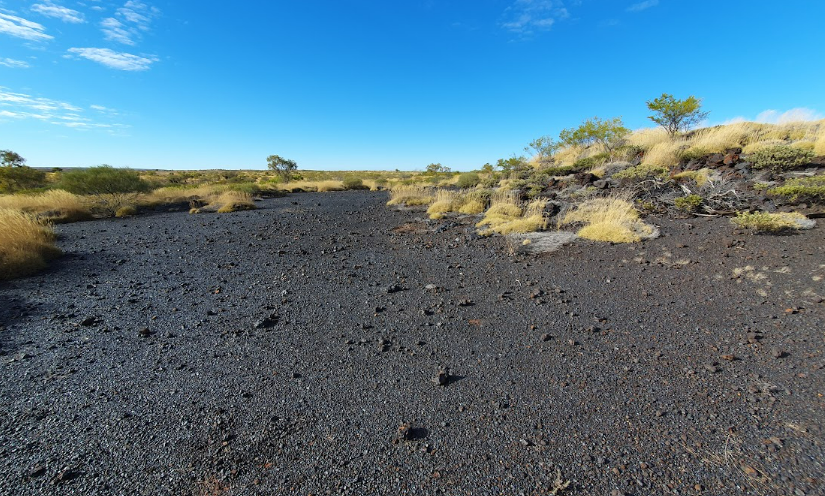
Black Canyon (ASX:BCA) reports that it has intersected “high-grade” mineralisation at the W2 Prospect, with portable x-ray fluorescent (pXRF) analysis showing grade ranges of between 15% and 55% manganese.
The company has completed a maiden reverse circulation drilling program at the W2 and KR2 prospects.
W2 is part of the Wandanya Project within the company’s flagship Balfour Manganese Field in the Pilbara region of Western Australia, which hosts a resource of 314 million tonnes @ 10.5% for 33.1 million tonnes of contained manganese.
Managing Director Brendan Cummins says with each hole drilled, Black Canyon begins to build a picture of the distribution, thickness and internal structure of the mineralisation.
“What was of particular interest was the consistency of the horizon over 240m strike and how we intersected mineralisation on the eastern-most holes on every line, so the mineralisation remains open to the north, south and east,” he says.
The mineralisation is interpreted as fault related hydrothermal, stratabound manganese enrichment, which Black Canyon says represents a “significant new exploration model” on the eastern margin of the Oakover Basin.
This style of mineralisation expands the scope to explore for additional high-grade mineralisation along strike where the company has mapped 1.75km of “intermittent high-grade outcropping manganese”, down dip within the sedimentary sequence and potentially along associated feeder faults.
The W2 Prospect sits 80km south of the operating 1.6-million-tonne-per-annum Woodie Woodie Mine, which has been mined since the early 1950s and historically produced a high-grade manganese ore with a high manganese content, high manganese to iron ratio, low phosphorus and hard, competent nature.

“Iron alteration and brecciation often associated from manganese mineralisation at Woodie Woodie was also observed,” Cummins says.
“Significantly the age of the rocks we have drilled at W2 are younger than the rocks that host Woodie Woodie, however similar processes may have occurred providing manganese rich fluids access to receptive units to form this stratabound mineralisation.
“The main advantage of this style of mineralisation is the benefit of hydrothermal high grades with the predictability of a mineralised layer which may extend over hundreds of metres and vary in thickness.”
Expedited manganese assays for selected representative holes from W2 are expected in the coming weeks to confirm the pXRF results.
“It is very early days but I am very impressed with the geology, initial pXRF results and the future exploration potential using this new mineralisation model,” Cummins says.
Samples have also been collected for density based beneficiation testwork to potentially produce a high-grade manganese product.
Earlier this week, Black Canyon released the results of heavy liquid separation testwork that showed ore from the KR1 prospect could be upgraded to 35%.
The company notes the higher grade 35% manganese product also has potential as a downstream feedstock for high purity manganese sulphate (HPMSM) processing.
HPMSM is used to make the precursor material for cathode active material and is the main input for manganese in batteries.
Benchmark Mineral Intelligence sees HPMSM demand climbing 3.5 times by 2030.
Previous hydrometallurgical testwork on manganese oxide samples from the KR1 deposit have shown Black Canyon can produce HPMSM that meets battery grade specification of >99% purity and within specification impurity levels.
Write to Angela East at Mining.com.au
Images: Black Canyon