

This article is a sponsored feature from Mining.com.au partner Aguia. It is not financial advice. Talk to a registered financial expert before making investment decisions.
With so many explorers vying for capital in a risk-averse market, companies need to differentiate themselves and one way to do that is by adopting a self-funding model.
Advisory firm BDO says the Australian exploration sector witnessed a sharp decline in capital raising in the March quarter this year, with only 26 companies raising over $10 million – marking a “stark contrast” to previous periods.
Cash on hand also decreased, averaging around $9.8 million for the quarter.
Having been involved with Australian equity capital markets for over four decades and the resources sector globally, Warwick Grigor is all too familiar with the challenges explorers face in raising capital to keep drilling.
In his early career, Grigor was a mining analyst with stockbroking firms, including County NatWest Securities. In 1991, he and Andrew Forrest established Far East Capital, an ASIC-licenced specialist investment bank.
In 2008, Grigor sponsored a successful new stockbroking company named BGF Equities and took on the role of executive Chairman. After three years, Canaccord Genuity acquired 50% of BGF and four years later Grigor retired from broking to resume operatorship of Far East Capital.
In June 2024, he was appointed the executive Chairman of South America-focused gold, copper and phosphate explorer Aguia Resources (ASX:AGR), which at the time was completing the acquisition of Andean Mining and the Santa Barbara Gold Mine.
This was a crucial acquisition for Aguia because it provided the company with a quick path to production and cashflow.
The traditional exploration model from discovery to mining can easily take seven to eight years, according to Grigor.
But with the Andean Mining acquisition came a small processing plant already on site.
“It made more sense to modify this for continuous operating mode and process ore as it is extracted, thereby generating cash flow,” Grigor says. “This is far less dilutive than four to five years of continual drilling.”
First gold pour unlocks initial cashflow
Aguia, which has a market capitalisation of $44.4 million, started off 2025 with its maiden gold pour at Santa Barbara, and while cashflow is modest to start with as production continues to ramp up, Grigor says it could actually be “much bigger” within just a few months.
“It could be quite significant,” he says.
Especially given the high gold price environment, with the safehaven metal continuing to sit above US$3,300 ($5,038) an ounce.
Aguia received an initial $193,000 in May from the first gold sales. It was a slightly lengthy process to receive the first payment because of the need for the company to undergo a stringent auditing process to achieve government certification as a prerequisite to the sale, but Aguia now expects payments will occur on a more regular basis with this step now completed.
Following its first gold pour, a drought interrupted production for a few months while Aguia worked to establish an alternative, more reliable water source.
Having done that, the company was able to resume ramp up plant capacity from 30 tonnes to 50 tonnes per day, still achieving the targeted rate roughly on schedule.
However, Grigor says the bottleneck that became apparent during the ramp up process was the ability to feed this level of tonnage to the mill.
“That means we need greater emphasis on underground development in order to have enough development heading, and this will be the focus over the next month or two,” he says.

Costs right now, as Aguia works to unlock enough ore to supply feed to the mill to sustain the 50-tonne-per-day throughput rate, are above US$400 an ounce but still significantly less than the ruling gold price of US$3,300 per ounce.
“Costs are still within reach of the target of US$400-500 per ounce, but the best result will be achieved when the 50-tonne-per-day production level is attained,” he explains.
“Right now, the mine is either just above or just below breakeven. As the weeks go by, and as we get better delivery of ore to the mill, we expect that there will be plenty of cashflow from which to fund the drilling, and then some.
“The goal is always to avoid going back to the market to raise funds, though it would be foolish to say this will never happen.
“We have just received commitments for $2.6 million in a convertible loan issue that is coming from medium to longer term investors. That instrument is much less dilutive than the standard 20% discounted placement that seems so common nowadays.”
Besides a swift path to production, Santa Barbara also provided Aguia with in-situ high grades of up to 30 grams per tonne gold. This means the company has been able to adopt a narrow vein, high-grade mining model using air leg mining which minimises dilution and maximises head grade.
“If we assume that long-term the operating costs are in the range of US$400-500 per ounce, it will be one of the lowest cost gold mines around,” Grigor notes.
“The operating margin will be 500-600%. A move of $100-200 per ounce in the gold price will have minimal impact on us.”
This transition from market-reliant explorer to self-funded developer has essentially been a turnaround story for Aguia. Just prior to announcing the takeover of Andean Mining in December 2023, Aguia’s shares were trading at just $0.01.
By October 2024 shares were back up at around $0.054. While they have come off their recent peaks, the share price is still nearly three times what it was before the acquisition.
Scaling production sustainably
Aguia is now focusing on tapping into the exploration upside to grow the resource at Santa Barbara by drilling the 7km vein system.
The first goal of drilling is to delineate extensions above and below the existing workings, which Grigor says is already happening.
“Already the first six holes are providing information to assist with mine extension planning, leading to the opening up of more headings. Continual drilling will start to unlock the real potential of this system,” he says.
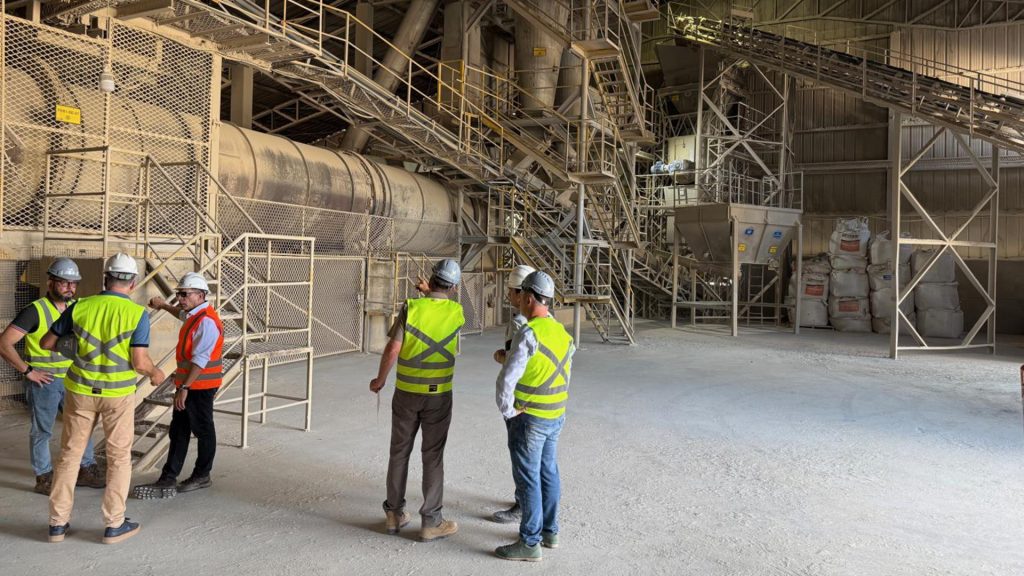
In parallel, Aguia is advancing its phosphate project in Brazil, where discussions are in progress with offtake companies that have expressed an interest in forward sales and financing.
Last month the company was offered financing of up to $4 million from Brazil’s Southern Development Bank for the development of the Tres Estradas Mine and Pampafos processing facility in Brazil, but directors are still discussing the terms.
The funding from either source will enable the company to start mining operations at Tres Estradas, as well as upgrade the processing facility which has been leased from Dagoberto Barcellos.
Tres Estradas has a measured and indicated resource of 83 million tonnes @ 4.11% phosphorus pentoxide and another 21.8 million tonnes @ 3.6% phosphorus pentoxide of inferred resource. Exploration continues to define additional tonnages.
Grigor says this is also a low capex, high cashflow margin business.
“Our numbers suggest that for an outlay of $2-3 million, we can generate a cash margin of $6-8 million,” he notes. “It will be a great cash flow business with minimal technical risk.
“However, we still have to sell the product. This can either be to the local market or something more beneficial such as forward selling to traders in exchange for finance. At the moment fertiliser prices are high in Brazil, making it a good time to come on stream.”
“The objective is to make this an independent, stand-alone business with its own growth curve.”
Write to Angela East at Mining.com.au
Images: Mining.com.au & Aguia Resources