



As the nation celebrates Australia Day on 26 January, the country’s mining sector is entering 2026 from a position of strength and renewed focus. Although slower global growth in 2025 due to uncertainty and heightened trade barriers adversely affected commodity demand, the Department of Industry, Science and Resources (DISR) notes growth has been, and will be, supported by easier monetary and fiscal policy, and by investment driven by rising artificial intelligence (AI) usage and the energy transition.
From $385 billion in 2024-25, Australia’s export earnings are now forecast to ease to $383 billion in 2025-26 and then to $374 billion in 2026-27. DISR says gold exports are rising rapidly, iron ore exports have held up better than expected and the AUD/USD has not risen as expected.
“Australia’s real GDP rose by 0.4% in the September quarter 2025, to be up 2.1% from a year before. Mining value-added fell by 1.8% in the September quarter to be little changed on a year ago reflecting the ongoing impact of reductions in nickel and lithium mining,” DISR reports in its December 2025 Resources and Energy Quarterly.
As is usually the case, Western Australia remains the engine room of the national resources economy, but its future growth will be incremental rather than dramatic. Commodity prices are expected to remain supportive yet constrained. Capital is still available, but increasingly conditional. And in critical minerals, government strategy is now as influential as geology.
This 2026 outlook report brings together key themes Mining.com.au has been reporting for some time to examine how the sector is evolving and what could determine success over the next 12-24 months.

Economy’s engine room
Echoing these sentiments, industry observers note Australia’s resources sector is being reshaped by capital discipline, commodity price normalisation, deeper government involvement, and a renewed focus on project quality.
Some are suggesting a “brownfield” shift where miners are prioritising the expansion of existing mines (brownfield) over new, risky developments (greenfield). And much of this shift centres around critical minerals.
As of early 2026, Australia’s critical minerals list includes 31 designated minerals essential for clean energy, technology, and defence, with a new $1.2 billion Strategic Reserve focusing on antimony, gallium, and rare earth elements. Key, high-potential minerals include lithium, cobalt, graphite, vanadium, and titanium.
Much of these are found and mined in Western Australia, which is poised to continue underpinning Australia’s mining performance through 2026, but the nature of its contribution is changing. Recent Geological Survey of Western Australia data confirms the state’s mineral and petroleum sector remains historically strong by value, even as global markets move away from post-pandemic extremes.
Iron ore still dominates export earnings, but gold, LNG, and an expanding suite of critical minerals are reinforcing diversification. Iron ore has transitioned from a growth engine into a cash-generation platform. Producers are prioritising efficiency, ore quality consistency, and mine life extensions rather than aggressive volume increases. This shift supports stability in royalties and employment while reducing exposure to downside volatility.
Gold continues to play a stabilising role. Supported by favourable pricing and WA’s deep operational expertise, gold projects remain attractive for their scalability and relatively fast development timelines. As macro uncertainty persists, gold provides an anchor for both regional economies and investor sentiment.
Exploration spending remains elevated compared with long-term averages, but is increasingly selective. The precious metal dominates budgets, while copper remains strategically important, and lithium exploration moderates from peak enthusiasm, reflecting a market that’s recalibrating rather than retreating.
In 2026, Western Australia’s mining sector is expected to be strong, diversified, and selective, favouring brownfields expansions, infrastructure-adjacent developments, and technically robust projects.

Capital no longer passive
A profound shift shaping the mining sector into 2026 is neither geological or technological, it’s financial. Mining finance has entered a structurally different phase. Easy money has exited the system, replaced by conditional capital, tighter scrutiny, and a renewed emphasis on execution.
Debt has re-emerged as a central funding tool, particularly through specialised lenders and private credit providers. Recent trends illustrate how structured debt is increasingly preferred over repeated equity dilution. albeit at the cost of tighter covenants and accelerated performance expectations.
Analysts and market insiders alike tend to agree equity markets remain open, but less forgiving. Capital raisings are smaller, more targeted, and increasingly tied to specific milestones and investors are prioritising management credibility, technical competence, as well as capital discipline over promotional narratives.
Alternative funding, including royalties, streams, and hybrid instruments, is now mainstream. These structures offer flexibility in a constrained capital environment, but permanently alter project economics.
In 2026, analysts believe they are expected to be embedded in many development funding stacks. In August last year, Mining.com.au reported a quiet revolution is underway in mine finance. As traditional lenders grow more cautious, new capital avenues are emerging.
One of these alternative options is bond financing, which is more common in North America but is emerging in popularity in Australia and proving much faster and more cost effective than traditional financing methods.
A company will issue a bond that accrues interest and has to be paid back by an agreed date, but unlike other financing avenues it does not provide the bondholder with any financial benefit from the growth of the company.
A recent example is Larvotto Resources (ASX:LRV) in December satisfying all conditions required to draw down the proceeds from its US$105 million senior secured bond issue. This includes a customary cost-to-complete test and all project equity being fully spent on the Hillgrove Antimony-Gold Project, as reported.
Larvotto subsequently completed its first drawdown under the bond for US$31.5 million, representing 30% of the total senior secured bond. All proceeds from the drawdown will be applied towards project construction, including the plant upgrade and development works.
The company remains fully funded for the restart of the Hillgrove Mine, supported by a cash position of $62.1 million as of 30 September 2025.

Debt to delivery
Meanwhile, Viridis Mining and Minerals (ASX:VMM) on 6 January 2026 received a non-binding letter of support from Australia’s official export credit agency, Export Finance Australia (EFA), for a debt facility of up to US$50 million.
EFA’s potential debt funding is intended to cover services supply opportunities in the execution phase of the Colossus Rare Earths Project in Brazil, as reported.
Managing Director Rafael Moreno says securing this letter of support represents the final cornerstone in the company’s Colossus debt financing strategy.
“Support from one of the world’s most respected export credit agencies further strengthen the Colossus Project as a global strategic rare earth development, reinforcing the international backing already received from EDC, Bpifrance, and BNDES,” Moreno says.
“EFA’s letter of support adds a fourth and final international financing pillar to our capital strategy, materially enhancing lender confidence and broadening our access to competitive, government-backed project finance.
“Our immediate focus now shifts to finalising the appointment of the mandated lead arranger and commencing the consolidated due diligence process across all participating lenders.
“Combined with the recent grant of the environmental preliminary licence and the execution of our strategic equity investment, Colossus is exceptionally well-positioned as we advance final discussion with several strategic equity and offtake partners and progress towards final investment decision in H2 2026.”
Alice Queen (ASX:AQX) has also been assessing various financing preferences to fund development of its Horn Island Gold Project including a broad brush plan of targeting a typical blended project finance package of 60% debt and 40% equity.
Recently speaking to Mining.com.au, Managing Director Andrew Buxton says one of the potential debt funding partners for Horn Island is Northern Australia Infrastructure Facility (NAIF).
Buxton says the company sees NAIF as a natural partner for the project given, it is located in Australia’s northern most outpost, the location is increasingly geopolitically sensitive, it has significant equity (7.5% free carried) held by the TOs (traditional owners Kaurareg People of Kaiwalagal) “and it will transform economic development and employment in an area where other industry is scarce and unemployment is very high”.
In parallel, Alice Queen is “always listening to the market”, meeting with potential investors and speaking with prospective partners on all of its projects, not just on Horn Island.
In this case, however, Buxton is of the view that, with the help and guidance of GBA Capital, it can bring Horn Island into production without any additional outside joint venture type arrangements.
Elementos (ASX:ELT) in October began making progress with its debt, equity, and offtakers interested in partnering to project finance the Oropesa Tin Mine and smelting assets in Spain. Speaking to Mining.com.au, Managing Director Joe David says the tin developer was unpacking big plans with major project milestones expected.
David notes Elementos was continuing to evaluate other tin projects within close geographic proximity to Oropesa and the Robledollano tin smelter. It plans to leverage the assets and team it has in Spain to grow its exposure to tin.
Meanwhile in April 2025, Toubani Resources (ASX:TRE) received a non-binding and non-exclusive commitment letter for Africa Minerals and Metals Processing Platform (A2MP) to provide a minimum US$160 million (debt facility.
Upon settlement, A2MP is to appoint Gaurav Gupta to Toubani’s board who is expected to take an active role in supporting the Kobada Gold Project financing, equity, and stakeholder engagement workstreams ahead of a final investment decision (FID).

Commodity price stability
Commodity markets heading into 2026 are defined less by volatility and more by constraint. Rolling coverage by this news service, including analysis drawing on Oxford Economics, points to a period of price stabilisation across key commodities, rather than the extreme swings of previous cycles.
Oxford Economics’ 2026 Commodity Outlook: Four Themes To Watch reports the recent surge in precious metals has raised concerns that commodities may now be overvalued.
“Yet from a secular perspective, the broader commodity complex remains far from expensive. Indeed, it is still deeply undervalued. Broad commodity prices have seen only modest nominal gains over the past three years, following their recovery from pandemic-era lows,” its December report shows.
In real terms, Oxford Economics continues, prices across the broad commodity complex have been essentially unchanged, while real energy prices have declined by roughly 7% over this period and over 25% from their mid-2022 peak
Iron ore prices are expected to remain supported within a narrower band. Demand growth has moderated, but disciplined supply and ongoing infrastructure needs continue to underpin the market. The result is a pricing environment that rewards efficiency rather than expansion.
Iron ore spot prices (62% Fe fines CFR Qingdao) have been stable at just above US$100 (CFR) a tonne since August 2025. According to the Department of Industry, Science and Resources (DISR) December 2025 Resources and Energy Quarterly, although Chinese steel production has declined, prices have remained stable due to increased stockpiling by Chinese buyers.
“A pricing dispute between BHP (ASX:BHP) and China Mineral Resources Group (CMRG) has resulted in Chinese mills rejecting some BHP cargoes. Looking forward, prices are expected to fall modestly through to the end of 2027, because of both weak steel demand and higher iron ore supply,” DISR reports.
“From US$93 (FOB) a tonne in 2024, the iron ore price is forecast to average US$87 a tonne in 2025, US$85 a tonne in 2026, and then US$82 a tonne in 2027.”
Copper keeps on keeping on
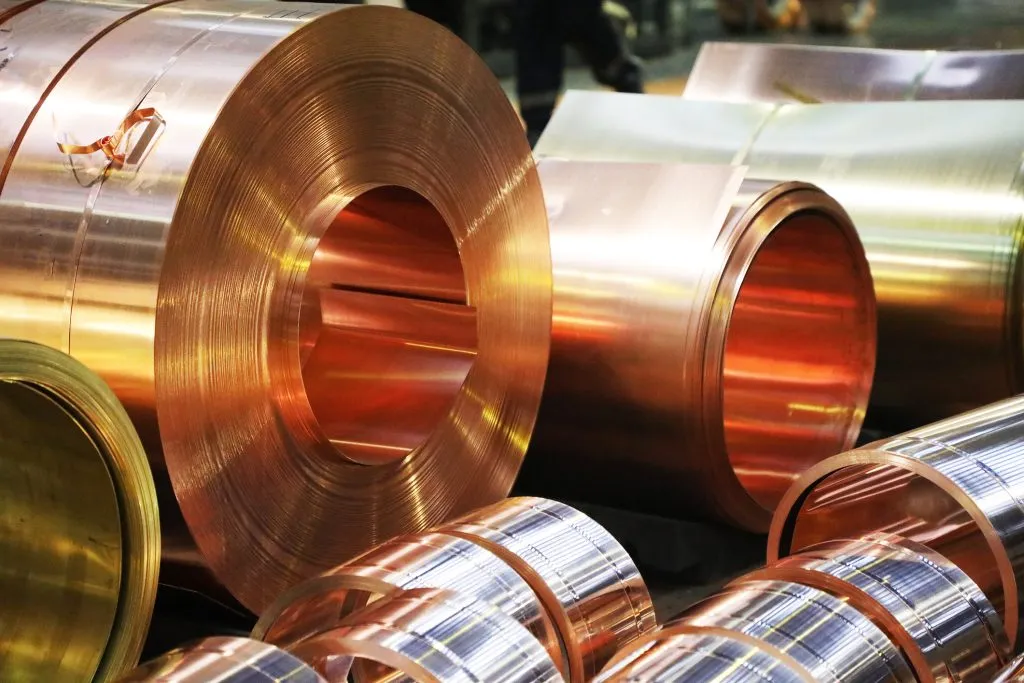
Copper stands out as a structurally supported commodity. Electrification, renewable energy, and infrastructure investment underpin long-term demand, while supply growth remains constrained. Prices are expected to stay elevated, but not speculative, favouring high-quality projects with clear execution pathways.
DISR notes copper prices hit record levels in the December 2025 quarter due to a combination of strong demand and recent supply disruptions. Copper prices surged to a record US$11,870 a tonne in the second week of December reflecting tighter supply and improved market sentiment.
“High prices are likely to persist through 2026 without a near term boost in supply or weaker demand. Prices should ease in 2027 as operations recover from disruptions, and new mines begin production,” its December quarterly reports says.
“The Commodity Exchange Inc (COMEX)-London Metal Exchange (LME) price differential has continued to vary as the markets try to work out the likelihood of further changes in US tariffs on copper imports.”
Redefining the golden rule
Gold continues to benefit from macro uncertainty and monetary policy dynamics. Its role as a counter-cyclical stabiliser is likely to persist through 2026, reinforcing its appeal for both producers and investors.
Economic uncertainty and lower US interest rates have pushed gold prices to record highs above US$4,300 an ounce. A pullback in prices towards the end of November was prompted by some investors selling gold after positive outcomes from US-China trade negotiations, according to DISR.
The World Gold Council’s Gold Return Attribution Model suggests investment activity is being driven by speculation about gold prices based on perceptions of future geopolitical and fiscal risks.
Speaking to Mining.com.au, Aguia (ASX:AGR) non-Executive Chairman Warwick Grigor says the gold market is not in a cyclical move regarding its price.
“In the commodities markets, people are used to gold or any commodity going up and then going down and going up. But what you’ve got here is not a cyclical movement in the gold price. It’s structural,” Grigor tells this news service.
“The whole purpose and understanding of gold has changed. That’s got to do with the US dollar. It’s got to do with Trump. It’s got to do with China buying.”
Grigor does not see gold’s rally slowing down anytime soon.
“What you’ve got here is not a cyclical movement in the gold price. It’s structural”
As DISR reports, continued gold purchases by central banks appear to reinforce investor confidence in the gold price. Gold is being used by central banks as a currency hedge and a financial asset with which to manage risks, including sovereign risk.
Gold is likely to remain strong at around US$4,000 an ounce over 2026 but prices are expected to fall in 2027.
Meanwhile, battery metals, particularly lithium, have moved from hype to reality. Long-term demand remains intact, but near-term pricing reflects oversupply and capital discipline. Low-cost producers and integrated supply chains are favoured.
PwC predicts that almost every second car sold will be a battery electric vehicle (BEV), leading to a demand increase for global batteries of 35% by 203, as reported.
Ongoing demand growth and production curtailments increased lithium prices over the quarter. Spodumene concentrate prices increased by over 19% from September to an average of US$975 a tonne at the start of December. Lithium hydroxide prices have increased by more than 15% over the same period to an average of over US$9,750 a tonne, as per DISR.
Across all commodities and states, several common themes emerge include a year of capital discipline, commodity price stability, and that Australia’s mining sector is not contracting, it is consolidating.
Write to Adam Orlando at Mining.com.au
Images: iStock, Unsplash & Mining.com.au


