
Earlier this month on Mining.com.au, this news service explored the first of October’s two birthstones, a colourful staple of Australia’s gemstone mining industry.
While opal remains the traditional birthstone for those born in October, tourmaline is a modern alternative, giving the month a double rainbow of birthstones.
Similar to opal, tourmaline stones display nearly every colour of the rainbow, providing the widest colour variety of all gemstones.
Tourmaline is a complex group of borosilicate minerals containing silicon, boron, aluminium, oxygen, and hydrogen.
Its composition can also include varying amounts of trace elements, such as sodium, calcium, potassium, iron, magnesium, lithium, manganese, titanium, chromium, vanadium, copper, and fluorine.
These varying elements contribute to tourmaline’s diverse colours, with iron dominant in schorl (black tourmaline), lithium common in colourful elbaite, and manganese producing pink, red, and yellow hues.
According to the Gemological Institute of America (GIA), most gem-quality tourmalines are rich in lithium. While tourmaline is not commonly synthesised in laboratories, this does not mean all tourmaline stones are natural.
Some tourmalines are treated to improve colouring, such as pink tourmalines being irradiated to increase colour saturation, while blue and green stones often undergo low-temperature heat treatment to improve or lighten colours.
Although tourmaline is a relatively common mineral, gem-quality specimens are rare.
Where the rainbow begins
Tourmaline is primarily sourced from Brazil, Madagascar, Mozambique, Nigeria, and the US.
Brazil is the primary producer of the stone, with the majority of tourmaline mines existing in the Minas Gerais and Paraíba states.
The Minas Gerais region is known for unearthing a veritable rainbow of tourmaline colours, famously producing the watermelon tourmaline which displays a natural gradient from green to pink.
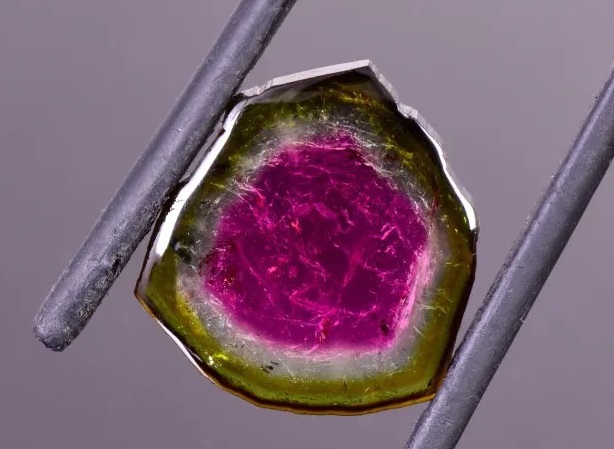
The region also produces tourmaline in a wide range of colours, including blue, green, and red, which Natural Gemstones describes as a “testament to the rich mineralogy of the region”.
Paraíba is also deemed a ‘world-famous’ region for providing neon-blue and green tourmaline stones, often referred to as Paraíba tourmalines.
Natural Gemstones describes Paraíba tourmalines as among the “most prized and valuable in the world” due to their rare neon-blue and green hues, which result from the presence of copper and manganese.
Meanwhile in the US, tourmaline mining dates back to the early 1900s in California, as well as significant deposits in Maine.
Californian tourmalines often feature shades of pink and green and are commonly sourced from the Pala region.
Maine also contributes to the pink and green tourmaline market and produces the rare watermelon variety. Its deposits are among the oldest known tourmaline deposits in the US.
Australia also produces tourmaline, although its mining industry is smaller than that of opal, October’s other birthstone.
Tourmalines are often sourced in Western Australia and New South Wales, with the most famous tourmaline deposit being the Tomkap Mine in the Yinnietharra region of WA.
Tomkap is renowned for producing massive black tourmaline crystals weighing up to 7kg, as well as other colour varieties.
An electric rainbow
Beyond its colourful appearance, tourmaline also exhibits piezoelectricity, according to the Commonwealth Scientific and Industrial Research Organisation (CSIRO).
Piezoelectricity is the ability of certain materials to generate an electrical charge when squeezed, pressed, or subjected to mechanical stress.
This property gives tourmaline applications beyond jewellery and gemstones, including use in some pressure-sensitive gauges and sensors.
Tourmaline’s ability to generate an electric charge in response to mechanical stress has applications in pressure-sensitive gauges and sensors used in testing equipment, medical imaging, submarine depth-sounding instruments, and military devices.
Tourmaline’s industrial applications highlight the broader uses of birthstones beyond jewellery, a topic this news service will continue to explore in the coming months.
Next month, Mining.com.au will explore two more birthstones in the November edition of its ‘A Taste of Birthstones’ series.
Write to Maddison Elliott at Mining.com.au
Main Image: Mining.com.au