Water stress is nothing new for Australian mining communities with around 70% of the country being deemed arid or semi-arid.
With 81% of Australia being broadly defined as rangelands extending across low rainfall and variable climates, these conditions make the country ideal for mining operations, according to the Department of Climate Change, Energy, the Environment and Water (DCCEEW).
DCCEEW reports the multitude of Australia’s rangelands to be economically important for the country’s success, supporting the mining industry to generate annual revenue in excess of $12 billion.
However, arid and semi-arid regions pose significant challenges for the mining industry and nearby communities, as water scarcity can affect mine site operations and threaten regional towns’ water security.
Groundwater near mining operations can contain high levels of dissolved minerals and microbial contamination, which makes the water unfit for human consumption — leaving many regional Australian communities without a reliable source of water.
The Commonwealth Scientific and Industrial Research Organisation (CSIRO) is currently addressing this issue by developing water treatment technology to support remote and Indigenous communities affected by mining.
By implementing water treatment technology, it will ensure these affected communities are able to access more reliable drinking water from groundwater.
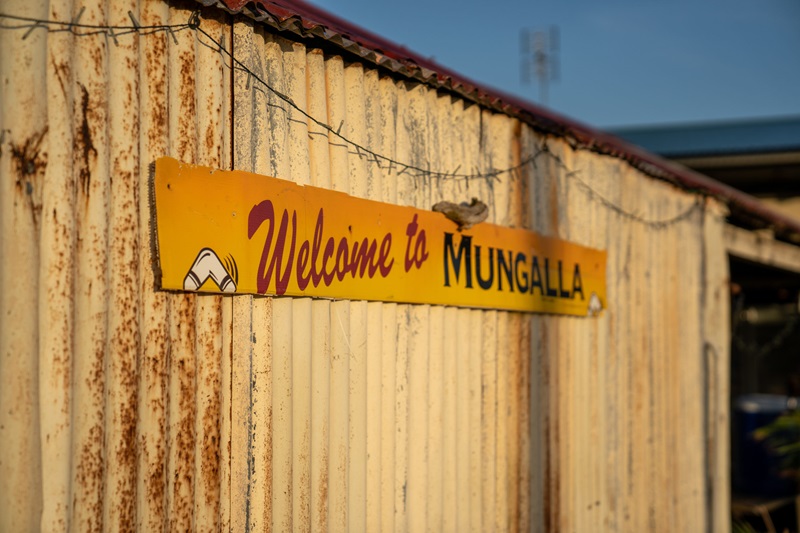
Near Ingham in North Queensland, the community surrounding Mungalla Station faces limited access to safe drinking water, as groundwater from sources such as underground aquifers (bore water) is not suitable for direct consumption.
“Town water is available at the entry of Mungalla Station along Forest Beach Road but needs to be plumbed into the Homestead, approximately 1.2km,” community spokesperson Jacob Cassady says.
“If our bore water was fit for consumption, it would provide a year-round safe water supply that is also suitable for drinking.”
CSIRO has been engaging with the mining sector to test and advance water treatment technologies, while supporting water management processes for mining operations.
Clean water for the community and mining
The need for clean water in regional towns is self-explanatory.
Mungalla Station is owned by the Nywaigi Traditional Owners who operate history and cultural tours, so with guests such as tourists and school groups arriving, the cattle station and ecotourism site must truck water in.
While there are no mining operations in Ingham itself, the town falls within the broader Townsville resources region, which services mining districts including Charters Towers and Ravenswood.
The broader North Queensland region hosts numerous projects and operations spanning the mining lifecycle, from early-stage exploration through to mineral processing and exports.
This includes junior exploration from companies such as Sunshine Metals (ASX:SHN), which is progressing drilling at its Ravenswood Consolidated Project near Charters Towers, through to mining giant Glencore’s (LSE:GLEN) port operations in Townsville, which facilitate the export of mineral products from across the region.
In mining operations, water is vital and serves multiple functions through the extraction and processing stages, such as material handling, flotation process, clarifiers, dust suppression, and for general water usages on mining campsites.
According to the Australian Bureau of Statistics, Australia’s mining industry extracted 1,349 gigalitres (GL) of water in the 2023–24 financial year, which represented a 6.5% decrease from the previous year.
This decrease reflects fewer rainfall-related disruptions, allowing for more efficient water use and reducing the need for dewatering.
Meanwhile, the mining industry used 132GL of distributed water in this same period, which represented a 14.2% increase from the previous year due to higher production activity and operational needs in major resource regions.
While nearly all traditional mineral- and ore-processing phases require water, the coal mining industry in particular relies on a secure supply of water.
Being the second-largest water user after agriculture, coal mining is responsible for around 90% of regulated mining discharges into the environment, according to the Institute for Energy Economics and Financial Analysis.
Giants leading the juniors
Glencore has a significant presence in the Australian mining industry, with 16 active mines and seven metals processing facilities across Queensland, New South Wales, Western Australia, and the Northern Territory.
Glencore has stated that it aims to understand and minimise its water footprint across its mining operations, while managing activities to protect shared water resources and ecosystems.
The company follows water target setting and tracking guidelines to set site-specific water targets, considering the area of influence, environmental knowledge base, and catchment consent.
Glencore has achieved 19 of its 2024–28 site-level water targets to date, including four related to water catchment improvements, 10 to water-use conditions, four to water quality conditions, and one to groundwater management.
At its Australian assets, water targets are weighted 60% towards water use, 20% towards water quality, and 20% towards groundwater.
Water sustainability initiatives are not limited to major mining companies, with some junior miners also prioritising water efficiency at their assets.
Anax Metals (ASX:ANX), for example, is focused on reducing legacy environmental harm and future risk at its Whim Creek Copper-Zinc Project in Western Australia.
The company has refurbished existing stormwater infrastructure and built new systems to manage, divert, and treat rainwater runoff, helping prevent environmental contamination and reduce freshwater intake.
This infrastructure also helps protect regional water quality and reduce the risk of local water scarcity.
Aside from easing pressure on local water supplies, recycling and reusing water at mining operations can lower water costs and allow companies to make surplus water available for other uses, according to the Fitzroy Partnership for River Health.
Anax Metals owns an 80% stake of the Whim Creek Project, located 120km southwest of Port Hedland, with the remaining 20% held by Develop Global (ASX:DVP).
Atlas Copco Group identifies closed-loop systems, rainwater harvesting, dry processing techniques, and constructed wetlands as key strategies for saving and reusing water in mining.
Write to Maddison Elliott at Mining.com.au
Main Image: iStock