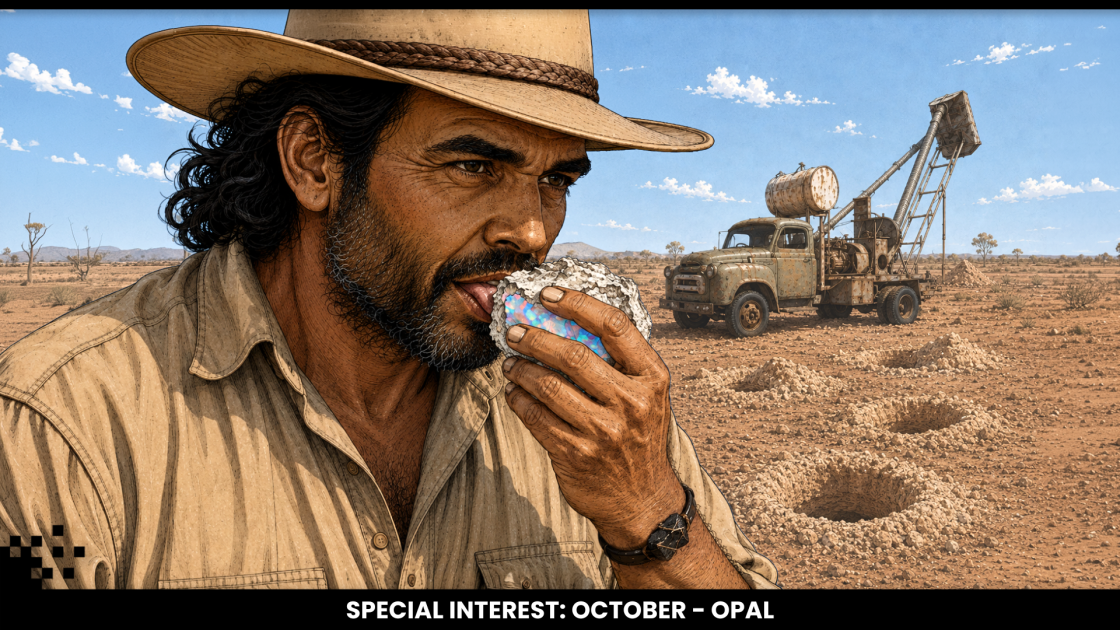
Australia is famous for many things: our unique but dangerous wildlife, figures such as Steve Irwin and the Wiggles, and our beloved Vegemite.
Among these Aussie icons is a massive mining industry.
When discussing Australia’s mining industry, most are referring to iron ore, gold, lithium, lead, bauxite, or other rocks or minerals. Many forget the significance of Australia’s opal industry.
One of the two October birthstones, opal, is composed of hydrated silica. Its spheres create shifting flashes of rainbow colours through the diffraction of light.
The gemstone can be found in many countries such as Brazil, Honduras, Mexico, and parts of the US, but Australia accounts for 95% of the world’s precious opal — making it the country’s national gemstone.
The gemstone was initially mined commercially at Listowel Downs in Queensland, way back in 1875, followed by White Cliffs in New South Wales.
Modern commercial mining of opal is primarily conducted at Coober Pedy in South Australia. Coober Pedy is the main producer of white opal, though more recently, other types of gemstone are also found there.
The sky is opalite
Recently, you may have heard of opalite through Taylor Swift’s song, ‘Opalite’. But the opalite sold as a gemstone is connected to opal chiefly through its appearance.

That opalite is usually man-made glass or plastic resin mixed with an opalescent appearance. Opals, on the other hand, are formed deep in the ground — well, not necessarily that deep.
Opals can be found anywhere from a few centimetres below surface to around 30m deep from a solution of silicon dioxide and water.
The gemstone is formed when silica-rich groundwater seeps into cracks in rocks. As the silica is deposited and hardens, microscopic silica spheres form within the opal.
In this process, water picks up traces of silica from sandstone as it runs down through the earth.
Now a silica deposit, the process repeats itself over long periods of time until, eventually, an opal is formed.
The rainbow-reflective gemstone gets its colouring from this process. The inside of an opal contains numerous silica spheres, which diffract light to create flashes of colour.
Smaller silica spheres are more common in opals, diffracting purple, blue, and green colours. Larger spheres diffract yellow, orange, pink, and red colours.
This makes opals with yellow, orange, pink, and red tones more rare.
Digging at the end of the rainbow
In some modern spiritual beliefs, opal signifies independence and freedom.
This omen carried into how opals are mined, being one of the few minerals that a miner can extract economically while working alone.
In the early days, miners sink shafts with picks and shovels until they encounter dirt that signals potential to host opals.
They then branch out sideways, driving along the level with picks and explosives, and extracting opals found with a handpick or screwdriver.
At the time, most opal mining was a two-person job, with one miner underground and another operating the windlass to haul dirt to the surface.
Today, many shafts are sunk by Calweld-type drills, which cut vertical holes about 1m in diameter with an auger bucket.

A pot of opal
As a major producer of opal, Australia recorded annual production of uncut gems valued at between $100 million and $200 million from 2000 and 2005.
Earlier export figures show a decline, from $85 million in 1996–97 to $69 million in 1997–98 and $60 million between 1998–99.
The Government of South Australia says the state’s annual opal production averaged about $40 million in the 1990s. Its production was estimated at $12.63 million in 2013.
Opals Down Under lists Europe, Hong Kong, Japan, Taiwan, and the US as destinations for Australian opal.
And while Australia dominates opal production on Earth, there is somewhere more extraterrestrial where opals exist: Mars.
The October gemstone was first discovered on Mars by NASA rovers and orbiters in 2008, which makes sense when you consider the formation of opals: all opals need is silica and water.
If that fun fact wasn’t enough to please the October-born, or if you’re more of a tourmaline fan, stay tuned.
Next weekend, Mining.com.au will dive into its second October edition of its ‘A Taste of Birthstones’ series, where we talk about all things tourmaline.
Write to Maddison Elliott at Mining.com.au
Main Image: Mining.com.au