


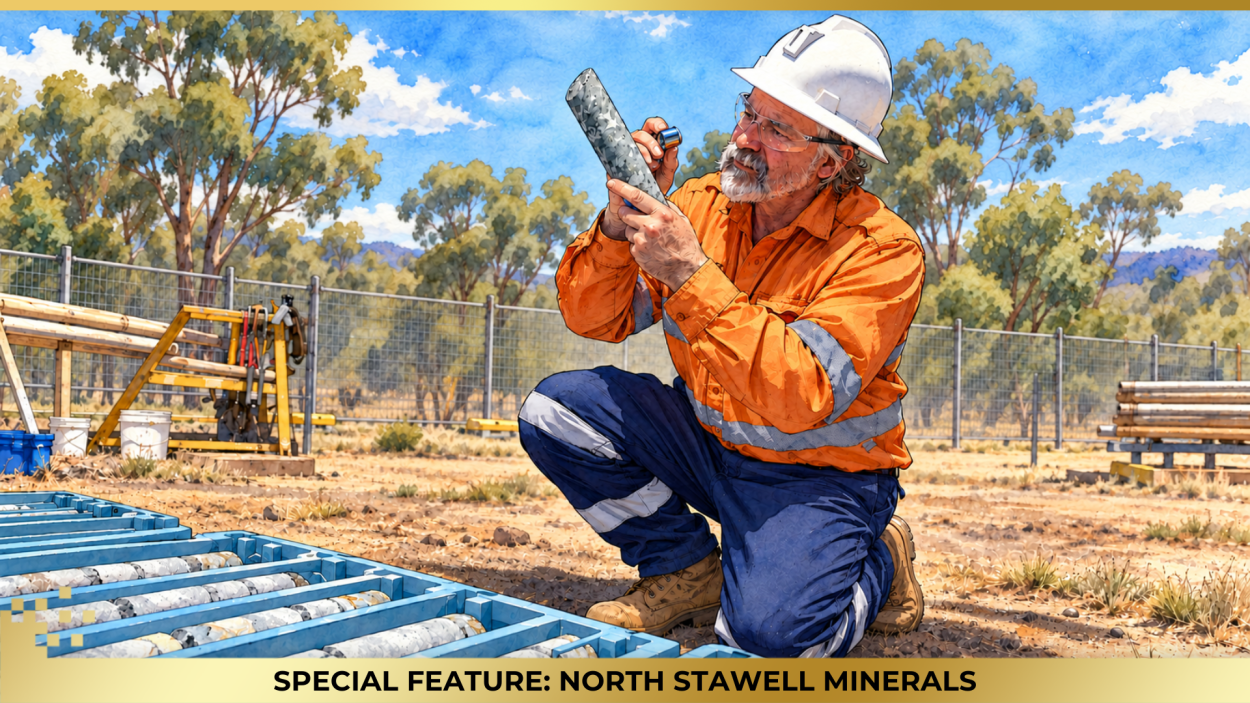
This article is a sponsored feature from Mining.com.au partner North Stawell Minerals. It is not financial advice. Talk to a registered financial expert before making investment decisions.
Since its spinout from Stawell Gold Mines in 2020, North Stawell Minerals (ASX:NSM) has been focused on unlocking the exploration potential of the western Stawell Corridor in Victoria, Australia.
Led by a small team out of Stawell, the company has spent the past five years systematically building its geological understanding of the region through more than 700 drill holes, extensive geophysical surveys, and geochemical programs.
The team’s strategy centres on identifying gold mineralisation hidden beneath shallow cover, an area that largely escaped discovery during Victoria’s gold rush era.
Executive Director Bill Reid explains that the company’s spinout was to enable North Stawell to broaden its regional exploration work, allowing the Stawell Gold Mine to focus strictly on mining operations.
The Stawell Corridor comprises a geological unit running through central western Victoria, which Reid notes has a multitude of similarities to other more high-profile gold areas in Victoria.
“The gold event that created the Stawell Corridor is the same age as Bendigo and Ballarat, but the difference is that the rocks, particularly around Stawell, disappear under a thin blanket of unmineralised cover, starting just 6km north of the mine,” Reid says.
“That’s where the initial opportunity lies because there’s potential for shallow-covered, large accumulations of gold mineralisation that the old-timers just couldn’t find as they could not see through the unmineralised cover.”
Armed with high-resolution geophysical datasets and a geological model refined from decades of exploration and mining in the Stawell goldfield, North Stawell is now targeting repetitions of the district’s two principal gold systems.
These include basalt-hosted mineralisation and the ‘high-grade’ structural lodes that have established the region as one of Victoria’s most prolific and successful gold mining regions.

Unlocking Victoria’s hidden gold potential
Reid explains that in Victoria, most outcropping gold mineralisation was found around 150 years ago, so the real opportunity North Stawell has identified lies under this thin veneer of unmineralised cover that has provided a number of shallow targets.
Identifying these targets has been far from straightforward, but Reid notes that the company has a substantial pipeline of opportunities to test, with a number of new targets awaiting evaluation.
Victoria has a long history of gold mining, leading Australia in gold discoveries in the 1800s, as previously reported. Since its gold industry began, Victoria has produced 2,400 tonnes of gold, accounting for close to 2% of all gold mined globally.
The Stawell Corridor makes up part of Victoria’s Golden Triangle, with the Bendigo and Ballarat areas forming the other two points. The Stawell Zone itself, however, has key geological features that differentiate it from the other zones, namely that before the main gold mineralisation event, a lot of basalt was thrust up into the geology.
“There’s this sea of endless sediments, and the important thing about the basalts that have been pushed into these sediments is twofold,” Reid says.
“First, we know that the basalts host and control the mineralisation at Stawell, making them a higher-order vector to gold mineralisation across the belt. By identifying these basalts, we can target other areas with geological characteristics similar to the Stawell gold mine, which provides a significant advantage from an exploration viewpoint.
“The other key benefit is that the basalts have a distinct chemistry compared to the surrounding sediments, allowing them to be detected using geophysics. This means that we can effectively see through the cover that’s been an impediment to exploration in the region for more than 150 years.”
Reid explains that because the basalts themselves are coherent units, they do not react when the rocks get squashed, meaning they are resistive and do not bend or flex. Because of this, the faults and folds that control the gold mineralisation in the area actually wrap around them and drive the gold onto the margins of the basalts, through dilation zones, and above the basalts.
“This creates a sort of pressure zone above the basalts, which allows us to see the mineralisation in the environment,” Reid says.
The mineralisation associated with the Stawell goldfield is extensive, having historically produced around 4.5 million ounces (Moz) of gold. Reid notes that the primary gold system is typically of moderate grade, averaging between 3 and 7 grams per tonne. Additionally, gold occurs within a second style of mineralisation known as the Mariners-type lodes, which comprises a network of splays and veins developed above the basalts.
Mariners-type lodes are fault controlled, plunging, narrow-vein, high-grade gold systems that are comparable to several well-known Victorian gold deposits, including those found in the Ballarat area.
Historically, the Mariners lodes above the Stawell basalt produced just under 1Moz of gold at grades ranging between 28 and 30g/t. According to Reid, these exceptional grades make Mariners-style targets some of the most compelling exploration targets in Victoria.
North Stawell is targeting repeats of both the high-grade Mariners-style lodes and the basalt hosted mineralisation associated with the Stawell gold system. To support this effort, the company has flown a high-resolution airborne gravity survey across its project areas in Western Victoria, enabling it to map basalt units concealed beneath surface cover.
Reid notes that the survey has significantly improved the company’s understanding of the distribution and geometry of these basalts, providing the key to unlocking its pipeline of exploration projects.

Following a proven gold blueprint
Having been spun out of Stawell Gold Mines, North Stawell benefits from an extensive legacy of geological research, exploration data, and operational knowledge built over decades of mining in the district.
The Stawell Gold Mine has produced more than 4.5Moz of gold through a combination of historical and modern mining, with an additional 0.8Moz contained within its current resource inventory.
Using this deep understanding of the Stawell gold system, North Stawell is applying the mine’s geological model as a blueprint to guide regional exploration, refine geological interpretations, and identify new mineralised systems.
This approach is supported by the use of high-resolution geophysical data, which is proving particularly effective in targeting deeper basalt units concealed beneath cover.
The Stawell Gold Mine contains gold mineralisation in structures above the basalts (the Mariners-type), gold mineralisation on the basalt margin (the Stawell-type), and large basalt slabs.
Reid notes that one of the key advantages of the Stawell geological model is the predictability provided by the basalt units, which act as clear exploration guides.
“If you drill through sediments into basalt and you haven’t intersected mineralisation, it’s a strong indication that you‘re in the wrong position or angle. This allows us to reassess quickly, refine our targeting and move with confidence,” Reid says.
This geological model means that the company is more confident when targeting mineralisation and defining resources. It also helps improve resource classification and reduce uncertainty compared to more complex gold systems.
Reid notes that the Stawell Gold Mine continues to provide valuable insights into the district’s broader mineral endowment. The operating mine has demonstrated the scale and continuity of the mineral system, with the same basalt-hosted geological fingerprint that underpins the Stawell Gold Mine extending well beyond the mine lease.
“From Stawell, there’s about 3.5km of basalt that they’ve mined extensively and we know that there’s mineralisation there. We can trace that geological fingerprint right through our northern tenements, under cover,” Reid says.
Exploration to date has identified what North Stawell interprets as more than 60km of basalt strike length across its tenements. This presents opportunities for repeats of both Stawell-type basalt-hosted mineralisation and higher-grade Mariners-style gold systems.

Darlington: Testing the next discovery target
Recent exploration efforts have focused on the Darlington Project, which Reid describes as one of the company’s most exciting prospects from an exploration perspective.
“While it is not as advanced as the Wildwood Project, located 20km to the north, Darlington is particularly compelling because it continues to return a diverse range of geological and mineralisation indicators,” Reid says.
What makes Darlington especially attractive to North Stawell is the interpretation that it hosts both Mariners-type and Stawell-type mineralisation. The potential for both types of mineralisation present a unique exploration opportunity and significantly enhances the project’s prospectivity.
The basalt target being explored by North Stawell at Darlington is located approximately 6km north of the Stawell Gold Mine. Reid notes that the geophysical data suggest that the basalt can be interpreted as the northern continuation of the same basalt unit that hosts the renowned Stawell gold mineralisation, highlighting its potential to host a repeat of the mineralised system.
To date, four drill holes have intersected the basalt at a vertical depth of approximately 300m, with two of those holes returning gold mineralisation. Reid notes that the mineralisation occurs along the basalt margin, exactly where the company’s geological model predicted it would be found.
“What we’re seeing at Darlington, particularly in the sediments above the basalt at shallower depths, is multiple higher-grade intersections that we would typically expect to see in comparable settings at Stawell in the sediments above the basalt,” Reid explains.
“This basalt exhibits many of the characteristics we associate with the Mariners lodes at Stawell, which is very different from the Stawell-type mineralisation. That’s particularly encouraging because Mariners-style mineralisation is a different and significantly higher-grade gold system than the traditional Stawell-type mineralisation.”’
In some areas, the company has observed significant visible gold, with one of the best intercepts to date returning 2.3m @ 28.2g/t, which Reid describes as a very attractive shallow exploration target for North Stawell.
North Stawell has so far tested the basalt at Darlington in a handful of areas, following on from the geophysical work completed previously. Early drilling of geophysics-only targets has already delivered what Reid describes as encouraging results, including narrow mineralised intercepts that provide technical validation of North Stawell’s exploration model.
“From the drilling that we’ve completed, the holes returned pretty exciting technical results. That geophysics response is 900m long and 400m wide, so it presents a very large target for us to explore,” Reid says.
North Stawell has also partnered with the Commonwealth Scientific and Industrial Research Organisation (CSIRO) on numerical modelling designed to identify the areas on the basalt that are most likely to have opened up during the gold event. That work informed the company’s initial drilling, which focused on these predicted zones and delivered immediate results.
Building on previous exploration work, North Stawell has completed an induced polarisation (IP) survey across the Darlington area targets, identifying a strong chargeability anomaly approximately 300m south of the existing drill holes. By combining the geological modelling, geophysical datasets, and historical drilling information, North Stawell has defined what Reid describes as a clear program for further exploration at Darlington.
“While we have multiple targets across the belt, it’s extremely encouraging to see a geophysics-generated target deliver positive results so early in the exploration process. These are the kinds of outcomes that give us real confidence in our targeting approach,” Reid says.
Darlington has the potential to be a value-generating discovery for North Stawell, with early results providing encouraging signs that the project could host a substantial mineralised system. However, Reid is careful not to overstate the opportunity, noting that additional drilling will be required to fully assess the extent and economic potential of the mineralisation.

Wildwood: Giving a known resource new life
The Wildwood deposit represents North Stawell’s other key exploration focus. Reid describes it as relatively shallow, with just 10–40m of unmineralised cover over the top of the underlying target.
“We’re more confident now that the IP can see through this cover and provides a clear picture of the underlying basement signatures,” Reid says.
“This means that we can apply the same approach we’ve used successfully at Darlington and return to Wildwood with a fresh perspective, enhancing the existing resource with further exploration potential.”
Wildwood has been the subject of multiple drilling campaigns historically and currently hosts a resource of approximately 87,000 ounces at 2.4g/t gold. While Reid acknowledges that the existing resource is not large by itself, he notes that it remains a meaningful foundation and, importantly, exhibits many of the same geological and mineralisation characteristics that underpin the nearby Stawell Gold Mine.
Reid notes that the size and grade mean the company needs to look at the project from a different angle. Working smarter means bringing in an IP survey and searching along the rest of the basalt, which he highlights has never actually been tested before.
“IP will help us to better target our drilling and bring smarter science and cost-effective exploration into the project,” Reid says.

The road ahead
With encouraging technical results emerging from both Darlington and Wildwood, North Stawell is now focused on advancing the next phase of its exploration strategy. This includes expanding its use of IP surveys, which have already played an important role in defining targets and improving drilling efficiency.
At Wildwood, North Stawell intends to conduct additional IP work over areas where historical drilling has already confirmed mineralisation. By testing the effectiveness in known mineralised zones, Reid says the company can then apply it more broadly along the basalt-hosted structures that extend throughout the district.
The next major exploration priority is Darlington West, where overlapping IP and gravity geophysics will help to define further targets.
“This represents a significant exploration opportunity and the vector is towards mineralisation,” Reid says.
“We’ve seen numerous indications that we’re close to a mineralisation system, but we haven’t quite made the breakthrough yet. What gives us confidence is that the Darlington area continues to exhibit some very encouraging geological similarities to the Stawell Gold Mine.”
Beyond its flagship projects, North Stawell has identified a substantial pipeline of exploration opportunities across its broader landholing. High-resolution gravity, magnetic, and IP surveys have generated a growing inventory of targets, providing the company with a strong platform for future discovery.
Prospects including Lubeck Tip, Forsaken, and Ashens are among those earmarked for further work as North Stawell continues to build momentum across its priority exploration programs.
North Stawell is also evaluating opportunities to diversify its asset base as it continues to advance its exploration portfolio. Reid notes that the company is mindful of the challenges faced by single-project explorers, particularly in a region where seasonal farming activities, weather conditions, and land access constraints can influence exploration timelines.
While the company remains focused on unlocking the potential of its Victorian projects, management is actively assessing complimentary opportunities that could broaden its asset base, reduce operational risk, and further strengthen North Stawell’s position within the junior exploration sector.
For North Stawell, the challenge is no longer in finding targets, but in systematically unlocking a pipeline of opportunities hidden beneath one of Victoria’s most productive gold belts.
Write to Amy Rotman at Mining.com.au
Main image: Mining.com.au, North Stawell


