


Pivotal Metals (ASX:PVT) is launching a detailed ground-based time domain electromagnetic survey at its 100% owned Horden Lake Project in Québec, Canada.
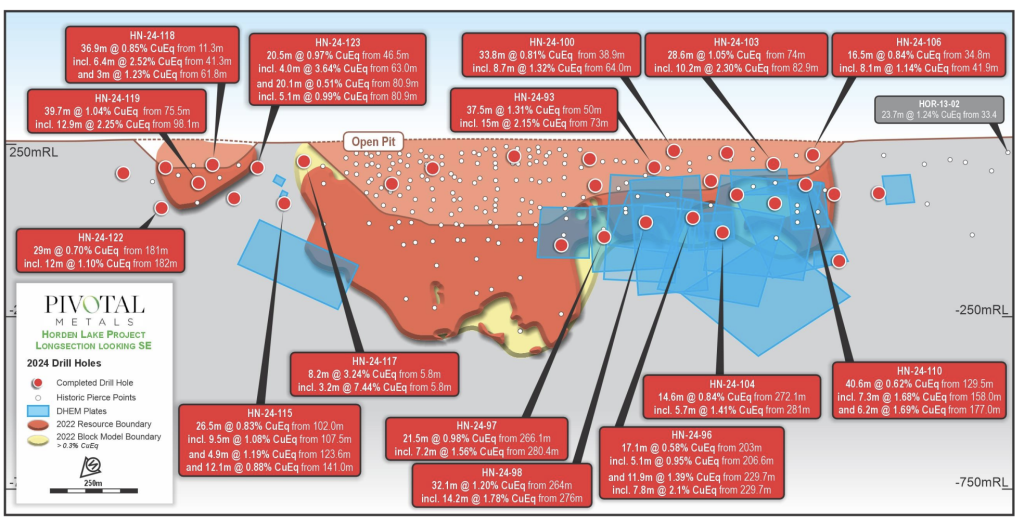
Mobilising on 22 November, the large loop TDEM survey crew is targeting accumulations of semi-massive and massive sulphide mineralisation below, along strike, and parallel to the Horden Lake deposit, and will complement the targets generated in Pivotal’s 2024 drilling and downhole electromagnetic (DHEM) program.
The survey is expected to take four weeks to complete.
It is being completed by a Val d’Or based specialist geophysical contractor. Val d’Or is northern Québec’s regional mining hub and Pivotal benefits from access to specialist skills and contractors located in close proximity to its Horden Lake and BAGB projects.
Pivotal recently completed a $3 million capital raise and is well funded to advance its active work program at the Horden Lake project. A metallurgical testwork program is now well advanced with results anticipated late Q4 or early Q1 2025. Additionally, a resource update is also underway, with results to follow the completion of metallurgical testwork.
Managing Director Ivan Fairhall says Pivotal is expanding its search for new mineralised bodies to the entire length of the main mineralised trend and the newly identified parallel trend.
“The first DHEM survey on the property, completed earlier this year, confirmed the unusually high conductivity of the Horden Lake mineralisation and highlighted the unrealised potential for discovery of additional semi massive to massive mineralised sulphide bodies within the project area,” Fairhall says.
“We are looking to leverage this level of conductivity with this detailed TDEM survey – it’s perfectly suited to our project and we’re excited to apply this technique for the first time at Horden Lake.”
The large loop TDEM survey method has been chosen to identify new mineralised semi-massive to massive sulphide accumulations located along the main mineralised trends at Horden Lake. The survey is configured to investigate both known mineralised trends of the project.
Pivotal says the technique provides the potential to discern highly conductive targets penetrating up to 500m-plus depth through use of a very low survey frequency, large loops, and ground based measurement.
Previously applied airborne geophysical methods in the area were unable to discern highly conductive sulphides due to limitations in survey frequency, and/or were incomplete in their coverage over the mineralised trends, and/or were unable to penetrate to depth.
These limitations, coupled with the 2024 identification of the unusually conductive nature of the Horden Lake resources motivates the expansion of the search area and application of the ground TDEM method, and establishes a great opportunity for the discovery of additional high-grade resources over the project area.
The planned survey comprises two loops of 1,700 by 2,300 metres with readings at 50 metre station spacing along 100 metre and 150 metre spaced lines for a total 29-line kilometres read. A very low frequency of 0.5Hz input signal has been selected to discern the highly conductive sulphides as identified from the 2024 DHEM survey results.
Meanwhile, Pivotal is also completing a comprehensive data compilation and review of its BAGB project portfolio, which consists of three distinct project areas – Midrim/Alotta, Lorraine, and LaForce).
Prospectivity of these project areas is reflected in a number of included ‘high-grade’ Cu-Ni-PGE historical deposits on the claims package. Pivotal is seeking to further investigate the growth potential of these deposits, as well as discovery of additional deposits in these mineralised belts.
Planned 2025 work will incorporate high resolution ground geophysical methods to identify potential large sulphide accumulations for drill testing. Evidence of ‘high-grade’ precious metals occurrences have also been identified, noting in particular the Lorraine project where bonanza gold grade intersections were historically reported in drillhole and underground sampling.
The Horden Lake deposit was discovered in the 1960s. Between 1962 and 1969, geophysics were completed and 157 diamond drillholes totalling 32,229m. At the time the project was remote, with access only possible via float plane or helicopter.
In 2022, Pivotal completed a comprehensive evaluation of all historical data, and calculated an updated inferred and indicated MRE totalling 27.8Mt @ 1.49% CuEq.
Owing to the limited distribution of multi-element assays, gold was only domained in the central portion of the deposit. Palladium showed high correlation to nickel and was therefore able to be extrapolated. The balance of the gold, platinum, cobalt and silver which have been observed, but not modelled, represents potential upside on the project.
Write to Adam Orlando at Mining.com.au
Images: Pivotal