


This article is a sponsored feature from Mining.com.au partner Magnis Energy Technologies Limited. It is not financial advice. Talk to a registered financial expert before making investment decisions.
On the road to global decarbonisation, one critically important material that is often overlooked compared to lithium or nickel has perpetually been graphite.
It is a crystalline allotropic form of carbon that occurs as a mineral in some rocks and can be made from coke.
While historically graphite’s demand has been driven by traditional and industrial applications such as a solid lubricant, in pencils, and as a moderator in nuclear reactors, increasingly its prominence in electric vehicles (EVs) that is now driving demand.
Magnis Energy Technologies (ASX:MNS) Chief Executive Officer (CEO) David Taylor explains that graphite has been declared a critical mineral in Australia, the European Union, Japan, the UK, and US given its importance to the global transition to clean energy.
As such, it is somewhat the centrepiece of the company’s burgeoning portfolio.
Magnis recently completed a Bankable Feasibility Study (BFS) update that confirmed the viability of its 100% owned Nachu Graphite Project in Tanzania. The mine will produce and supply ‘high-purity’ graphite anode feedstock at a commercial scale for the rapidly growing lithium-ion battery market.

To date, Magnis has demonstrated the production of a ‘high-performance’, commercial lithium-ion battery grade (>99.95%) Coated Spherical Graphite (CSPG)-based Anode Active Material (AAM) from its Nachu graphite feedstock with the help of its strategic technology partner C4V.
In addition, Magnis has plans afoot to establish a lithium-ion battery AAM manufacturing plant utilising ‘high-purity’ natural graphite feedstock from Nachu. Taylor says this downstream AAM production facility will deliver a secured supply of one of the most sustainable, cost-competitive, and high-performance CSPG anode products in the marketplace for the ever-growing US and European lithium-ion battery markets.
AAM plant an important cog
The CEO explains: “Magnis’ vertically integrated battery technology and materials strategy currently entails its strategic investment in a lithium-ion battery manufacturing facility, Imperium3 New York, and its Nachu Graphite Project in Tanzania. Graphite is a key raw material for lithium-ion batteries and to be used in lithium-ion battery anodes it requires further downstream processing to purify it to a level.
“Magnis’ vertically integrated battery technology and materials strategy currently entails its strategic investment in a lithium-ion battery manufacturing facility”
An AAM manufacturing facility is an important cog in Magnis’ strategy as it would potentially enable Magnis to integrate its existing assets as well as meet the rapidly growing demand from lithium-ion batteries.”
The proposed AAM processing facility will strengthen Magnis’s vision of vertically integrating its strategic assets across the lithium-ion battery value chain, as well as meeting the growing supply deficit of critical materials for the broader battery market. Several locations within the US are currently being investigated.
Taylor notes that the plant size and scale has not been determined yet, however the AAM plant will have some interesting features.
The CEO says: “Magnis along with its technology partner C4V LLC, a US battery intellectual property company, have developed innovative processing technology IP and know-how to process Nachu Flake Graphite into CSPG AAM purely from mechanical processing steps only.
This process is unique globally as it avoids chemical and thermal purification enabling us to produce low-energy and low-carbon footprint CSPG AAM and is made possible by C4V’s IP as well as Nachu’s consistent intrinsic high-grade and high-quality of crystal with minimal imperfections.
The planned AAM facility will utilise this process in a scalable manner to produce commercial volumes for customers.”

Partnerships are paramount
The CEO reiterates that the unique characteristics of the Nachu Graphite Project and Magnis’s partnership with C4V to produce a globally unique low-energy and low-carbon footprint CSPG AAM means that it makes sense for Magnis to move into downstream graphite processing and build an AAM facility.
For the company, partnerships are paramount to the success of its strategy.
“Securing offtake from OEM and other major customers will provide third party validation and successful commercialisation of the process into a large scale AAM facility is expected to provide significant value to our shareholders.
We have plans for the phased production of AAM, commencing with the operations of a demonstration plant followed by setting up a large-scale AAM production facility in the US in the next 3 to 5 years.
The demonstration plant aims to supply the AAM for the qualification process with the OEMs and lithium battery cell manufacturers.”
While talks with prospective offtake partners remain ongoing, the CEO says the company’s current established partnership with C4V is also critically important.
Taylor notes: “Our technology partner C4V have been instrumental in providing both the technical background and research into lithium-ion battery technology as well as commercial manufacturing. This is a milestone we have recently achieved together at our iM3NY facility.”
“Our technology partner C4V have been instrumental in providing both the technical background and research into lithium-ion battery technology as well as commercial manufacturing”
C4V’s innovative and scalable processing technology has eliminated the need of any harsh chemical and thermal purification producing a significantly low-energy and low-carbon footprint anode product.
The CEO adds that several locations within the US are currently being investigated for the proposed AAM processing facility, with specific criteria in mind for the right address.
“Major interstate roads, railway lines and proximity to ports will be determining factors within the USA where the IRA could be taken advantage of. We’ve seen the value of such infrastructure at our iM3NY battery plant location in Endicott New York.
Magnis will update the market if and when it finalises a location.”
Nachu shows strong ESG and financial credentials
While the AAM processing facility in the US is a major cog in the Magnis value chain, complementing its importance, Taylor says, is the company’s world class Nachu project in Tanzania.
The CEO adds that while Nachu has strong ESG credentials and will generate significant job creation in Tanzania with a large local workforce, the project has very attractive economics.
Magnis is seeking about US$450 million in total pre-production capital and is targeting 60% in debt and 40% in equity. The project is expected to have a net present value (NPV) of US$1.2 billion, an average life of mine annual EBITDA of US$309 million, for a payback period expected to be within just 2 years.
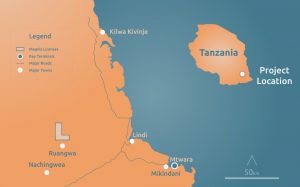
Yet importantly, Taylor adds, Nachu is one of the largest natural flake graphite projects in the world and the only graphite project in Tanzania to be granted a Special Economic Zone by the government.
Magnis has plans to produce 236,000tpa of graphite concentrate. Nachu will deliver ‘very high-purity’ natural flake concentrate that either removes or minimises the need for expensive downstream chemical purification required in traditional processes. The mine will be open pit mining and has mineralisation near the surface with a simple and proven processing flowsheet – crushing and screening, grinding, flotation, filtration, and drying.
In addition, the CEO says globally, Nachu is important given that to meet demand for anode materials, an estimated 97 natural flake graphite mines will need to be built by 2035.
A World Bank Group report finds that the production of critical minerals, such as graphite, lithium, and cobalt, could soar by nearly 500% by 2050, to meet the growing demand for clean energy technologies. The report projects that the graphite industry will grow at a compound annual growth rate (CAGR) of 5.3% to reach US$21.6 billion by 2027.
Analysts also forecast graphite demand from the batteries sector will balloon by 1,400% between 2020 and 2050. A graphite shortage also looms with an expected deficit of 20,000 tonnes in 2022 alone.

Grasping the importance of graphite
Graphite is the most stable form of carbon that exists in nature in crystalline form.
When compared to lithium or nickel, graphite has always been somewhat overlooked when it comes to the key minerals needed for decarbonisation.
However, the role of graphite – which is the most commonly used anode material – has predominantly been for industrial uses which has previously driven demand. It is also used in special applications such as in soil conditioners, as well as foils used for sealing in the chemical and petrochemical industries and in the energy and engineering industries.
Taylor says that lithium-ion batteries typically contain 7-10x more graphite than lithium by volume. With the knowledge that lithium-ion battery demand is set to grow 30% CAGR to 2030, the market for the material is huge.

As previously mentioned, graphite may have been overlooked in the past given that many focus on the cathode chemistry of a battery, but it is now considered a key critical material for battery production. Given its importance in the anode as well as its current dependence on China, many governments including the US and the EU have identified it as essential and of national interest.
Forecasts on the demand of graphite show that there is not a lot of time to meet projected deficits given the demand for battery raw materials coupled with the supply concentration risk from China’s dominance in this space.
Taylor notes that for a sustainable supply chain for the battery world, a more diversified set of graphite mines, as well as downstream refining/processing facilities are needed to come online to also reduce supply bottlenecks that may cause significant price volatility.
Enter, Magnis Energy Technologies.
Write to Adam Orlando at Mining.com.au
Images: Magnis Energy Technologies Ltd & iStock