


The ASX has followed Wall Street lower on the release of weak US manufacturing data, which spooked investors further following China’s stats earlier in the week.
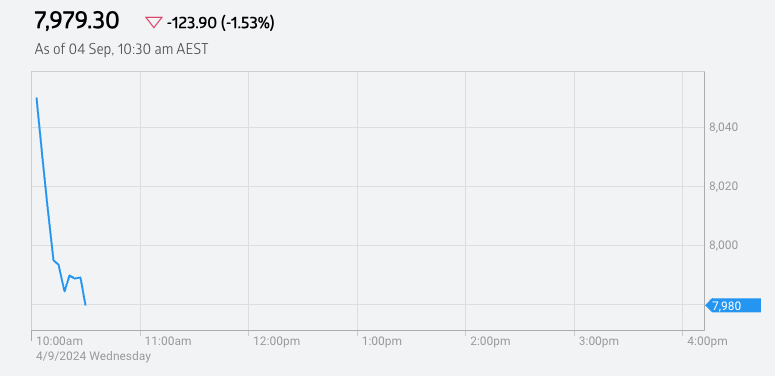
The S&P/ASX 200 slid 123.90 points, or 1.53%, to 7,979.30 points at 10:30am AEST.
All 11 sectors were in the red, with materials edging back 0.83% followed by industrials with a 0.23% dip. Energy was down only marginally with a 0.08% dip. The session’s top sector, Consumer Staples, is lower by 0.05%, continuing its 2.71% decline for the last five days.
Economic activity in the US manufacturing sector contracted in August for the fifth consecutive month and the 21st time in the last 22 months, according to the Institute for Supply Management (ISM).
The ISM’s manufacturing purchasing managers’ index registered 47.2% in August, up 0.4 of a percentage point from the 46.8% recorded in July, but still below the 50% mark that signals a contraction.
“Demand remains subdued, as companies show an unwillingness to invest in capital and inventory due to current federal monetary policy and election uncertainty,” ISM Chair Timothy Fiore says.
“Production execution was down compared to July, putting additional pressure on profitability.”
This follows weak PMI data out of China on Monday (2 September).
The bottom performing stocks included iron ore producer Fortescue Metals Group (ASX:FMG) and uranium explorer Deep Yellow (ASX:DYL), which were down 8.59% and 7.44% respectively.
Copper major Sandfire Resources (ASX:SFR) slid 6.20%, while Australia’s newest uranium producer, Boss Energy (ASX:BOE), retreated 5.93% and coal producer Whitehaven Coal (ASX:WHC) wiped off 5.44%.
The index has lost 1.14% for the last five days, and sits 2.08% below its 52-week high.
US jobs data for August is also slated for release on Friday, which has investors in a ‘watch-and-wait’ mode given the expectation that potential rate cuts will hinge on the outcome of the latest data.
The S&P/ASX200 is Australia’s leading share market index and contains the top 200 ASX-listed companies in terms of market capitalisation, and accounts for about 80% of the country’s equity market. The index is designed to measure the performance of the 200 largest index-eligible stocks listed on the ASX by float-adjusted market capitalisation
It is recognised as the institutional investable benchmark in the country.
Write to Angela East at Mining.com.au
Images: Stock