


While equities were again held down by US President Donald Trump’s tariff agenda, metals markets received a shot in the arm on an improved outlook for demand in China.
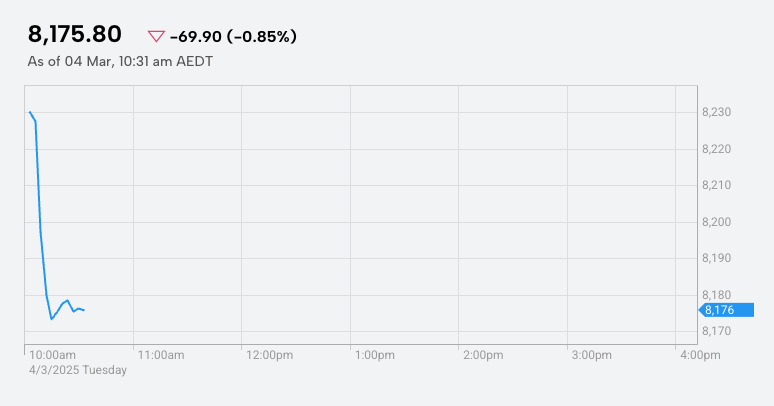
The S&P/ASX 200 dropped 69.9 points, or 0.85%, to 8,175.80 points, as of 10.30am AEDT. The index has lost 0.92% in the last five days, but is virtually unchanged over the last year to date.
All 11 sectors were in the red after the opening bell. Materials slid 0.4%, energy was down 0.31% and industrials edged back 0.19%.
Meanwhile, nickel led base metals up on indications of improved factory activity in China.
ANZ Senior Economist Adelaide Timbrell says the country’s official manufacturing Purchasing Managers Index unexpectedly returned to expansionary territory.
“This comes ahead of the National People’s Congress, China’s biggest political gathering of the year,” she says.
“Premier Li Qiang is expected to lay out the country’s economic blueprint for the year. Expectations are for further stimulus to support the economy.
“Nickel led the sector higher, on data last week that showed more than 8,000 tonnes of nickel was ordered out of LME warehouses on Thursday, driven by requests for the metal in Asia.
“This could be a sign that demand is starting to catch up with supply.”
Trading Economics showed nickel was up over 2% at the time of writing to US$15,914 ($25,623) a tonne.
Gold also gained ground as Trump said the time for negotiation was over and that he would now begin implementing tariffs on key trading partners.
According to Trading Economics, the safehaven metal was fetching around US$2,892 an ounce this morning, marking a 1.24% rise.
This saw Ramelius Resources (ASX:RMS), De Grey Mining (ASX:DEG) and Genesis Minerals (ASX:GMD) all shift higher.
Ramelius climbed 1.5% to $2.70, De Grey rose 1.5% to $2.03 and Genesis advanced 1.25% to $3.23.
The 25% tariffs on exports from Mexico and Canada will come into effect today (4 March) US time.
The S&P/ASX200 is Australia’s leading share market index and contains the top 200 ASX-listed companies in terms of market capitalisation, and accounts for about 80% of the country’s equity market. The index is designed to measure the performance of the 200 largest index-eligible stocks listed on the ASX by float-adjusted market capitalisation.
It is recognised as the institutional investable benchmark in the country.
Write to Angela East at Mining.com.au
Images: ASX & iStock