


Danish investment bank Saxo Bank says gold exchange traded funds (ETF) investors are showing signs of life as the first US rate cut draws near.
The precious metal punched through a new record high of US$2,500 ($3,721) an ounce last week and has enjoyed an “almost uninterrupted rally” since last October, when it was fetching around US$1,810 an ounce.
It is up over 20% year to date.
Saxo head of commodity strategy Ole Hansen says demand from family offices, rich individuals, central banks, and price momentum has kept gold supported.
Though action from ETF investors has been subdued until now.
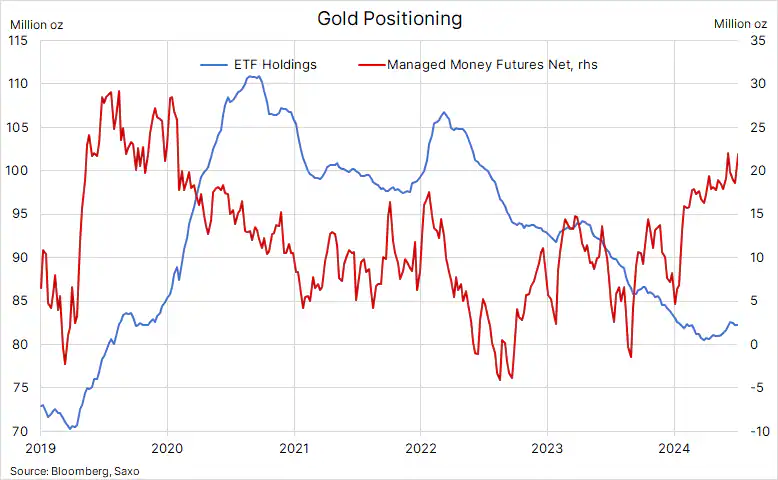
“While leveraged investors, such as hedge funds, joined the rally early back in February and March when a technical breakout occurred above US$2,200, we have only recently seen a small pick-up in demand from investors in exchange-traded funds,” he notes.
“We believe demand is likely to pick up as the US Federal Reserve cuts rates, thereby lowering the cost of holding a position in gold and commodities in general.”
Hansen says the safe haven metal may offer some short-term resistance while traders turn their attention to US Federal Reserve Chair Jerome Powell’s speech at the Jackson Hole Economic Symposium on Friday (23 August).
He says traders and investors will be looking for confirmation that the Federal Open Market Committee (FOMC) is moving towards the first of several rate cuts next month.
“A cut will be dependent on whether incoming economic data continues to support the recent softness seen in key economic measures,” Hansen says.
“In the short term, traders will be looking for support around US$2,475–80, followed by US$2,400.
“Rate cuts could see interest rate-sensitive investors return to gold via ETFs, which have seen consistent net selling since 2022 when the FOMC began its aggressive rate-hiking campaign.”
The gold price has already hit Saxo’s revised 2024 target, but Hansen believes it still has “more fuel left in the tank”.
The price is expected to be supported by ongoing geopolitical risks related to Russia/Ukraine, the Middle East and uncertainty surrounding the November US presidential election.
Another driver Hansen sees as positive is the “strong retail demand in China amid the desire to park money in a sector seen as relatively immune to a struggling economy and property woes and the outside risk of the Yuan devaluing”.
Continued central bank demand amid geopolitical uncertainty and de-dollarisation, and gold’s ability to offer a level of security and stability that other assets may not provide, are also key factors supporting higher prices.
Write to Angela East at Mining.com.au
Images: Saxo and iStock