



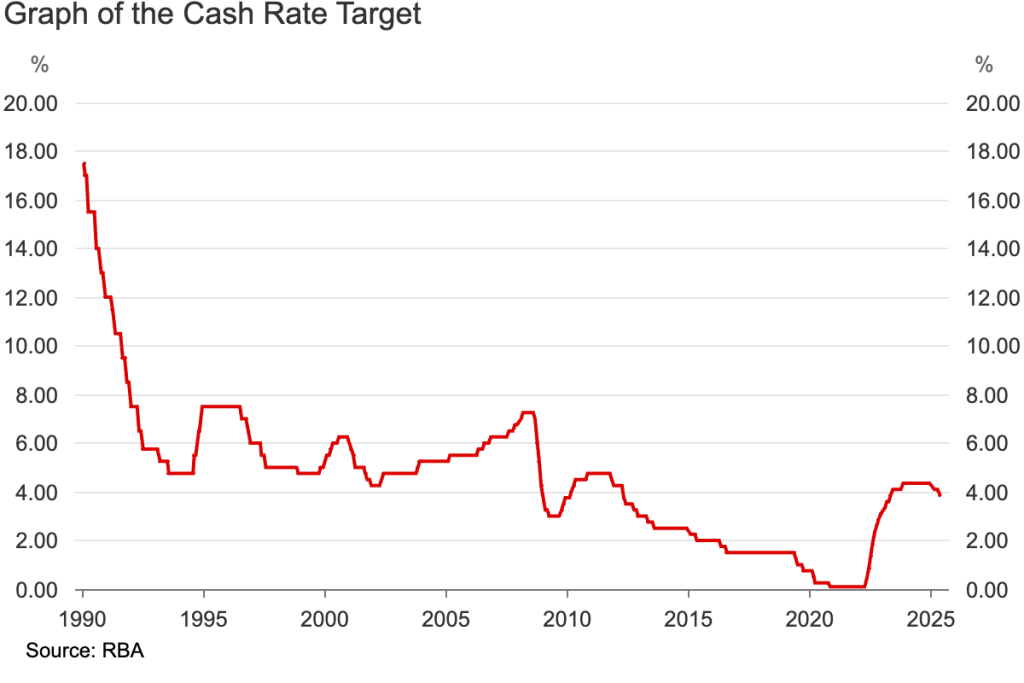
The Reserve Bank of Australia has today cut the cash rate by 25 basis points to 3.85%, amid falling inflation, tight labour markets, weak productivity, and softer GDP and CPI forecasts. The last time the cash rate was 3.85% was 3 May 2023.
At 2.9%, annual trimmed mean inflation was below 3% for the first time since 2021 and headline inflation, at 2.4%, remained within the target band of 2-3%.
Inflation has been falling since its peak in 2022, as higher interest rates bring aggregate demand and supply closer towards balance. The RBA says data on inflation for the March quarter provided further evidence that inflation continues to ease.
Saxo Chief Investment Strategist Charu Chanana calls it a “dovish rate cut, weighed down by a cocktail of global and domestic uncertainties”.
“While inflation has eased and labour markets remain tight, the board flagged slower real income growth, weak productivity, and softer GDP and CPI forecasts,” Chanana says.
“Uncertainty featured prominently in the statement – not just about geopolitics and trade, but also about how domestic demand, wages, and firm pricing behaviour will evolve from here.
“The AUD fell in response and, with the RBA sounding increasingly uneasy, the path of least resistance for the currency may remain lower – especially if domestic data softens further or global risks flare up again.”
The RBA stresses that the outlook remains uncertain.
“Uncertainty in the world economy has increased over the past three months and volatility in financial markets rose sharply for a time,” the RBA says.
“While recent announcements on tariffs have resulted in a rebound in financial market prices, there is still considerable uncertainty about the final scope of the tariffs and policy responses in other countries. Geopolitical uncertainties also remain pronounced.
“These developments are expected to have an adverse effect on global economic activity, particularly if households and firms delay expenditure pending greater clarity on the outlook. This has also contributed to a weaker outlook for growth, employment and inflation in Australia. That said, world trade policy is changing rapidly, thereby making the central forecasts subject to considerable uncertainty.”
Overseas developments aside, private domestic demand appears to be recovering, real household incomes have picked up, with the RBA stating there has been easing in some measures of financial stress.
“There are uncertainties about the outlook for domestic economic activity and inflation stemming from both domestic and international developments. While the central projection is for growth in household consumption to continue to increase as real incomes rise, recent data suggest that the pick-up will be a little slower than was expected three months ago,” the RBA says.
“There is a risk that any pick-up in consumption is even slower than this, resulting in continued subdued growth in aggregate demand and a sharper deterioration in the labour market than currently expected. Alternatively, labour market outcomes may prove stronger than expected, given the signal from a range of leading indicators.
“More broadly, there are uncertainties regarding the lags in the effect of monetary policy and how firms’ pricing decisions and wages will respond to the demand environment and weak productivity outcomes while conditions in the labour market remain tight.”
Write to Adam Orlando at Mining.com.au
Images: RBA & Stock


