

Military Metals (CSE:MILI) CEO Scott Eldridge says the company is excited about the momentum building in its projects and the growing recognition of antimony’s strategic role.
Eldridge says the company has renewed the meaning of the Tiennesgrund Antimony-Gold Project in particular, after completing a preliminary field and historical data review.
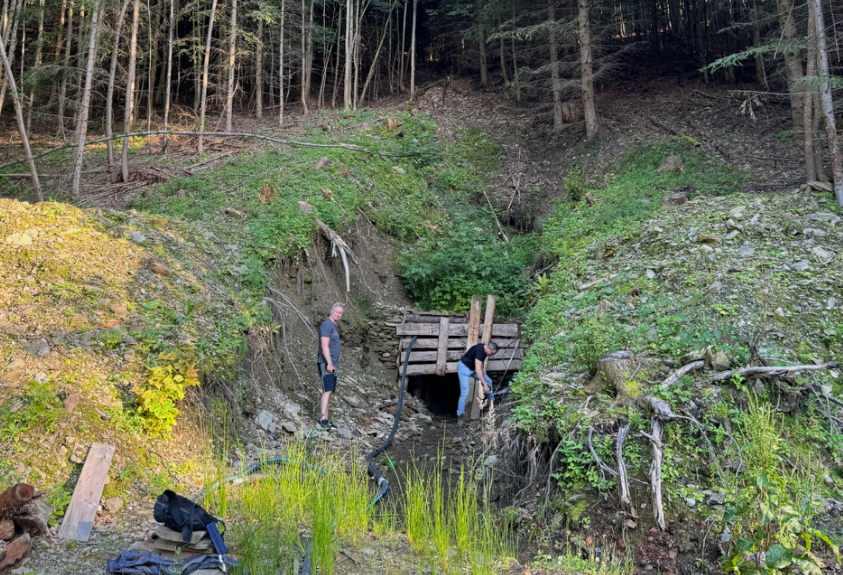
Last week, Military Metals visited the project in Slovakia in anticipation of a field campaign focused on structural controls of mineralisation so that drill targets can be accurately delineated. The upcoming program is expected to begin in October 2025, as reported by Mining.com.au.
Antimony is listed as a critical raw material under the European Union’s Critical Raw Materials Act, and Tiennesgrund has potential to support the continent’s ambition to secure domestic supply chains for essential minerals, Eldridge says.
“I am thrilled to report on my recent site visit to our Tiennesgrund project, where historical sampling has revealed impressive grades of up to 39.4% antimony and 9.69 grams per tonne gold,” the CEO says.

“These results, combined with consistent gold values in all antimony samples, point to tremendous potential in this under-explored district-scale property. I personally inspected the historical adits and mineralised dumps, which include reports of 26,000 tons grading 18-24% antimony from one adit alone.
“Our team is gearing up for a field program in early October, focusing on mapping structural controls to refine drill targets. This builds on robust historical data and aligns with Europe’s Critical Raw Materials Act, positioning us to support secure supply chains for industries like defense and renewables.
“Reflecting on my participation in the EIT RawMaterials Summit earlier this summer, the emphasis on strategic stockpiling and the absence of European antimony production reinforces the urgency of projects like Tiennesgrund. We’re proud to potentially contribute to addressing Europe’s antimony shortfall and strengthening regional resilience.”
Echoing recent market analysis, Eldridge notes China’s dominance in antimony mining and processing has left Western nations vulnerable, especially with export controls and geopolitical tensions on the rise.
He says the US stockpile is at critically low levels, heightening risks for military applications like munitions and night vision.
Amid this backdrop Military Metals is tackling this through a portfolio of historical assets in allied jurisdictions including the West Gore project in Nova Scotia, which produced 7,000 tonnes of 46% antimony concentrate during World War I, aiding the Allied effort; the Trojarova deposit in Slovakia, 3km from the historical Pezinok mine; and the Last Chance project in Nevada, with antimony production during WWI and WWII yielding an estimated 192 tons of metallic antimony by 1963.
“With prices at all-time highs and NATO increasing defense spending from 2% to 5% of GDP amid global conflicts, we’re committed to collaborating for supply independence,” Eldridge continues.
“Exploration companies like ours are vital for long-term solutions, and I believe coordinated North American and European efforts can achieve this in the next three to five years.”
The CEO adds that antimony is central to this revival, essential for hardening lead in bullets, primers, armor-piercing rounds, and more.
Military Metals is advancing ‘high-grade’ antimony projects in North America and Europe to establish secure, domestic, and allied supplies.
“By reducing import dependence, we’re fortifying national security and supporting the resurgence of American industrial strength,” Eldridge says.
“It’s time to channel that ‘industrial exuberance’ again. Let’s collaborate to rebuild resilient supply chains.”
Write to Adam Orlando at Mining.com.au
Images: Military Metals