


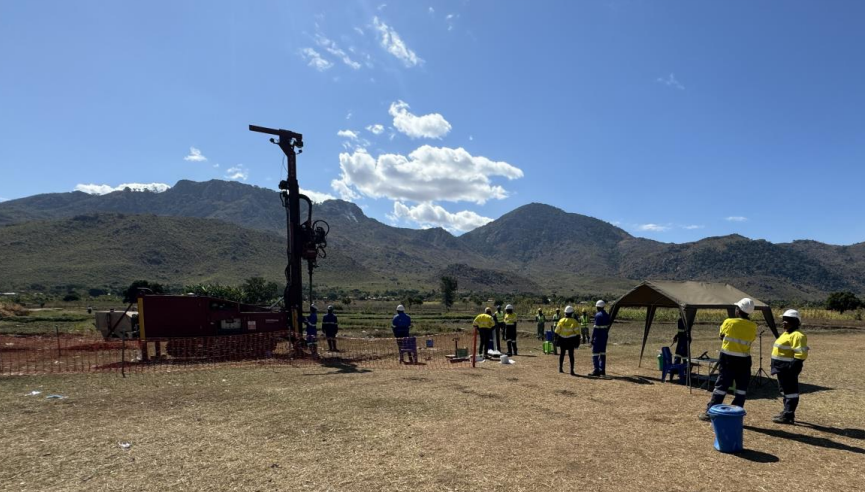
Chilwa Minerals (ASX:CHW) has provided updates on the ionic adsorption clay (IAC) deposit potential at its Lake Chilwa licence package in Southern Malawi.
Building on previous exploration, Chilwa is focusing on testwork to evaluate rare earth element (REE)-bearing clays beneath heavy mineral sands (HMS) and adjacent to hard rock targets.
Elevated aggregate rare earth oxide values were previously identified in composites from HMS drilling, with the basal clay horizon emerging as a possible additional source of mineralisation.
The company will use existing drill samples to test around 200 holes at the Mposa deposit, focusing on basal clay interviews. Assays and leach tests will evaluate grade distribution and extractability, allowing rapid progress without new drilling.
Managing Director Cadell Buss says that the work completed strengthens the company’s understanding of the mineralised system at Lake Chilwa.
“While the presence of rare earths within the HSM was expected due to monazite, rare earth values within the basal clay horizons suggests a contribution from other potential REE sources,” Buss says.
“This supports our view that a component of the rare earth assemblage is derived from secondary processes operating within the basin, rather than being solely locked up in discrete heavy minerals.
“Importantly, further information may be generated from existing drilling and sample material, allowing us to advance our rare earth understanding in a disciplined and cost-effective manner.
“The next phase of work will focus on further characterising the basal clay units and assessing their potential through targeted analysis and test work.”
Chilwa Minerals is focused on the Critical Minerals Project, comprising mineral sands and rare earths, at the Lake Chilwa project in southern Malawi.
Rare earth elements are actually found in abundance but are often difficult to find in a pure form. Of the entire suite of nearly indistinguishable silvery-white soft metals, neodymium, praseodymium, dysprosium, and terbium account for the lion’s share (roughly 80-90%) of the rare earths market value.
China currently controls about 70% of REEs mining and about 90% of refining, which creates structural vulnerability for Western original equipment manufacturers (OEMs), as reported by Mining.com.au.
The European Union has set 2030 targets for domestic extraction (10%), processing (40%), recycling (25%), and a cap of less than or equal to 65% reliance on any one country.
Barclays research estimates global rare earth demand will surge six-fold by 2050 due to the anticipated scale-up of electric vehicles, wind turbines, and other clean technologies.
Write to Amy Rotman at Mining.com.au
Images: Chilwa Minerals


