
MDF Global MDF Global
Apple’s iPhone boom highlights critical minerals powering smartphones•Presenting a united front for Queensland’s copper sector•Thailand seeks Myanmar mine access amid arsenic pollution•Egypt to set up state-backed company to license artisanal gold miners, free detainees•Brixton closes $7.4 million raise for Thorn, Langis projects•Heliostar banks record $78.7 million for Ana Paula push•Mining giants bet billions on 2030 supply crunch•Gunnison Copper reports Q3 output, revenue surge•Triumph Gold targets $15.46 million for Yukon push•African Rainbow Minerals faces a jobs dispute at Nkomati mine•Angola seeks 10% stake in De Beers under Anglo’s proposed exit•Gold price rebounds but heads for biggest weekly loss since June•Teck copper strike reaches BC port as operator sues union•Copper benchmark rocked by miner-smelter tug-of-war•Zimbabwe mining bill targets community, environmental safeguards•Mount Isa critical minerals hub secures Feasibility Study funding•Eramet initiates $814.5 million capital raise to reduce debt•Richemont backs natural gemstones, declines De Beers comment•‘Tis the season for administration as Comlek falls a second time•OceanaGold Philippines trials wireless blasting at Didipio mine Apple’s iPhone boom highlights critical minerals powering smartphones•Presenting a united front for Queensland’s copper sector•Thailand seeks Myanmar mine access amid arsenic pollution•Egypt to set up state-backed company to license artisanal gold miners, free detainees•Brixton closes $7.4 million raise for Thorn, Langis projects•Heliostar banks record $78.7 million for Ana Paula push•Mining giants bet billions on 2030 supply crunch•Gunnison Copper reports Q3 output, revenue surge•Triumph Gold targets $15.46 million for Yukon push•African Rainbow Minerals faces a jobs dispute at Nkomati mine•Angola seeks 10% stake in De Beers under Anglo’s proposed exit•Gold price rebounds but heads for biggest weekly loss since June•Teck copper strike reaches BC port as operator sues union•Copper benchmark rocked by miner-smelter tug-of-war•Zimbabwe mining bill targets community, environmental safeguards•Mount Isa critical minerals hub secures Feasibility Study funding•Eramet initiates $814.5 million capital raise to reduce debt•Richemont backs natural gemstones, declines De Beers comment•‘Tis the season for administration as Comlek falls a second time•OceanaGold Philippines trials wireless blasting at Didipio mine
ASX stocks

ASX works its way to two-month high

The Australian Securities Exchange (ASX) hit a high note today (29 April) after US President Donald Trump walked back tariffs on some auto part imports. 

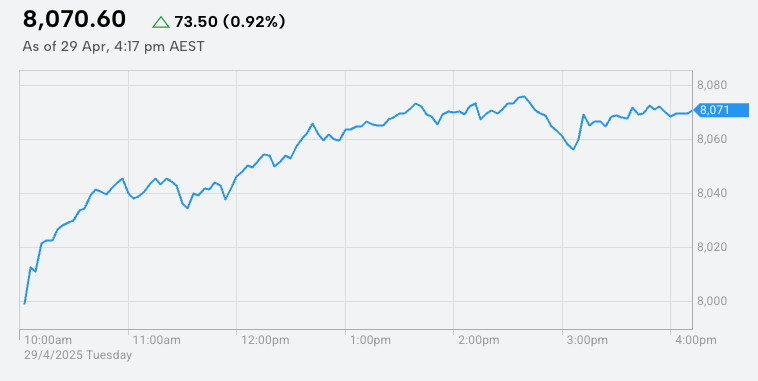
The S&P/ASX200 climbed to over 8,076 points by mid-afternoon (AEST), marking its highest level in the past two months.

By the closing bell it was sitting up 73.5 points, or 0.92%, at 8,070.6 points. Over the last five days the index has gained 3.25%, but is down 1.08% year to date.

Ten of the 11 sectors finished the session in the green, led by energy with a 2.3% rally. Utilities advanced 2.01%, materials climbed 1.37% and industrials lifted 0.99%. 

Uranium producer Boss Energy (ASX:BOE) finished in top spot with a gain of 14.29% to close at $3.20.
Mineral Resources (ASX:MIN) came in a close second with a 13.15% surge to $20.57 despite telling investors it is cutting its FY25 production guidance for the Onslow Iron Ore Project and reporting an increase in costs and debt. 

The diversified miner now expects to produce 8.5-8.7 million tonnes from the operation in FY2025 – down from the 8.8-9.3 million tonnes expected previously, while debt has risen to $5.4 billion.  

The top five of the S&P/ASX 200 was dominated by the uranium miners, with Deep Yellow (ASX:DYL) climbing 11.71% to $1.15 and Paladin Energy (ASX:PDN) rising 8.5% to $6.13.

Northern Star Resources (ASX:NST) remained the worst performing stock for the day, losing 4.74% to close at $19.88 after cutting its FY25 production target and increasing its cost guidance.

The gold miner now expects gold output to come in at between 1.63 and 1.66 million ounces at a cost of $2,100 to $2,200 an ounce. The previous target was for 1.65 to 1.8 million ounces at a cost of $1,850 to $2,100 an ounce.

The S&P/ASX200 is Australia’s leading share market index and contains the top 200 ASX-listed companies in terms of market capitalisation, and accounts for about 80% of the country’s equity market. The index is designed to measure the performance of the 200 largest index-eligible stocks listed on the ASX by float-adjusted market capitalisation.

It is recognised as the institutional investable benchmark in the country.

Write to Angela East at Mining.com.au 

Images: ASX

Add to Watch List:
Author Image
Written By Angela East
Content Director Angela East is an experienced business journalist and editor with over 15 years spent covering the resources and construction sectors and more recently working as a communications specialist handling media relations for junior resources companies.