


Australian employment growth was weaker in October, however ANZ analysts say it remains at levels consistent with inflation ultimately returning to the Reserve Bank of Australia’s 2-3% target.
Employment grew by 15,900 in October compared to 61,300 in September. The unemployment rate remained at 4.1%, but was up around 5 basis points from September’s 4.1% print, according to ANZ senior economist Adelaide Timbrell.
A 0.1 percentage point fall in female participation in the workforce pushed overall labour force participation to 67.1%.
“Our preferred measure of labour market tightness (FTE-pop) was stable over the month and remains at levels consistent with inflation ultimately returning to the RBA’s 2-3% target band,” Timbrell says.
“We still expect the first rate cut to occur in February 2025, with risks tilted to a later start to the easing cycle.
“While the labour market is still resilient, the very slight easing this month as well as the lower-than-expected wage print yesterday may make it easier for the RBA to start unwinding the restrictiveness of the cash rate.”
The S&P/ASX 200 closed up 30.60 points, or 0.37%, to 8,224 points by the closing bell on Thursday (14 November).
The index is virtually unchanged over the past five days, but is currently 1.91% below its 52-week high.
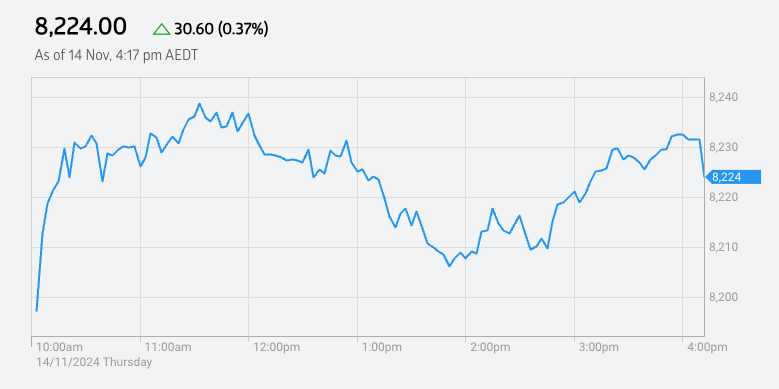
Seven of the 11 sectors ended higher, however materials continued its run down, closing 1.02% lower, while energy slipped 0.64%.
Gold miners are still struggling to find momentum, filling four of the bottom five spots. West African Resources (ASX:WAF) tumbled 7.22% to $1.38, Vault Minerals (ASX:VAU) slid 5.30% to $0.31, Ramelius Resources (ASX:RMS) retreated 4.93% to $1.93 and Northern Star Resources (ASX:NST) dipped 4.78% to $15.75.
The gold price managed to find a northern trajectory only briefly yesterday before resuming its descent. It was trading at around US$2,567 on Thursday afternoon.
The S&P/ASX200 is Australia’s leading share market index and contains the top 200 ASX-listed companies in terms of market capitalisation, and accounts for about 80% of the country’s equity market. The index is designed to measure the performance of the 200 largest index-eligible stocks listed on the ASX by float-adjusted market capitalisation
It is recognised as the institutional investable benchmark in the country.
Write to Angela East at Mining.com.au
Images: ASX & Stock