


This article is a sponsored feature from Mining.com.au partner ABx Group. It is not financial advice. Talk to a registered financial expert before making investment decisions.
ABx Group’s (ASX:ABX) partnership with mining giant Rio Tinto (ASX:RIO) is a prime example of the interest a junior can attract if it has the right project or technology.
In mid-January, the $9 million small cap inked an agreement with $44 billion Rio Tinto that opens doors for ABx’s 83% owned refining technology subsidiary ALCORE.
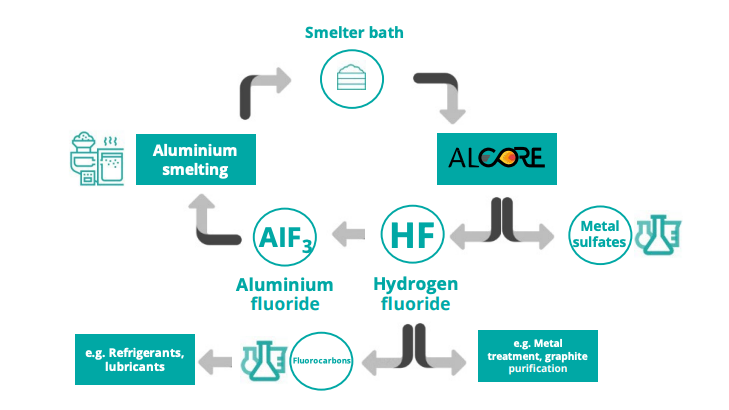
ALCORE has developed a process to recycle fluorine waste into industrial chemicals from aluminium smelter waste.
One of these industrial chemicals is hydrogen fluoride, for which the main applications are to produce fluorocarbons and aluminium fluoride. Hydrogen fluoride is also increasingly used in the manufacturing process for lithium-ion batteries.
ALCORE plans to combine the hydrogen fluoride with aluminium hydroxide via an existing commercial process to produce aluminium fluoride – an essential chemical for aluminium metal production.
Hydrogen fluoride is mainly produced from fluorspar, which is obtained from the mineral fluorite.
Fluorspar is relatively high cost and has been identified as a critical material by the US, Europe, Japan and Canada. It has also been dubbed the “quiet achiever of the lithium-ion battery boom” by Benchmark Minerals.
Australia does not mine any fluorite, or produce any fluorspar, hydrogen fluoride or aluminium fluoride, and imports all its requirements.
Around 1.2 million tonnes of aluminium fluoride is produced globally each year worth US$1.5 billion ($2.38 billion).
Australia is the largest producer of primary aluminium metal without its own domestic aluminium fluoride production, so aluminium smelters in the country rely entirely on imported aluminium fluoride. Over 80% of that supply comes from China.
Most modern aluminium smelters produce excess bath, which contains about 50% fluorine, for which the only meaningful market is new smelters, which require bath to commence operations.
Market watchers suggest that the global bath market will increasingly be in surplus because far fewer new smelters are being built. It is estimated that the global aluminium smelting industry produces a 300,000-tonne surplus of bath annually.
Addressing a critical supply gap
ABx says all the major global aluminium producers are eager for alternative applications for excess bath, to avoid the unpalatable options of on-site storage or landfill.
“Typically, to capture the attention of a customer, you have to solve a problem for them,” Managing Director Dr Mark Cooksey tells Mining.com.au.
“From the beginning of interactions with Rio Tinto, we confirmed that we could address two of their problems: an application for their smelter bath waste and a domestic source of aluminium fluoride.
“Most aluminium smelters around the world have a similar issue with the bath waste, and our discussions with numerous smelters continue.”
Besides aluminium fluoride for aluminium smelting, other traditional markets include hydrochlorofluorocarbons for refrigerants, hydrogen fluoride for metal treatment and polytetrafluoroethylene for wire insulation and bearings.
Demand is also increasing for fluorine use in lithium-ion batteries and graphite purification.
The US Department of Energy (DoE) forecasts that from 2025 to 2035, fluorine demand for energy applications will increase from 5% to 22% of total fluorine demand.
The department says the increase will be driven by fluorine’s use in lithium-ion batteries, with electric vehicle batteries representing the most dominant sub-technology and accounting for 19% of the total demand.
Fluorine demand this year is tipped to exceed current production capacity by 1-4%, according to the DoE forecast. By 2035, demand is forecast to exceed current production capacity by 40-70%.
Since the emergence of Alcore in 2019, ABx has engaged with numerous suppliers and customers in the aluminium fluoride value chain.
“In the case of Rio Tinto, the relationship grew and eventually led to the support now being provided,” Cooksey notes.
In mid-January ABx inked a lease agreement with Rio Tinto Aluminium for an industrial facility adjacent to the Bell Bay aluminium smelter in northern Tasmania.
The road to commercialisation
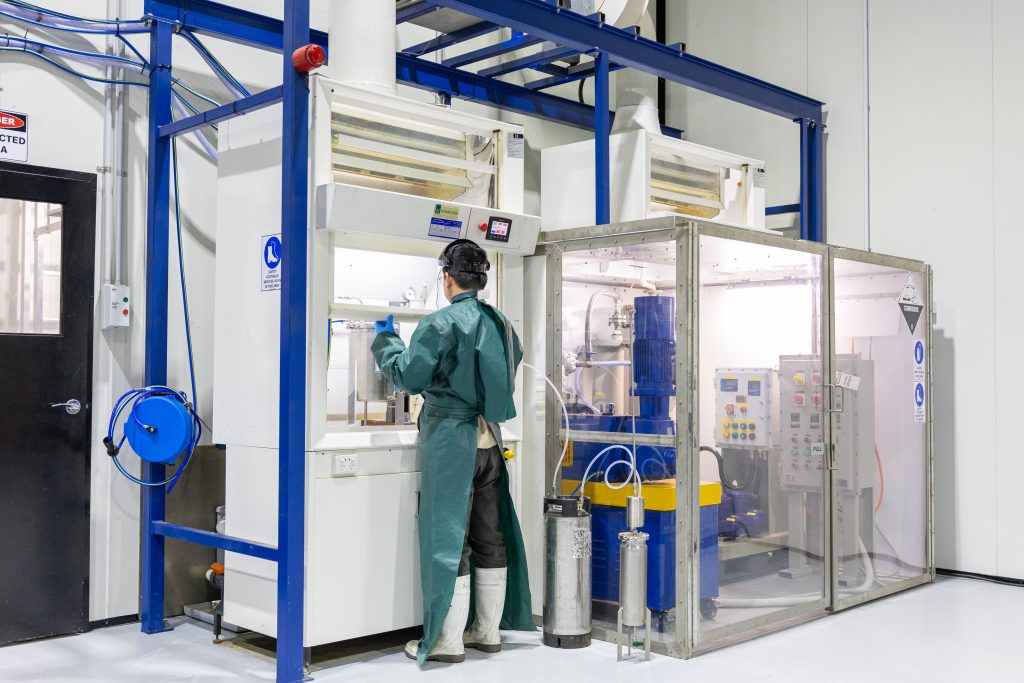
ALCORE will establish a pilot plant at the facility, which comprises a 500m2 building on an industrial site and offers access to local engineering services and suppliers in Bell Bay.
Cooksey says there are several aspects to the partnership with Rio Tinto.
“The first is that Alcore is getting access to an ideal facility for its pilot plant at a reduced rate,” he tells this news service.
“The second is that ALCORE can use bath waste from the Bell Bay aluminium smelter in its pilot plant. Thirdly, the co-location offers the potential for technical exchange via personnel working on each site.
“And finally the close partnership will facilitate negotiations on commercial terms for when the commercial plant is in operation.”
Cooksey adds that the partnership is significant because it enhances the supplier-customer relationship.
“As this is a circular economy solution, Alcore and Rio Tinto are each a supplier to each other,” he says.
“The location next to the Rio Tinto Bell Bay smelter is significant because it facilitates close interaction by numerous staff from both ALCORE and Rio Tinto. This should lead to more innovation and faster progress.”
Additionally, the Tasmanian Government has provided indicative terms and conditions for a $1 million conditional loan to Alcore to support the construction and operation of the continuous pilot plant.
The Australian Government is also backing the project and in 2022 committed $7.6 million by way of a grant under its Modern Manufacturing Initiative.
There are only a very small number of efforts globally to investigate reprocessing of aluminium smelter bath, according to Cooksey.
“There is no commercial technology and we believe that we are the closest to commercial production,” he says.
The process to produce hydrogen fluoride has been operated at pilot scale in a batch reactor. The next stage is to construct and operate a bath continuous pilot plant, which is due to be built this year followed by commissioning in early 2026.
The aim of the continuous pilot plant is to assist with the selection of reactor designs and process conditions for the commercial plant and produce saleable hydrogen fluoride for evaluation by customers.
Once the process is demonstrated at pilot scale, it will take about 12 months to build a commercial plant.
Write to Angela East at Mining.com.au
Images: Mining.com.au & ABx Group