



Sprott Asset Management has launched an “at-the-market” equity program to issue up to an additional US$500 million of trust units via its Sprott Physical Copper Trust (TSX:COP.UN).
The Sprott Physical Copper Trust is a closed-ended trust created in June 2024 to invest and hold substantially all of its assets in physical copper metal.
Sprott Asset Management CEO John Ciampaglia says the Sprott Physical Copper Trust is the world’s first physical copper investment vehicle.
“The trust was created to provide investors with an alternative to rolling copper futures and a complement to investing in copper mining equities,” he says.
Sales of units from the Sprott Physical Copper Trust will be made through issuances on the Toronto Stock Exchange or other existing trading markets in Canada at the market price prevailing at the time of each sale.
These sales will be carried out by agents – including Cantor Fitzgerald Canada, Virtu Canada, Canaccord Genuity and BMO Nesbitt Burns – that will only sell units on marketplaces in Canada.
The trust will use the cash raised from the program to buy physical copper.
“Copper is an increasingly important metal in an era of growing energy demand, electrification and the adoption of new copper-intensive technologies,” Ciampaglia says.
In June, Sprott Asset Management market strategist Paul Wong and ETF product manager Jacob White said a new “copper supercycle” is emerging, built on several rising geopolitical and market trends, including electrification, national security concerns, environmental policy, supply constraints and deglobalisation.
“In combination, these are a powerful catalyst for copper demand,” they say.
“Copper demand is surging due to the global push towards electrification, which covers a wide array of technologies and initiatives. EVs are a major factor, they require about 2.4 times more copper than a traditional car.
“Renewable energy sources like solar and wind power, which are expanding rapidly, need large quantities of copper for turbines, solar panels and electricity infrastructure. The electrification of public transport systems also fuels the demand for copper.”
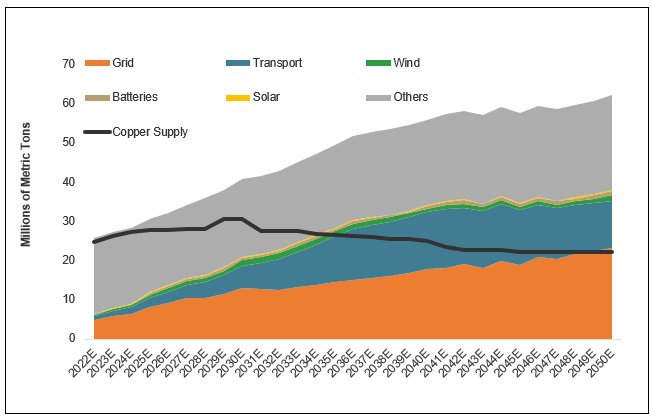
At the same time, new supply lags behind the rapidly growing demand.
Wong and White say developing a new copper mine is lengthy and expensive, often taking over a decade from exploration to production.
“These projects increasingly face stringent environmental regulations and community resistance, complicating development in major copper-mining regions,” they say.
“The mining sector has also seen long periods of underinvestment due to the cyclical nature of commodity markets. The long run of low copper prices has meant reduced exploration budgets and fewer discoveries.
“As demand ramps up and consistently outstrips supply, sustained higher prices should characterise the copper market.”
The copper price is up around 20% since mid-January 2024 at US$9,915 ($14,718) a tonne. It hit a high of US$10,889 in May this year.
Write to Angela East at Mining.com.au
Images: iStock, Sprott Asset Management


