



Shares in RareX (ASX:REE) have soared after the company signed a deal to acquire the niobium-enriched Khaleesi Project in Western Australia and finalised a $1.5 million capital raise.
As of 11:06am, shares in RareX were up 35.71% to $0.019.
Consisting of one granted and five pending tenements, the project covers 966km2 in the Eastern Yilgarn region, along strike from the Ponton Dyke — which RareX says has returned “some of Australia’s best rare earths intersections” — and AngloGold Ashanti’s (NYSE:AU) Tropicana Gold Mine.
Although Khaleesi has been the subject of previous drilling, half of the holes were only assayed for gold, rather than niobium and rare earths. Those that were assayed showed broad areas of niobium mineralisation up to 1,000 parts per million.
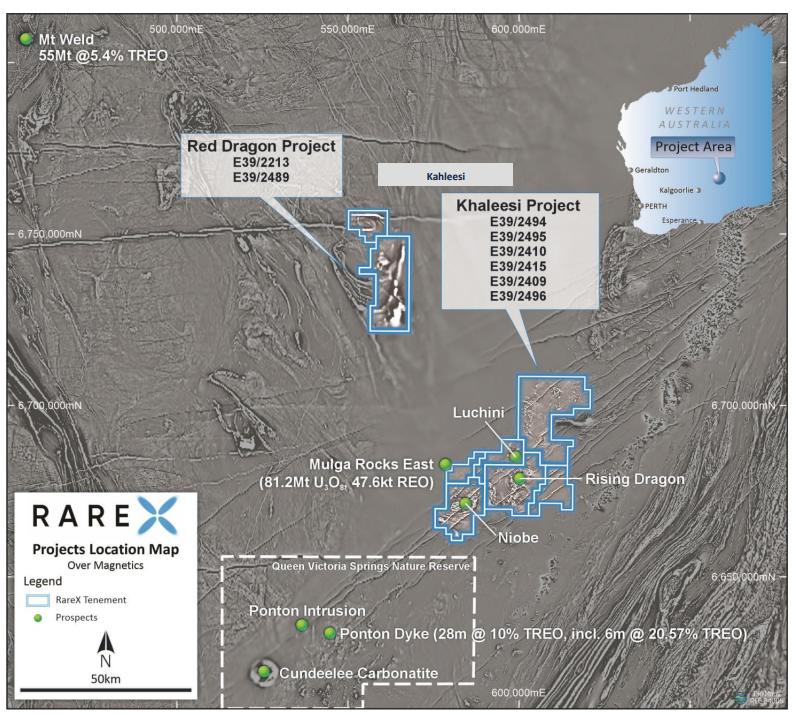
A review of existing data by Perth-based consultant Resources Potentials pointed to a 20km-wide alkaline intrusive complex at the Khaleesi Project, with the same age profile as Lynas Rare Earths’ (ASX:LYC) Mt Weld Project. Data from more than 10,000m of shallow drilling indicates the potential for niobium-enriched carbonatites within that wider intrusion.
RareX says there are two targets that stand out for initial exploration — Luchini and Niobe.
The Luchini target sits in an area that saw around 10,000m of drilling completed by AngloGold Ashanti between 2006 and 2014. Many holes at the southern portion of the prospect showed elevated niobium, which is thought to be coincident with a uranium anomaly identified by radiometric survey data.
The Niobe target, meanwhile, consists of two drill lines — roughly 2km apart — on either side of a magnetic low. Like Luchini, past drilling work returned elevated niobium and rare earth mineralisation.
“The new Khaleesi Project is well endowed with geological data from large-company programmes that were mainly gold-focused and never properly tested or evaluated the extensive niobium anomalies and rare earth potential,” CEO James Durrant says.
“Through our due diligence we’ve identified the opportunity for a district-scale niobium project and will immediately commence a highly targeted exploration program.”
Under the terms of the agreement, RareX will pay $100,000 in cash and issue more than 9.8 million shares worth roughly $137,000 to two vendors, Beau Resources and Sustainable Minerals. Three of the six tenements will also include a 2% royalty, with certain buy-back conditions.
The deal comes as RareX closes the book on a $1.5 million capital raise that saw 107 million shares issued to new and existing investors at $0.014 each. The shares, which came at no discount, will be issued to two tranches.
Subject to shareholder approval, a number of RareX directors have subscribed for $150,000 worth of new shares.
The proceeds will be used to fund the exploration and development of both Khaleesi and the Cummins Range Project to the north of WA.
Write to Oliver Gray at Mining.com.au
Images: RareX


