

This article is a sponsored feature from Mining.com.au partner Rua Gold. It is not financial advice. Talk to a registered financial expert before making investment decisions.
New Zealand has substantial resources but until recently has not attracted the same level of attention as other mining jurisdictions, which provides plenty of untapped opportunity.
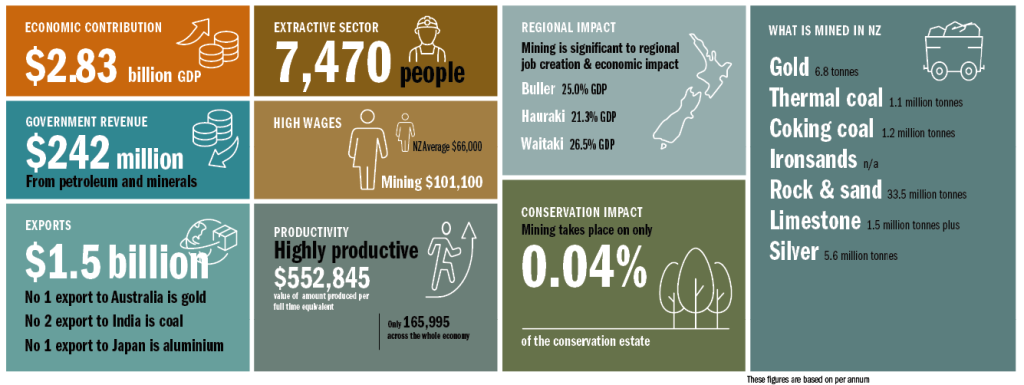
Mining contributed only just over 1% to the country’s US$260 billion ($398 billion) gross domestic product in 2024, but is growing in significance as other mining jurisdictions become too crowded, mined out or difficult to navigate from a regulatory perspective.
New Zealand did not previously rank among the top mining nations globally, however its new pro-mining policies have had a hand in propelling it to number 12 in terms of investment attractiveness in the Fraser Institute’s Annual Survey of Mining Companies 2024, up from 43rd position in the previous year.
Last year, the government introduced the Fast-track Approvals Act, which was designed to streamline and accelerate the approvals process for projects that would deliver regional and national benefits.
The government is also targeting a doubling of its mining exports to $3 billion over the next decade.
This improved landscape prompted Rua Gold (TSX-V:RUA) to position itself as the dominant landholder in New Zealand’s past producing Reefton Goldfield, located on the South Island.
Rua was a first mover, announcing that it was entering the region long before a change in government in October 2023 – ultimately the catalyst for the mining sector re-think.
The company was born from the reverse takeover of Reefton Goldfields by First Uranium Resources which was announced in July 2023.
The tie-up was completed in February 2024 and by July of the same year, Rua revealed its $22 million play for Siren Gold’s (ASX:SNG) Reefton assets, which gave the company control of 120,000 hectares of ground in this historical goldfield.
The Reefton district historically produced over 2 million ounces at grades of between 9 and 50 grams per tonne.
Federation Mining success fuels district optimism
Rua said in July the goldfield was seeing a resurgence in interest, led by the construction of Federation Mining’s Blackwater mine, which is expected to enter production in 2026 producing 65,000 ounces each year at all-in sustaining costs of $1,625 per ounce.
CEO Robert Eckford says the company owns 95% of the land surrounding Federation Mining’s operations.
“They’ve got a resource underneath the old workings. That’s 800,000 ounces at 24 grams a tonne. So super high grade, currently a resource and they’ve raised $225 million off Aussie super to develop that mine,” he explains.
“If these guys have raised $225 million, they’ve found 800,000 ounces of 24 gram-a-tonne material, what does it look like for an entire district scale play? That’s what we’re uncovering for Reefton.”
Rua also has a foothold in a second gold district in New Zealand – the Hauraki Goldfield on the North Island which historically produced 15 million ounces of gold and 60 million ounces of silver at grades of between 15 and 30g/t.
At Reefton, Rua is targeting orogenic gold deposits, while at Hauraki the target is epithermal gold. Both deposit styles are known to host some of the highest gold grades globally.
Reefton, nicknamed ‘The Town of Light’ because it was the first town in New Zealand and the southern hemisphere to have a public electricity supply and electric street lighting, was the site of a gold rush that started in the 1860s.
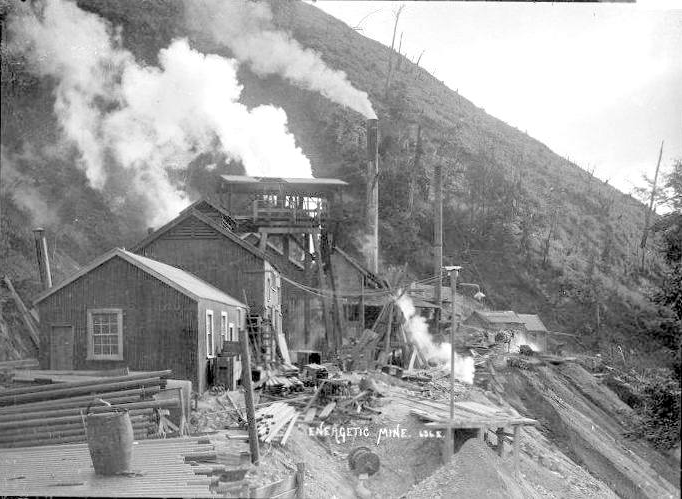
Eckford says exploration and mining came to a standstill around the 1950s and there has not been a “decent exploration campaign” since then.
“It stopped only because they didn’t have the technology to go to the depths that we have underground mines today,” he tells Mining.com.au.
“So, you’ve got these shallow historical underground mines, the deepest they go to is around 500-600m and they’ve never been explored under that.
“That’s the opportunity here, you’ve got an entire district-scale play – 120,000 hectares – and you know there’s gold there already, it’s just a question of how much gold is left.”
From historic boom to modern revival
Interestingly, Rua has ties back to the original gold rush of the 1860s, with Chairman Oliver Lennox-King’s great grandfather having bankrolled the initial rush.
“He’s got a whole generation of original gold hunters down in that Reefton district, and now this is a really personal project for him,” Eckford explains.
The rest of the management team also has runs on the board when it comes to New Zealand and building mines.
Collectively, the team has raised over $2.2 billion in capital, taken eight mines through to production, amassed over 150 years of experience in gold mining projects and generated more than $11 billion in value via strategic exits.
“We’ve all started our own successful gold mining companies in the past,” Eckford tells this news service.
“They’ve all been to the point of billion dollar-sized companies and we’ve sold them and had some success. Now we’ve come together with the sole focus of doing the same thing in New Zealand.”
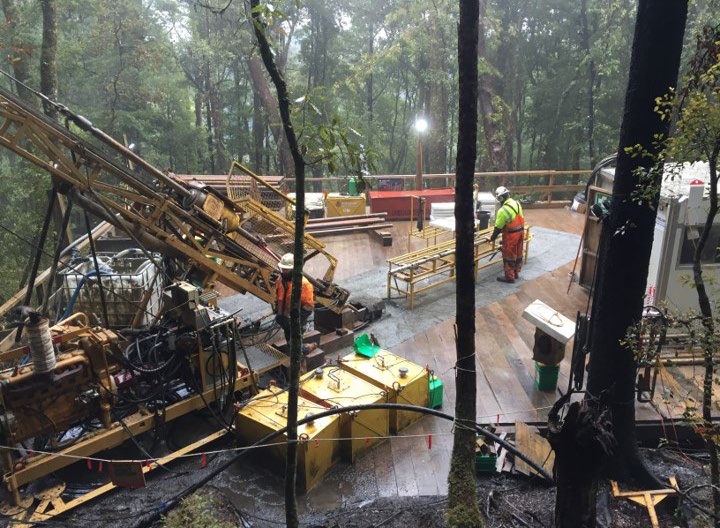
With $14 million cash in the bank, Rua has mapped out a fully funded 12-month exploration program that includes an expanded drilling program for the Reefton Project.
A third drill rig is being mobilised to accelerate exploration, with 4,000m of diamond drilling planned for Auld Creek over the next four months to expand the current inferred resource to between 300,000 and 500,000 gold-equivalent ounces by the end of this year.
Two rigs will be utilised at Auld Creek, where in June Rua reported top intercepts including 2.1m @ 64g/t gold equivalent, comprising 5.5g/t gold and 13.1% antimony, from 310m – 120m below the existing resource.
Eckford views the antimony as an “amazing kicker on the side”, particularly given the commodity is on the critical minerals lists of multiple countries and the price has jumped more than sixfold in the past two years.
“It’s now $60,000 a tonne and we’re seeing really high-grade antimony all the way through Auld Creek,” he notes.
“We talk about 12m @ 12g/t – that’s 2g/t gold and 2.5% stibnite, so very similar to what you see over in Victoria in the Bendigo/Ballarat region.”
Antimony joins gold as critical Kiwi resource
Earlier this year, the New Zealand Government released its first ever Critical Minerals List that featured both antimony and gold. China is the only other country to list gold as a critical mineral.
At the launch, Resources Minister Shane Jones pointed to gold and antimony in the Reefton Goldfield as being one of the key focus points of the critical minerals strategy for New Zealand.
“A firm known as Rua, who are a gold mining outfit, however they are getting closer and closer to uncovering a very rich vein of antimony, a highly sought after critical mineral with worldwide significance,” Jones said a few months later.
Jones, who labels himself “pro-mining minister”, is very active at mining conferences – including the International Mining and Resources Conference in Sydney and Prospectors & Developers Association of Canada convention in Toronto – to promote New Zealand as “open for business”, according to Eckford.
Rua says it is sitting on the vast majority of New Zealand’s antimony inventory.
Rock chips have been found in several areas across the Reefton district with grades up to 40.3% antimony and 74.3g/t gold. It is common for high-grade gold and stibnite (antimony ore mineral) to be co-located, with the stibnite often used as a pathfinder for gold.
The third rig will focus on high-grade gold shoots at Cumberland, where drilling has previously returned intersections including 1m @ 26.9g/t from within a broader intercept of 14m @ 3.4g/t. The Cumberland-Galant deposit sits 3km south of Auld Creek.
Rua’s Glamorgon Project in the Hauraki Goldfield, meanwhile, is more of a ‘nearology’ story, sitting just 2.8km north of OceanaGold’s (TSX:OGC) Wharekirauponga Project, which has probable reserves of 4.1 million tonnes @ 9.2g/t for 1.21 million ounces of gold.
The Wharekirauponga Project, which is going through the six-month fast track permitting process now, also has an indicated resource of 2.42 million tonnes @ 17.9g/t for 1.4 million ounces of gold and an inferred resource of 1.9 million tonnes @ 9.8g/t for 600,000 ounces of gold.
Rua’s Glamorgan Project spans 15,000 hectares and has all the same surface features as Wharekirauponga, according to Eckford.
“It has never been touched before, so it’s a bit more greenfields. There are no historical workings that we’re chasing there but all the signs that we see are of major epithermal gold-silver deposits,” he says.
Drilling in the Hauraki Goldfield is slated to begin by October-November this year.
Write to Angela East at Mining.com.au
Images: Mining.com.au, New Zealand Minerals Council & Rua Gold