

This article is a sponsored feature from Mining.com.au partner Renegade Exploration. It is not financial advice. Talk to a registered financial expert before making investment decisions.
What’s next for a company poised between copper, gold, and a looming opportunity?
Renegade Exploration (ASX:RNX) finds itself at a crossroads. From its origins in North West Queensland – underpinned by copper, gold, and critical minerals prospects – to its emerging US presence, the ASX-listed junior explorer is laying tracks for what could be its most transformational phase yet.
Renegade is building momentum across two continents. Through various deals, including acquisitions, farm-in agreements, and joint ventures, the company is piecing together a diversified portfolio that balances near-term discovery potential with strategic optionality.
But the often-overlooked Yukon Project in Canada – long considered a legacy asset – could yet surprise as assays, geophysics, and regional comparables begin to line up in its favour.
With a strategy emerging from the “legacy assets” to more nimble, opportunity‐driven exploration, Chairman Robert Kirtlan unpacks where Renegade now stands, and what may unfold in the coming 12-18 months.
When Kirtlan and his team assumed control of Renegade, they inherited assets such as the Andrew Zinc deposit in the Yukon in Canada, that initally proved hard to monetise due to market, geological, and logistical challenges.
The company’s pivot since has been clear – focus on copper and gold, especially when paired with critical mineral upside, and hone in on geologically prospective provinces, particularly in the US.
“About three, four years ago we made a decision that we really liked gold and we really liked copper – and also anything around that critical mineral space that we maybe tripped over because it’s not an easy space,” Kirtlan tells Mining.com.au.
“But we did the deal to get a foothold into North West Queensland, a proven mineral province with some very big, world-class mines – Mount Isa itself, Ernest Henry, Cannington, and others. And then a lot of secondary tier-two, tier-three mines as well.
“So that was our focus. We put together our first deal where we farmed into a project to the north of Mount Isa, which we call the North Isa Project. We then did our second deal with Glencore (LSE:GLEN) on the Carpentaria joint venture.”
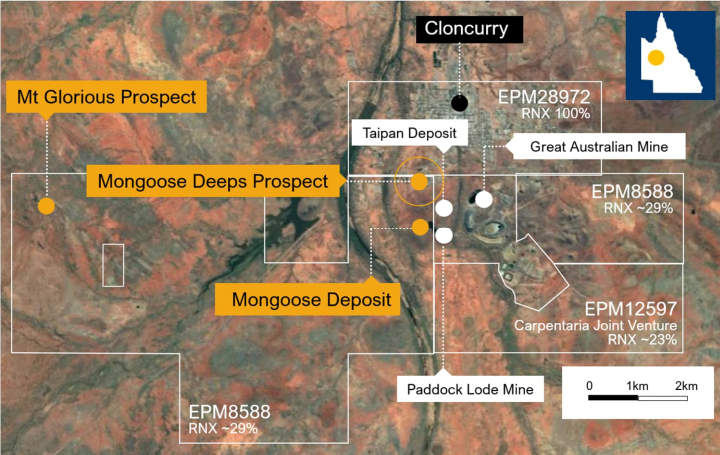
In Queensland, Renegade has established a solid base via the North Isa Project, the Cloncurry area, and the Carpentaria joint venture.
Renegade has a 23% interest in the Carpentaria JV, which covers a package of advanced copper and gold projects in Queensland’s Cloncurry mining district.
Its operating partner is Mount Isa Mines (a subsidiary of Glencore). Renegade did a deal to sole fund EPM8558 (36% Renegade), which it neighbours the Great Australia Mine, and has defined a resource on Mongoose.
Kirtlan says historical work, option agreements, drilling, and data compilation are giving shape to what used to be loosely defined potential.
But much has changed since Kirtlan and his team have come on board. When asked why investors should choose Renegade over other juniors, the Chairman leans on diversification and opportunism.
“I think it is our diversity … we’ve always got open eyes to opportunities. The fact that we’ve made that step, we’ve gone there … on a multi-prong front around base metals, gold, silver, critical minerals,” the Chairman tells this news service.

A finance guy’s approach
Unlike many junior leaders with purely geological backgrounds, Kirtlan brings an investment banking pedigree, having worked in New York and Sydney. This lens means M&A, joint ventures, and opportunistic acquisitions are core to Renegade’s strategy.
However, with 35 years in the resources sector and many of them arranging equity and debt financing for junior and major mining companies under his belt, Kirtlan knows success comes from both deals and drilling holes in the ground.
Also bear in mind he did time in the industry both at the coal face and in offices around juniors in Perth in 1980s. He’s not ignorant of the risks – exploration is high variance and less than 1% of asset projects ever become mines.
“The moral of the story at the junior end,” Kirtlan notes, “is we’re out there drilling holes trying to find the next big one.”
“The moral of the story at the junior end is we’re out there drilling holes trying to find the next big one”
“Often you don’t, but smaller discoveries still carry value. If you can trade them, trade them. If development makes sense, pursue it. But you always need to be able to pivot.”
That humility underlines Renegade’s posture. Moving cautiously, not overextending, and always keeping optional exits in mind – be it JVs, offtake, sale or development.
As such, Renegade’s structure – anchored by its copper base in Queensland but flexible into US and Canada gold and critical minerals domains – gives it a buffer against single-asset binary failure.
This pragmatism is evident in Renegade’s deal flow. Rather than blanket-pegging ground for optionality, the company targets specific geological trends, avoiding the dilution and cost of carrying uneconomic claims.
In Arizona, for instance, Renegade has resisted inflated vendor pricing and is working to structure a fair deal for a rare earths asset. If the vendor won’t move the deal will not close.
New chapter: US expansion
Back in May, Renegade acquired four projects in Nevada’s Walker Lane Trend for a measly US$150,000 – an acquisition that gives the company 100% ownership. The Walker Lane is an emerging hotspot for gold and silver discoveries, as well as for base metals potential – and Renegade seems to be moving aggressively.
Two projects in particular – Caisson and Broken Hills – have already been the subject of field work, including sampling, mapping, and rock chip assays.
As the Chairman notes, early results from Caisson are impressive. Among rock chip samples, grades up to 71.85 grams per tonne of gold have been recorded, along with strong gold values over significant strike lengths. The Broken Hills project too has produced striking silver‐gold rock chip results.
This US push gives Renegade more than just geography, it provides diversification, exposure to favourable policy developments, such as recent US moves to classify gold among critical minerals, supportive regulatory climate, and access to mining services infrastructure.
“In the United States, I have a little history there from having lived and worked there in the past. And I was interested in going there, principally because I think with the Trump administration, it was looking like a game changer,” Kirtlan tells this news service.
But for years, Renegade’s Yukon ground sat quietly in the background. Originally carried as a zinc play, the project recently took on a new complexion after the company re-examined its database in light of neighbouring results.
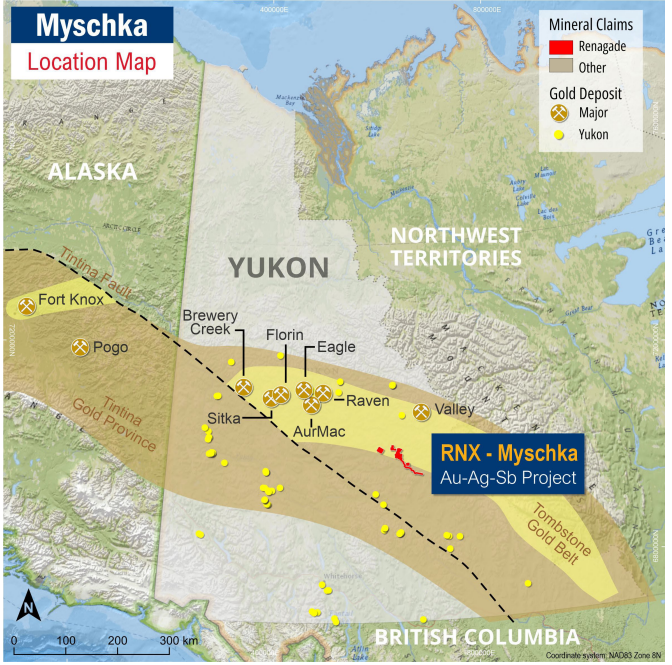
Renegade earlier this year confirmed the presence of not only higher-value elements like germanium and gallium within its zinc mineralisation, but also a gold prospect known as Myschka.
As Kirtlan recollects, because Renegade was being delayed on a deal to monetise the Mongoose deposit by Glencore, he and the company’s Aussie geologist opened up a database to investigate Yukon. And it didn’t disappoint.
“It was one of our zinc neighbours which caused this, they said that they had reasonably high-grade germanium and some gallium in their zinc,” Kirtlan recalls.
“We opened up the database because that had never been reported. Anyway, lo and behold, there it was – we’ve got similar metal to them.
“So we released that data in February and when we opened it up, not only did we find that the zinc has a little more value than we thought, but there was a gold prospect there called Myschka – and it has a very big footprint.”
Historical work from 2002 showed promising gold, silver, and antimony signatures, coinciding with renewed attention on the Tintina Gold Province. Just 80km away, Kirtlan says Snowline Gold’s Valley discovery has grown into a near-10-million-ounce deposit, re-rating the broader district.
Renegade’s exploration team – supported by local geologists out of Whitehorse and in collaboration with the Berdahl family, who were also behind Snowline Gold’s success – has since advanced soils, mapping, and rock chip programs plus helimag.
Renegade recently announced high grade gold, silver and antimony numbers from the program plus the magnetics are big so Myschka is now ready for drilling.
The Berdahl family retains a 10% free-carried interest in the Yukon asset, offering Renegade not just capital efficiency but also technical and local insight. Kirtlan says the partnership aligns Renegade with proven discovery credentials and positions it within a trusted network of explorers in the region.
“We get along pretty well (with the Berdahl family). I get along well with the old man Ron, and we’ve danced a few times (in terms of business dealings). And now they’ve had the big discovery, so they’ve deservedly done extremely well so far,” Kirtlan says.
“And we’re all proud of them because they’re great people, a nice family. They’re traditional and Ron’s son Scott, who runs the company, is a qualified geo and I believe went to MIT in Boston. So he’s up there and we’re fortunate to use them as a sounding board.”
The Chairman emphasises that while Yukon was once considered peripheral, the asset may prove valuable in the context of rising gold sentiment and renewed confidence in the territory.
Recent activity, including Pierre Lassonde’s participation in Yukon deals, suggests major investors are again willing to back projects despite historical permitting challenges. Recent new discoveries also provide impetus for Yukon as a destination.

Like Renegade, the market has been awaiting further assays and updates from the 2025 field season. Until now.
On 20 November, the company confirmed its Myschka prospect shares similar geochemical, geophysical, and geological characteristics as other major RIRGS gold deposits within the Tintina Gold Province’s Tombstone Gold Belt after completing rock chip sampling, field mapping, and a helicopter-magnetics survey.
A total of 63 rock chips were collected and analysed by ALS. These rock chips were combined with rock chips and a grid of soil samples from a 2002 program and Renegade’s field mapping, and a helimag survey to confirm that RIRGS is a compelling and valid model for exploration at Myschka.
The results could reposition Yukon from a legacy asset into a strategic gold-copper project at the heart of a resurgent Canadian belt.
Kirtlan says planning is now underway to drill Myschka in 2026 after recent fieldwork confirmed it has all the hallmarks of being another RIRGS deposit in the Tombstone Gold Belt.
“Myschka’s rock geochemistry is dominated by Au-Ag-Sb-As association as is recorded for many RIRGS deposits in the region,” the Chairman says.
“Snowline’s (TSXV:SGD) Rogue Project with almost 8M ounces of gold is only 80km away and we are excited to be planning a drill program at Myschka in 2026.”
US expansion: Riding the first wave
While Yukon adds optionality, Renegade’s expansion into the US represents a deliberate growth step. Work has since focused on Caisson and Broken Hills, where rock chip assays have already delivered standout results.
Gold grades up to 71.85 grams per tonne and silver-gold mineralisation across broad strike lengths. With drilling on the horizon, Renegade is hoping to validate surface potential into genuine deposits.
Kirtlan likens the current US dynamic to the influx of Australian juniors into Canada a decade ago – early movers stand to capture outsized and valuable ground positions before the market catches up.
To this end, Renegade has already been assessing acquisitions in Arizona (rare earths near Mountain Pass), Wyoming (a conglomerate heavy minerals project), and northern Nevada (advanced gold-silver systems).
Each opportunity is weighed for geological merit, price discipline, and strategic fit.
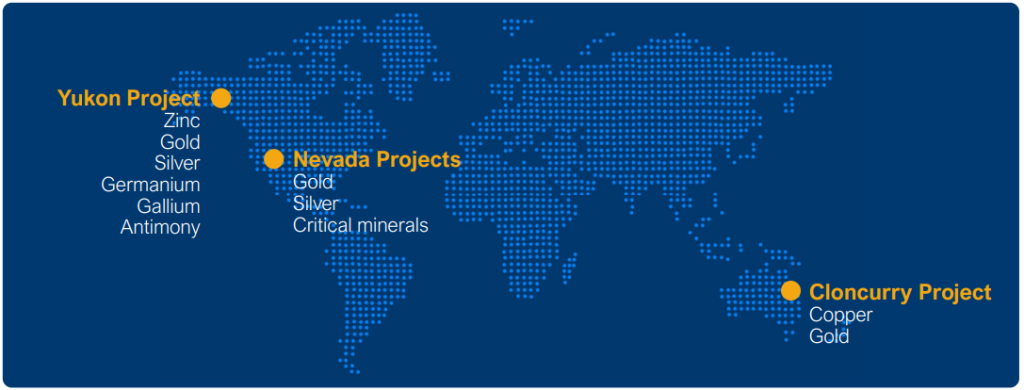
Near‐term catalysts: What to watch
Given the company’s trajectory, Kirtlan tells this news service there are a number of upcoming catalysts worth keeping an eye on. Drilling in Nevada at Caisson and Broken Hills will seek to determine whether surface rock‐chip results translate into continuous mineralisation. High gold assays are promising but drilling will test depth, continuity, and economics.
Further work at Greater Mongoose and Mongoose Deeps is another catalyst. Kirtlan says if the deeper gravity/magnetic anomalies confirm major copper systems, Renegade may unlock what could be a large copper‐gold deposit – particularly if there are high grade cores.
Another catalyst to monitor is advancing North Isa and the Carpentaria JV. Rationalising the JV with Glencore or acquiring additional ground under favourable terms could significantly de‐risk the portfolio. Also watch for a potential monetisation of Mongoose with neighbouring True North, it makes sense, the Chairman adds.
US policies supporting critical minerals, favourable exploration regulations, and incentives in states like Nevada are also helping drive Renegade’s next growth phase. Renegade welcomes measures announced by the Government of Canada, including the creation of a C$2 billion Critical Minerals Sovereign Fund and the proposed expansion of the Critical Mineral Exploration Tax Credit (CMETC) to cover 12 additional minerals including germanium.
Renegade’s Canadian projects are well-placed to be served by Canada’s new CMPA, which is designed to de-risk upstream and midstream chokepoints, moving promising projects from studies into construction with offtakes, co-investment, and permitting acceleration.
Renegade previously reported the presence of germanium and other strategic metals within its Yukon Project in Canada. Kirtlan says the inclusion of germanium within the Canadian Government’s critical minerals framework is an exciting development for future exploration at Yukon.
In Australia, state and federal support for resources and critical minerals continue to evolve, which the Chairman adds could help for permitting, funding, or partner interest.
Part two of this special feature further uncovers how Renegade is building momentum across two continents. From its copper‐gold strongholds in Queensland to a growing US footprint, the junior explorer is piecing together a strategy with three interlocking pillars – quality over quantity; geological leverage; and strategic flexibility.
Write to Adam Orlando at Mining.com.au
Images: Renegade, Unsplash & Mining.com.au