

It’s the time of year when fund managers reveal some of their top positions.
There’s no doubt about it. One theme stands out above all: artificial intelligence.
What does this have to do with mining?
A great deal, and it’s going to get bigger. Keep reading.
The problem for ASX investors is that Australia doesn’t manufacture semiconductors.
This is where the massive money and FOMO currently is in global markets. In other words, the action is overseas.
Statistics show that technology is just 2% of total ASX market cap.
That said, the ASX isn’t completely barren for firms that can benefit from the AI build-out. Australia has a large capex cycle happening around data centres, as one example.
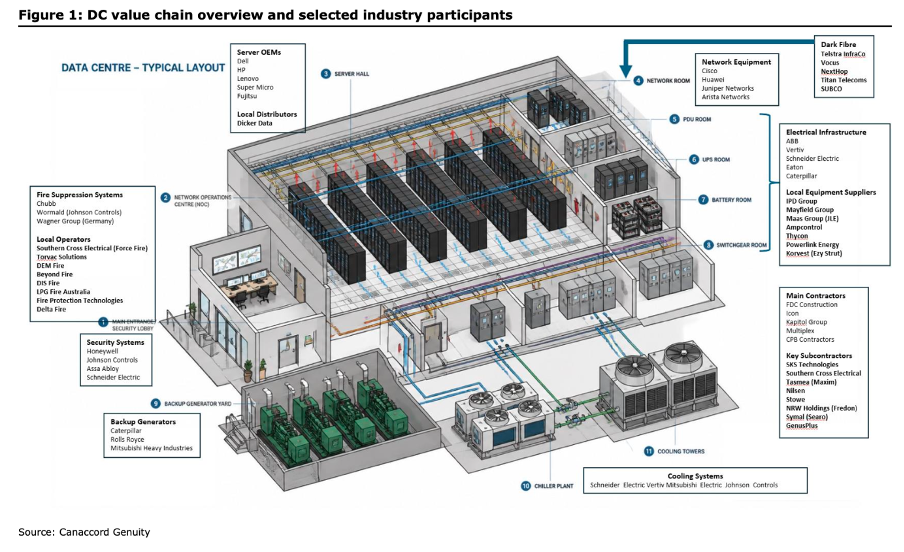
Canaccord Genuity recently published this handy graphic to show the mix of international and local firms involved in the ‘digital infrastructure’ sector:
However, this trade is not new. So much so that a reporter for the Australian Financial Review noted recently that it might be becoming too crowded.
Maybe. Maybe not. Fund manager Matthew Kidman said:
“Since the start of the new financial year, there’s been a big rotation out of these contractors because they’re becoming crowded. But I think we’ll see those companies perform strongly in the August reporting season as they give really solid outlooks.”
There’s also input from large-cap fund manager Jun Bei Liu, saying the ‘unappreciated’ way to play the AI boom is through resources, especially copper stocks.
Robert Friedland is a noted copper investor, too. He recently posted to X.com (formerly Twitter) the following:
“Copper is continuing to vanish off the LME. Stocks are down to 308,750t today with 108,725t already flagged for withdrawal. China draws are strong, the import arb wide open, CIF premiums climbing. Now even concentrate TCRCs have gone negative. All signs point to a bullish copper market.”
He also makes the point that a 50-megawatt (MW) data centre uses more than 2,000 tonnes of copper.
But it’s not just copper. There’s also increased demand for other inputs like tin, steel, plus land and power.
It’s also worth noting that the explosion in AI demand is on top of data centre demand that already exists.
It’s all only going to get bigger too. Stansberry Research recently included this forecast from McKinsey:
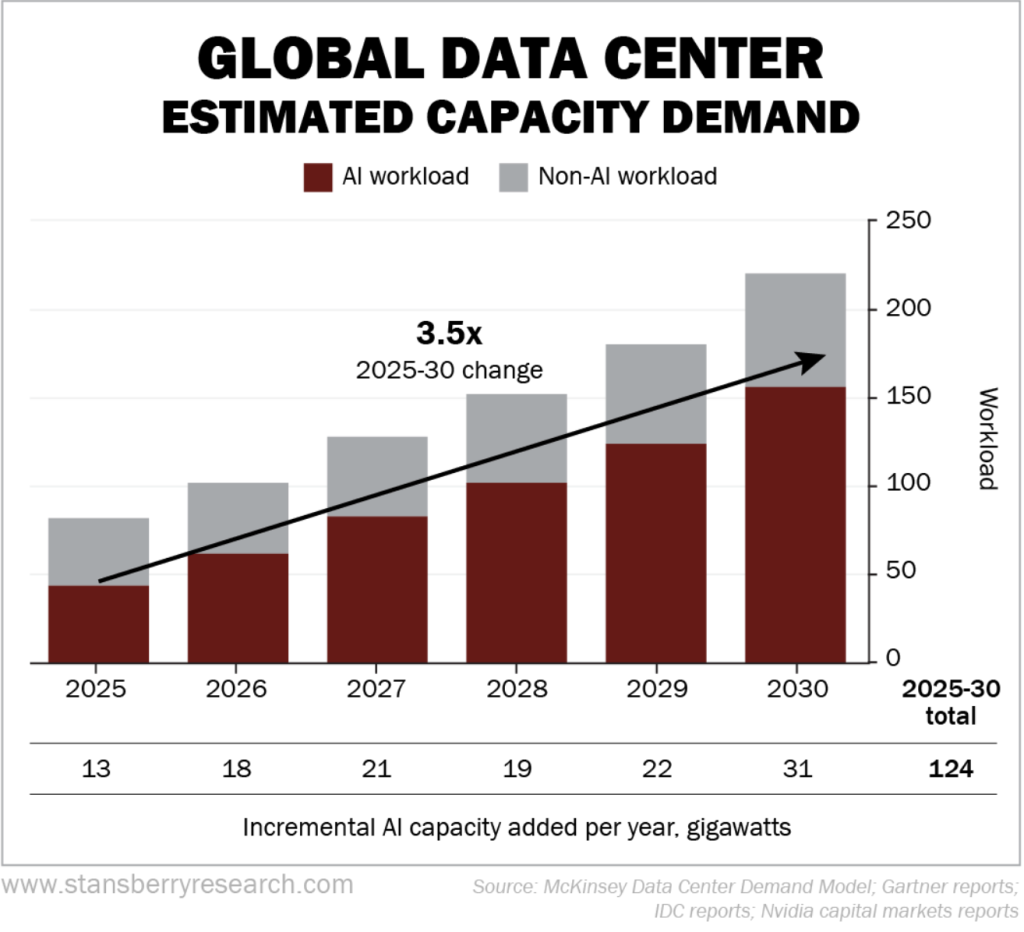
This could require up to US$7 trillion ($10.08 trillion) in spending over the next five years.
This is also going to cause a huge rise in the demand for electricity.
What remains uncertain is whether the resources needed to support this surge in construction and demand can be supplied by existing mines and producing projects around the world.
This, of course, doesn’t even account for the huge disruptions that are happening worldwide in key resource-producing areas.
Russia, for one, is now experiencing diesel shortages that could affect its export of key commodities.
The Strait of Hormuz closure doesn’t just affect oil and gas, but helium, iron ore, and fertiliser. China is willing to ban exports of rare earths and other key inputs if it believes it to be in its strategic interest.
This reinforces Australia’s geopolitical value as a reliable supplier of critical resources. A recent agreement to supply Australian uranium to India provides a clear example.
This also ties in with the AI trade, with the ABC reporting:
“New Delhi has flagged it wants to hugely increase its nuclear power industry to help power data centre development and further cut India’s fossil fuel dependence.”
Uranium stocks on the ASX rallied in response to the news.
There are multiple ways the Australian resource sector, and ASX investors, could benefit from the AI rollout worldwide.
That will put lithium, copper, rare earths, uranium, tin, and gas projects firmly into play for investment consideration.
One tin project, for example, is in Spain. The ASX-listed firm Elementos (ASX:ELT) is developing it. If it makes it to production, it will be the only producing tin mine in the EU. That’s how bare some metals are in key regions of the world.
Write to Callum Newman at Mining.com.au
Images: Stansberry Research, Unsplash & Canaccord Genuity