
The mining industry’s lack of success in finding major copper deposits has been well documented.
As S&P Global (NYSE:SPGI) has pointed out, this is a worrying trend that has persisted for more than two decades.
The firm’s latest annual review of copper discoveries has once again put the industry’s struggles in the spotlight, raising concerns about whether future supply can keep pace with demand.
According to S&P Global, the industry identified 263 major copper discoveries between 1990 and 2025, containing a combined 1.4 billion tonnes of copper in reserves, resources, and past production.
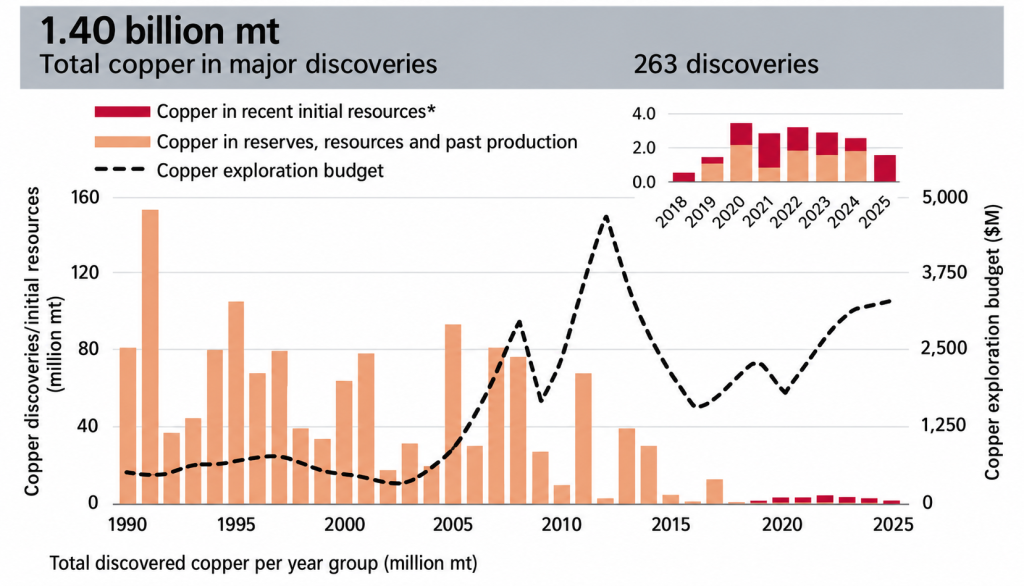
However, the latest assessment added just five deposits and 37 million tonnes (Mt) of copper to the previous year’s database, with much of the increase coming from the expansion of known deposits rather than entirely new discoveries.
S&P defines a major discovery as a deposit containing at least 500,000 tonnes of copper. But no deposit discovered in 2025 has yet met that threshold, it says.
The slowdown comes as demand for the metal is expected to accelerate, driven by electrification, AI data centres, and defence modernisation.
S&P has previously forecast that global copper demand could increase by 50% by 2040, adding to concerns over a potential supply shortfall that miners may struggle to address.
Why copper discoveries are declining
According to S&P, the problem stems from a combination of exploration strategies and increasingly difficult geology.
Since the early 2000s, miners have increasingly directed exploration spending towards existing operations, where established infrastructure, permitting arrangements, and geological knowledge can reduce costs and development risks.
In 2025, mine site programs accounted for 43% of global copper exploration budgets, compared with just 25% for grassroots exploration, according to S&P estimates.
Despite an increase in copper exploration spending since 2020, the industry’s focus on existing assets has done little to reverse the decline in major discoveries.
More than 60% of the additional copper volume recorded in S&P’s latest review came from deposits associated with existing mining complexes.
While expanding known resources can provide near-term production opportunities, S&P warns that continued underinvestment in early-stage exploration could weaken the industry’s long-term project pipeline.
The challenge also extends beyond how companies allocate their exploration budgets.
Many easily accessible copper deposits have already been identified, forcing explorers to search for deeper and more geologically complex systems.
Average copper drilling depths have increased by nearly 50% since 2010 to around 600m, while ore grades have generally declined.
Longer and more complicated permitting processes have added another obstacle, with the average time between copper discovery and production now estimated at 17.5 years.
Higher drilling costs and inflation have also reduced the amount of exploration work companies can complete for each dollar spent.
For the industry, the challenge is therefore twofold: finding more copper while operating in increasingly expensive and technically demanding environments.
Argentina emerges as a copper exploration frontier
Latin America remains the dominant place for major copper discoveries, accounting for approximately 773Mt, or 55% of the global total identified by S&P.
Still, much of the continent has untapped potential for more discoveries, with the report highlighting Argentina as one of the emerging frontiers.
Despite sharing a border of more than 5,000km with Chile, Argentina has historically attracted far less investment in copper production.
According to Fastmarkets, the country holds an estimated 75Mt of copper reserves, ranking sixth globally, but its production remains a fraction of Chile’s output.
Argentine President Javier Milei has sought to address that gap through investment policies, including the Large Investment Incentive Regime (RIGI), which offers tax and regulatory incentives for major projects.
Fastmarkets copper analyst Andy Cole had previously highlighted Argentina’s significant development potential, while cautioning that bringing new mines into production would require patience.
The country’s advanced copper project pipeline has been estimated at approximately 1.3Mt of annual production capacity, broadly comparable with the scale of Chile’s Escondida mine.
Exploration spending is already responding to the changing investment environment.
According to S&P, grassroots copper exploration budgets in Argentina more than tripled to US$66 million ($93.91 million) in 2025 from US$18 million the year before.
The country also recorded a 33% significant drilling ratio between January 2021 and July 2026, compared with 20% in Australia and 27% in the US, as S&P highlights. The measure represents the proportion of drill holes reporting significant results.
One of Argentina’s most prominent development areas is the Vicuña district, home to the Filo del Sol and Josemaria deposits, discovered in 2000 and 2003, respectively. Both projects are now being advanced through a joint venture between Lundin Mining (TSX:LUN) and BHP Group (ASX:BHP).
Further south, Mendoza province is also looking to expand its copper mining industry after decades of restrictions and opposition to major developments.
In December 2025, the province approved the PSJ Cobre Mendocino Project, marking the first legislative approval of a large-scale metalliferous mining development in more than two decades.
The project is being advanced by Switzerland’s Zonda Metals and Argentina’s Alberdi Energy.
Its original development plan targeted approximately 40,000 tonnes of copper annually, although subsequent engineering work has lifted projected production to around 75,000 tonnes a year.
Construction is targeted to begin in 2027, with production potentially starting in 2029.
BHP backs new exploration in Mendoza
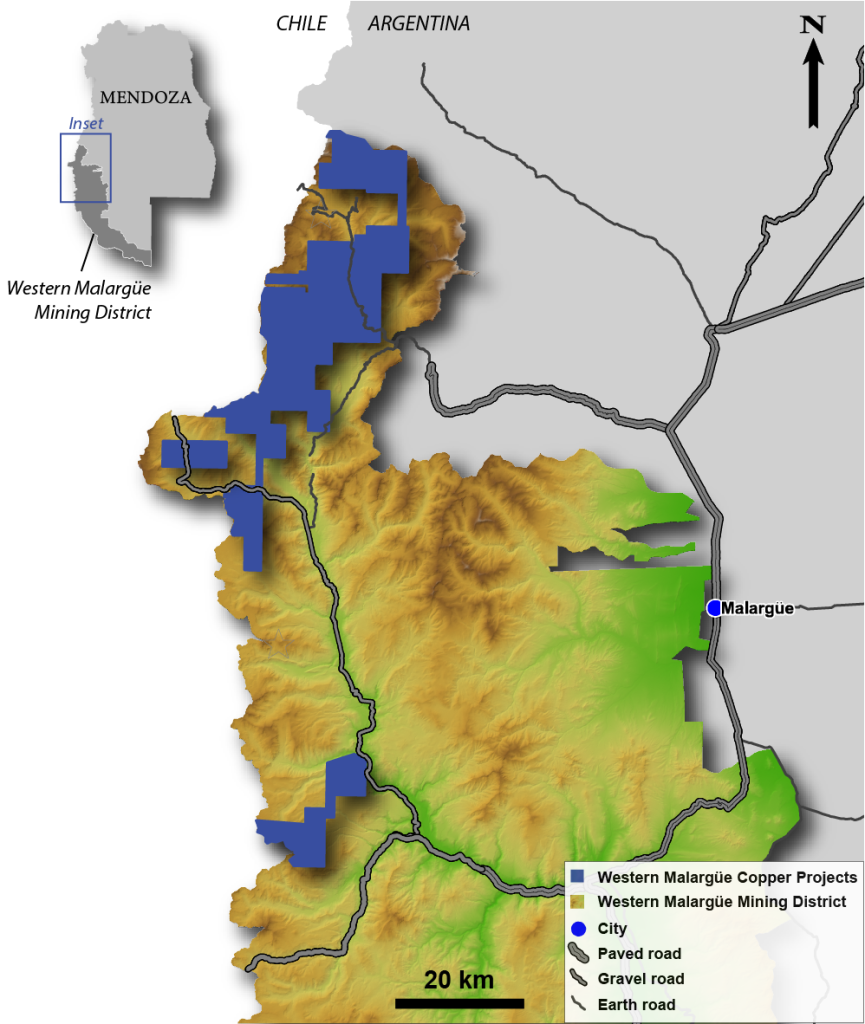
Another project attracting attention in Mendoza is the Western Malargüe Copper Projects, being advanced by Kobrea Exploration (CSE:KBX).
The district-scale land package covers approximately 733km² within a government-established mining district near the Chilean border.
It lies within the same broader metallogenic belt that hosts major Chilean copper deposits, including Los Bronces and El Teniente.
The area has undergone historical exploration, including geological mapping by Vale (NYSE:VALE), which helped identify porphyry targets.
Kobrea has since outlined numerous copper prospects across the property, including El Perdido and El Destino.
At El Perdido, the company completed its first diamond drilling campaign earlier this year, drilling six holes for a total of 2,358m.
The program confirmed the presence of a copper-gold-molybdenum porphyry system, with widespread alteration, quartz-stockwork veining, and associated mineralisation.
According to Kobrea, geological observations suggest the system strengthens at depth, although its interpreted core remains untested.
El Destino is another priority target, characterised by a large hydrothermal alteration footprint and geological features associated with porphyry copper systems.
Kobrea CEO James Hedalen has previously highlighted the potential for the district to host large-scale deposits sought by major mining companies.
That potential has also attracted BHP, which entered an exploration alliance with Kobrea in August.
Under the agreement, BHP will fund at least US$5 million in exploration over an initial two-year project-generation phase. The mining giant can subsequently earn a 75% interest in up to four selected projects by funding at least US$40 million in exploration on each project over eight years.
The partnership has already approved a US$4 million exploration program for the 2026–27 field season, including diamond drilling at El Destino and regional geological and geophysical surveys.
“We’ll continue to operate the projects during this phase, supported by BHP’s technical expertise and financial backing, with the goal of advancing discoveries as efficiently as possible,” Hedalen previously said.
Africa’s untapped copper potential
Argentina is not the only emerging exploration jurisdiction identified by S&P.
Across Africa, grassroots exploration activity is expanding as major miners look beyond established producing districts for new copper discoveries.
Zambia remains a key focus, with Rio Tinto (ASX:RIO) identified by S&P as one of the country’s leading grassroots copper explorers.
Botswana is also attracting growing interest, particularly in the Kalahari Copper Belt.
The belt stretches for approximately 800km and is regarded by the US Geological Survey as one of the world’s most prospective regions for undiscovered sediment-hosted copper deposits.
BHP has already committed US$25 million under a multi-year earn-in agreement with Cobre (ASX:CBE), targeting the Kitlanya East project in Botswana.
The Kalahari Copper Belt is also home to several major discoveries, including the Khoemacau copper operation, now controlled by MMG (HKG:1208).
Its Zone 5 underground mine was developed with an initial production capacity of approximately 60,000 tonnes of contained copper annually.
Many of the belt’s copper deposits occur along a large geological corridor, where mineralisation is associated with folded sedimentary structures known as anticlines or domes.
Towards the southern end of that corridor, Leviathan Metals (TSX-V:LVX) is exploring a previously underexplored domal structure at its Central Project.
The project is interpreted to contain approximately 24km of the prospective contact between the Ngwako Pan and D’Kar formations, a geological setting associated with copper-silver deposits elsewhere in the belt.
Leviathan launched a diamond drilling program of up to 10,000m earlier this year to test the contact and associated structures.
By August, the company had completed 14 holes totalling approximately 3,600m, identifying the target stratigraphy in 12 holes and visual copper sulphides in eight.
Drilling also confirmed the presence of the Hyena Hills dome, which the company considers a promising structural target for further exploration.
“We’ve seen visual copper sulphides in the majority of holes, and demonstrated the presence of a previously untested domal structure on Central, all in the opening stages of our program,” CEO Luke Norman said in August.
However, the company cautioned that visual observations are preliminary and laboratory assays are required to determine copper grades and mineralised widths.
Beyond Africa, S&P also highlighted the potential of jurisdictions benefiting from government-backed exploration and investment initiatives, including Saudi Arabia and Norway.
US explorers target historical copper districts
Meanwhile, established mining jurisdictions are also stepping up efforts to secure future copper supplies.
In the US and Canada, governments have increasingly prioritised domestic critical minerals production and measures aimed at accelerating mining project development.
This has renewed attention on historically productive but underexplored mineral belts.
One example is the Penokean Volcanic Belt in Wisconsin, where GreenLight Metals (TSX-V:GRL) is advancing its Bend Project.
The property lies within a region known for volcanogenic massive sulphide (VMS) mineralisation, including deposits such as the former Flambeau mine.
Bend has a historical mineral resource estimate (MRE) of approximately 4Mt, including a copper zone of 2.8Mt grading 2.41% copper (Cu). GreenLight does not treat the estimate as a current MRE.
GreenLight has been conducting an expanded drilling program of up to 7,000m to test extensions of the known mineralisation. Its earlier drilling returned several high-grade intersections, including 34.25m @ 3.74% copper equivalent (CuEq) from 275.25m in hole B25-004.
The project was also added to the US Federal Permitting Dashboard in July 2026 as a FAST-41 Transparency Project, a designation intended to improve visibility of its permitting process.
Further west, Nevada is also attracting exploration for VMS-style copper deposits, alongside its better-known gold resources.
Nevada Sunrise Metals (TSX-V:NEV) is exploring its Coronado Copper Project, covering approximately 11km² near the historic Big Mike open-pit mine.
Big Mike was discovered in the 1960s and mined during the 1970s. It is now classified as a VMS deposit under modern geological terminology.
Historical records cited by Nevada Sunrise describe a resource estimate of approximately 575,000 tonnes grading 3.41% Cu, including 67,000 tonnes of massive sulphide material grading 11.78% Cu. The estimate is not classified as a current MRE.
Mining of the high-grade portion reportedly produced approximately 11,300 tonnes of copper from around 91,000 tonnes of ore grading 10.5% Cu.
Nevada Sunrise believes additional copper deposits could occur along the same geological trend, potentially forming a cluster of VMS systems.
One target is Coronado South, identified through an airborne electromagnetic survey in 2018.
Initial drilling encountered sulphide mineralisation, although the company interpreted the results as a possible near-miss of the principal geophysical target.
Nevada Sunrise subsequently initiated a review of historical geological and geophysical data to identify new shallow drilling targets, including areas associated with high-grade copper intersections reported in 1976.
Canada’s copper porphyry potential
In Canada, exploration companies are also searching for new porphyry deposits in established copper-producing regions.
British Columbia remains a major focus, particularly within the Quesnel Trough, a geological belt that hosts some of the country’s largest copper mines.
Canada One Mining (TSX-V:CONE) is advancing its Copper Dome Project near Princeton, covering approximately 79km².
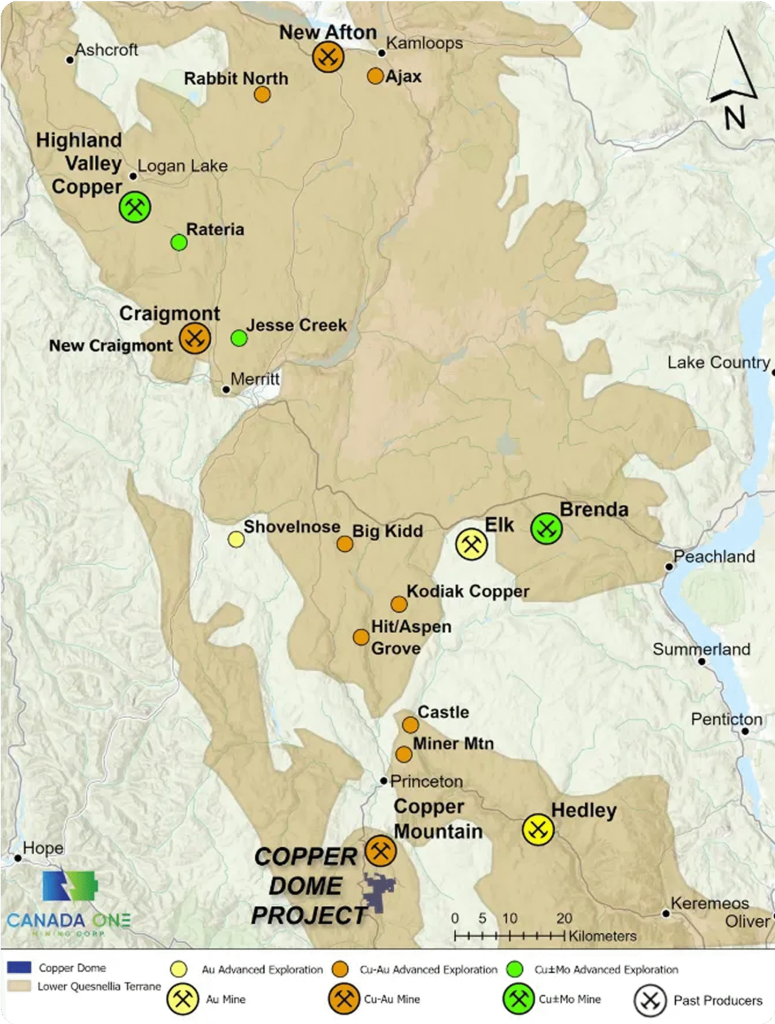
The project lies within the lower Quesnel Trough porphyry belt and directly adjoins Hudbay Minerals’ (TSX:HBM) Copper Mountain mine to the south.
Copper Mountain is one of Canada’s major open-pit copper operations, supported by proven and probable reserves of approximately 345Mt grading 0.256% Cu.
According to Hudbay’s latest reserve estimate, the operation has sufficient reserves to support production until 2045.
Canada One says Copper Dome and the neighbouring Copper Mountain operation are situated within a structurally complex alkalic porphyry copper-gold system.
Historical mining across the broader Copper Mountain district between 1927 and 2019 produced approximately 771,000 tonnes of copper, 700,000 ounces of gold, and 9 million ounces of silver, according to the company.
Copper Dome itself has undergone extensive historical exploration, including more than 8,900m of diamond drilling.
Previous results have identified high-grade copper mineralisation associated with northeast-trending structures similar to those at Copper Mountain.
Canada One has identified multiple areas of interest across the property and is working towards defining drill-ready targets. Its 2026 exploration program included fieldwork at the Camp Zone, Friday Creek, Reco Zone, and Copper Dome South.
The company has also secured a five-year drilling permit, providing a pathway for further testing of its targets.
The challenge ahead
The growing exploration activity across Argentina, Botswana, the US, and Canada highlights the industry’s search for new sources of copper.
However, finding mineralisation is only the first step towards bringing new supply to market.
According to S&P, 165 of the 263 major copper discoveries identified since 1990 have yet to enter production. Of those, 135 have not completed feasibility studies, while only 17 have reached construction or pre-production.
With copper demand expected to rise sharply over the coming decades, the industry faces mounting pressure not only to make new discoveries but also to advance existing projects through permitting, financing, and development.
The challenge will be balancing near-term expansions at established mines with the longer-term exploration needed to replenish the global copper pipeline.
Write to Jackson Chen at Mining.com.au
Main image: Mining.com.au