


This article is a sponsored feature from Mining.com.au partner Metallica Minerals Ltd. It is not financial advice. Talk to a registered financial expert before making investment decisions.
For emerging silica sand developer Metallica Minerals (ASX:MLM), ESG is at the forefront of its approach to delivering its low-impact Cape Flattery project.
The Cape Flattery Silica Sands (CFS) project is aligned to Australia’s 2022 Critical Minerals Strategy, which acknowledges silica sand’s importance in the transition to lower global carbon emissions.
Executive Chairman Theo Psaros says it was incumbent on Metallica to take a proactive approach to ESG given the increasing focus on these considerations by investors, governments and local communities. Metallica is well placed to benefit from this focus given it is an inherent component of its mine development philosophy.
Psaros says for Metallica’s CFS project, located on the eastern coastline of Cape York Peninsula, 220km north of Cairns in North Queensland, proactive engagement with the local community, particularly Traditional Land Owners, was also critical to the Project’s success.
Metallica has embraced the ‘S’ in ESG. Its early stage relationship building is growing positively as the company takes the Traditional Land Owners (TLO) through a process of exploration and evaluation, and soon through construction and operation.
“I want Metallica to be recognised as more than just a good corporate citizen but as a genuine partner who has diligently and honestly worked with Traditional Land Owners to bring a globally significant project into production.
We have been listening to what is important to them, taking on board their advice and guidance.
“We are working with the Traditional Owners and we are laying the foundation for Metallica, the clans, and the community of Hope Vale to benefit from a new silica sand project”
We are working with the Traditional Owners and we are laying the foundation for Metallica, the clans, and the community of Hope Vale to benefit from a new silica sand project.
We want our project to create inter-generational opportunities that give young people the ability to create a strong future and provide them with more resources and skills to care for the country.”
In March 2021, the company signed Aboriginal Cultural Heritage Agreements with Hope Vale Congress Aboriginal Corporation, as agent for the Nguurruumungu Clan, and Walmbaar Aboriginal Corporation, as agent for the Dingaal Clan. The agreements provided Metallica with a process that allowed drilling to take place off the existing tracks within EPM 25734 and as a result, the additional drilling increased the size and category of the JORC resource from 38.3Mt to 52.2Mt.
Japanese conglomerate Mitsubishi (TYO:8058) operates the adjacent Cape Flattery Silica Mines (CFSM), and also refines and exports approximately 3Mtpa of silica sand from Cape Flattery.
Psaros adds: “While one of the clans had already had many years of engagement with Mitsubishi and other companies, for one of the clans, when they spoke with us, it was the very first time that they had engaged with a resource company. So, it’s all been about fostering a partnership and developing a relationship and being respectful of their country, and the protection of country.
“So, it’s all been about fostering a partnership and developing a relationship and being respectful of their country, and the protection of country”
I recall my very first meeting with the clans some time ago, I said that we’re going to be part of your community and not the other way around.”
According to the executive chairman, feedback from stakeholders has been highly complementary regarding the company’s consultative approach to addressing environmental and social aspects of the proposed project.
Metallica has ongoing engagement with the Traditional Land Owners and other stakeholders in the community about everything from the proposed location for construction processing, to how quickly rehabilitation will occur.
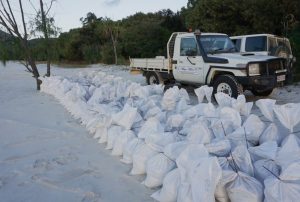
The company is adopting a ‘low-impact’ approach to silica sand mining to minimise environmental impact. Environmental management at the Cape Flattery Silica project will be comprehensive with key objectives including minimising the operation’s footprint (no tailings stamp); protecting biodiversity; responsible water use; rehabilitating disturbed areas; no chemicals to be used in production; and dust to be minimised using slurry pipelines during mining activities.
Psaros notes that Australia is renowned for having high environmental standards with legislation and policies in place that are generally well-understood and adhered to. Metallica is also implementing robust objectives regarding environmental aspects, which he says is not mutually exclusive to the other elements of ESG.
Respecting cultural sensitivities
Metallica is adopting progressive rehabilitation and will implement appropriate buffers, tree protection zones, and offsets (if required), while additional seeding with preferred species will also be undertaken.
“Through our discussions with the Traditional Land Owners, we have designed the project in such a way that much of the infrastructure will not be seen from any camping areas, and the location of infrastructure cannot be intrusive to any cultural activities.”
In addition, the company has been working to develop a local workforce from both clans who have undertaken a range work including for the drilling campaign, cultural heritage clearance and archaeology works, even to assist with monthly water bore testing and results monitoring.
Psaros explains that once agreements are in place many employment opportunities will be created and Metallica is proactively seeking and uncovering what skills the community and Traditional Land Owners have that can be utilised at the Cape Flattery Silica project.
He says the Traditional Land Owners were very clear about what they wanted: “They have said to us, ‘we want the jobs now, and we want them for our children’.”
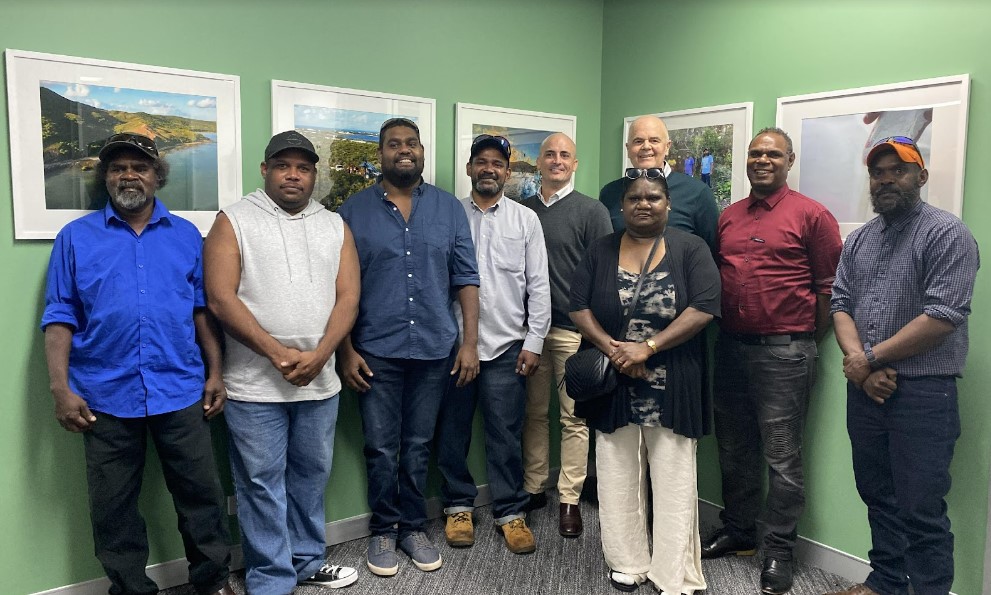
L-R: John Deeral, Raynard Baru, Shailand Deeral-Rosendale, Stanton Thompson, Nicholas Villa (CFS General Manger), Theo Psaros (Executive Chairman), Tayna Yoren, Fabian O’Burns and Kenneth McLean – Dingall Clan representatives.
Addressing Metallica’s engagement with the community, Walmbaar Aboriginal Corporation Chairman and Dingaal clan member, Kenneth McLean stated: “The fundamental aspect is companies working closely with the Traditional Land Owners of the community to benefit and provide more opportunities for a greater outcome, which will improve our local economy with jobs, businesses, educational support and providing silica to the world to lower carbon emissions. The partnership with Metallica Minerals is one that we value with their Cape Flattery Silica project on Dingaal country.”
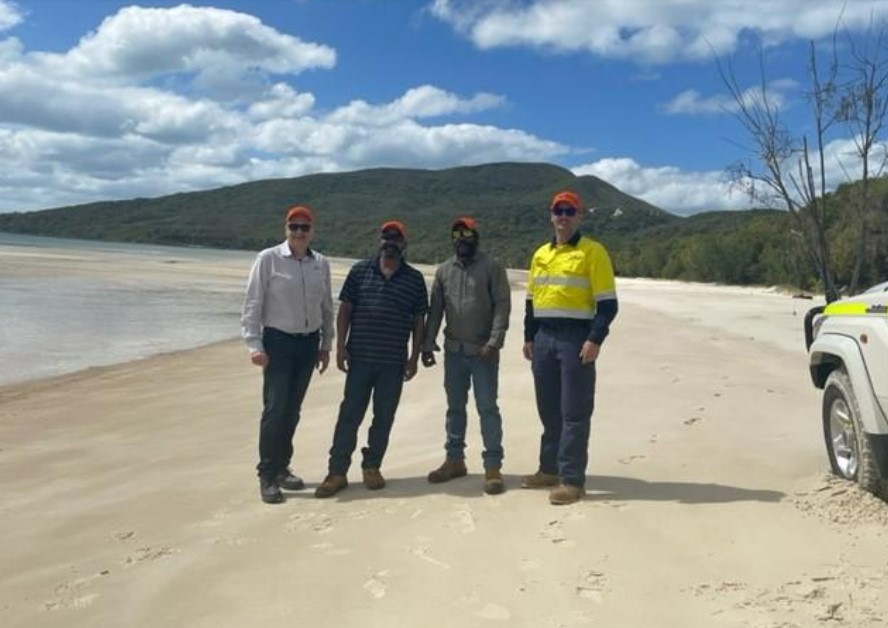
MLM Executive Chairman, Theo Psaros, CFS General Manager Nicholas Villa with Dingaal representatives, Kenneth McLean (Walmbaar Aboriginal Corporation Chairman) and Stanton Thompson (Walmbaar Aboriginal Corporation Director) during recent site visit to TLO land areas.
ESG is an umbrella term that refers to specific data and policies designed to be used for evaluating the material risk that an organisation is taking, based on the externalities it is generating.
As Metallica was an early mover to engage with Traditional Land Owners, it found prospective financiers have been more receptive to undertake talks as ESG is a key driver for lenders and investors alike.
Psaros notes: “It’s been two years of relationship building where I’m comfortable that the relationship is very, very good with the clans. One of the biggest lessons we’ve learned along the way is the likely impact an ESG framework embedded into your planning and operations going forward was a key focus for financiers. Up to this point, I am very happy with what we’ve done and accomplished in an environmental, social and governance sense.”
Commercial agreement talks continue
Metallica is now in position to continue to undertake discussions for commercial agreements for the mine to proceed and is also working to complete a Cultural Heritage Management Plan Agreement. Reflecting back on the company’s expansive and evolving ESG framework, Psaros had a cultivated and pragmatic view.
“Its reach extends beyond our shores. It addresses things like who is going to buy our product and what is their social responsibility. We’ve got a product that the world wants so we have to be aware of how our customers are behaving as well. It’s evolving, but I am happy with what we are achieving on this front.”
“We’ve got a product that the world wants so we have to be aware of how our customers are behaving as well”
In August, Metallica entered into a Memorandum of Understanding (MoU) with Mitsui & Co. (TYO:8031), one of the largest global trading and investment companies based in Japan. The MoU builds on discussions between the parties and covers negotiations to evaluate the feasibility and possibility of a sale and purchase transaction (off-take transaction) of all or specific portions of the silica sand products that MLM will produce in the future.
The MoU defines the desire to engage in further analysis and discussion of business opportunities and will remain effective for 12 months. While the MoU does not itself provide for any binding offtake arrangement, it establishes a platform for the parties to collaboratively explore entering into binding offtake arrangements.
Sands of time
According to industry research firm IMARC Group, high-purity silica sands are becoming more sought after, with the global market growing at a compound annual growth rate (CAGR) of around 6% between 2010 and 2017.
In 2017, a total of 188Mt of silica sand was produced globally.
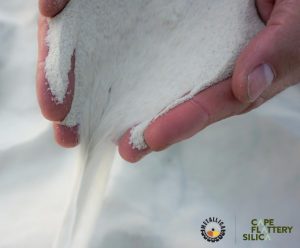
This growth has been driven by silica sand’s applications across a broad range of industries including glassmaking, foundry casting, water filtration, chemicals and metals, hydraulic fracturing, and an increasing number of hi-tech products, including solar panels.
For example, in the global glass-making industry, one of the major consumers of high-purity silica has experienced significant growth recently from the construction and automotive industries.
IMARC also estimated the global silica sand market could grow from US$7 billion in 2019 to US$20 billion in 2024.
Cape Flattery Silica Sand Project’s Prefeasibility Study (PFS) confirms the project can be a long-life silica sand project producing high-quality silica sand for the booming Asia-Pacific glass manufacturing markets supplying the solar panel industry. The PFS found the project could have pre-tax net present value (NPV) of $290 million, an internal rate of return (IRR) of 34.9% and life of mine cash revenue of $2.127 billion.
Capex is estimated to be $79 million (including a 15% contingency of $10 million) with a payback period from commencement of production of less than four years.
The project is forecasted to export 1.35Mtpa of silica sand, which could help manufacture more than 133 million 375W solar panels on the basis of 74% of the panel being comprised of SiO2. That is equivalent to 3.35 billion panels over the expected 25-year life of the project at full production.
Write to Adam Orlando at Mining.com.au
Images: Metallica Minerals Limited & iStock