



This article is a sponsored feature from Mining.com.au partner Macro Metals. It is not financial advice. Talk to a registered financial expert before making investment decisions.
Simon Rushton is a man who knows mining.
He was the right-hand power player that worked next to the legendary Chris Ellison as they built Mineral Resources (ASX:MIN) from an obscure small mining services firm to a Top 50 ASX company.
Rushton’s appreciation for this experience shines through. It’s what brought him to where he is today.
He recalls: “12 years was an apprenticeship under Chris Ellison directly. I worked with that man every day.”
That would be a big enough pedigree for most. But Rushton also founded and sold his own company and received critical senior operational leadership training from Rio Tinto (ASX:RIO).
That’s the kind of mining pedigree rarely seen at the helm of a junior.
Now, Rushton is bringing the Mineral Resources strategy to Macro Metals (ASX:M4M).
Rushton’s decorated career is the very definition of preparation for an executive role. There’s unlikely to be a leader with more human and intellectual capital in the junior market today.
Or, as he puts it, “I’ve now got the full commercial, corporate, contractual, strategy piece from Mineral Resources.
“And then from 2022 to 2024, operational exposure, responsibility, and accountability for operational productivity, profitability, and safety.”
His ambition is to move Macro Metals upwards and onwards on the same lucrative and fulfilling path as Mineral Resources.
The team at Macro are out to prove to their shareholders that they can deliver what they say they will do safely, competently, and consistently.
The strategy is proven. Rushton has the training and operational skills from the very best. His team is built on experience and quality.
Now it’s just a matter of executing.
That means high performance under pressure and earning industry respect — just the way Rushton likes to operate.
The first move: Get Macro a mining services division
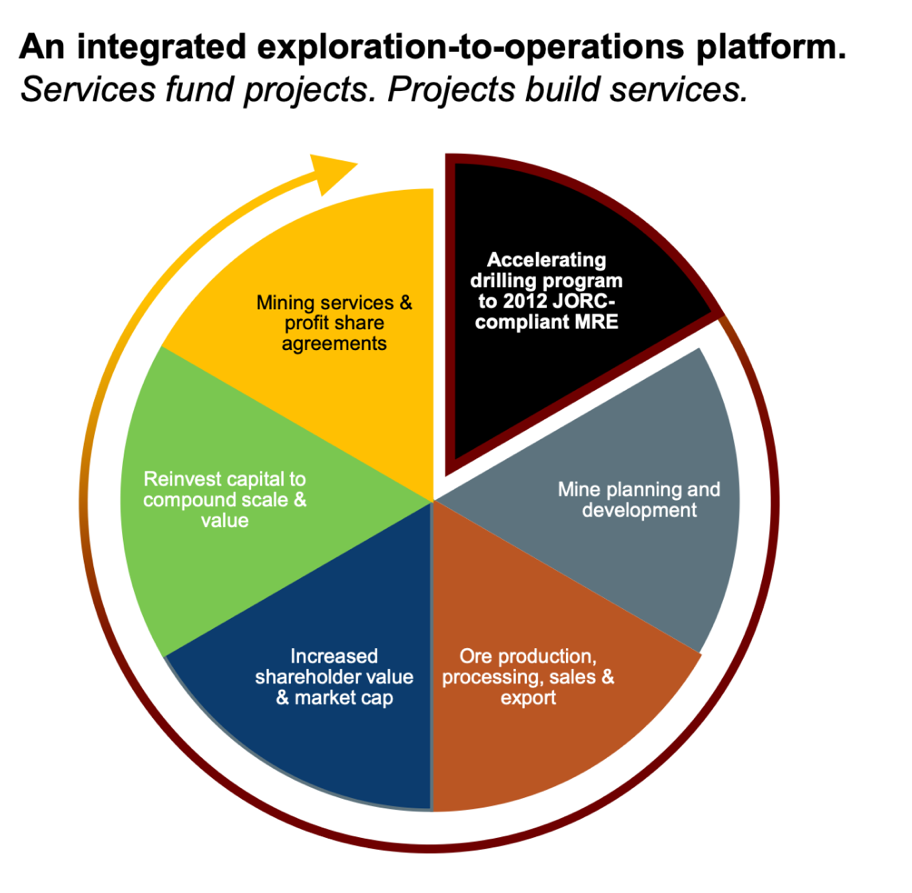
The genius that transformed Mineral Resources was a ‘flywheel’ business strategy: generate positive cash flow before reinvesting it into projects that, in turn, keep growing the company asset base and generating more work for its own services division.
Once you have a second cash-producing asset, you can buy a third, and then a fourth.
It results in a cumulative stream of different revenue sources that builds the company on a solid, diversified foundation.
It looks like this:
What does every company need first? The answer is revenue to cover overheads.
Rushton never wanted Macro to be like most juniors who are critically reliant on raising money from the market and diluting the equity base.
The company strongly believes in capital discipline.
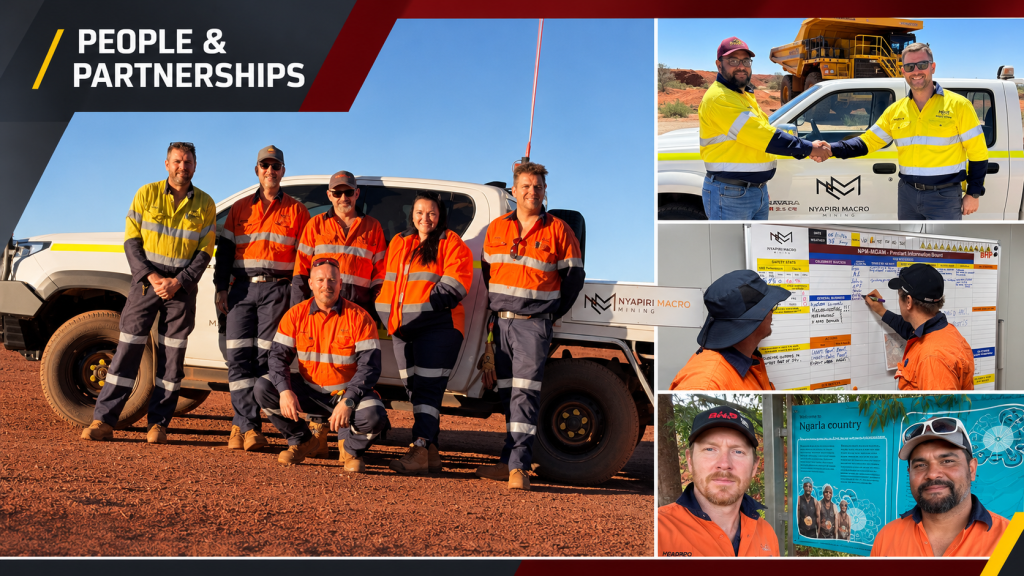
The quickest and most efficient way to get cash: Be a service provider
One of Rushton’s first moves as managing director of Macro Metals was to establish the company’s mining services division by partnering with Indigenous-owned mining service companies and forming joint ventures (JV).
They bring local knowledge, access, and contacts, while Macro offers operational expertise. It’s a very compelling proposition for clients.
That said, Rushton was still particular.
“I didn’t want to run the counterparty risk of working for tier-threes and tier-fours and maybe not getting paid,” he shares.
“I know exactly what it takes to work for a tier-one — a major, multibillion-dollar mining firm. You need a certain set of skills and qualifications and standards that don’t come cheaply.”
In June, one of Macro’s mining services JVs secured a contract with BHP Group (ASX: BHP).
Multi-commodity, hundred-billion-dollar operations such as BHP don’t work with small-time companies unless there is a very good reason.
There can be no higher endorsement than this. Major miners want to partner with companies run by people with the know-how.
This contract came after Macro formed a shrewd partnership with an industry veteran that could bankroll a competitive bid.
Macro said it’s now taking more inbound enquiries from the top-level companies in Australian mining.
The flywheel spun — and landed right where it needed to be. Macro can now run a capital-light mining services division that can scale as it wins contracts.
The flywheel is spinning the way Rushton wants it to.
Rushton says he is confident that the mining cycle upswing is underway and that he can help grow the mining services division into something much, much bigger.
That, in turn, can help fund exploration or equity-based partnerships in the future.
That’s what turns the flywheel faster and faster.
Where the really big upside comes from in the mining sector
Rushton and the team at Macro Metals know perfectly well that the real value in resources lies in leveraging both rising commodity prices and capital growth in project valuations.
They don’t have to own all of a project to benefit from this. They can start small and strategic.
Rushton puts it this way:
“I don’t need to own 100% of the asset. If I can go in and get the mining services, I can make a steady locked-in margin.
“That’s insulated from the commodity price, but […] we can also get exposure to commodity price increase through a profit share or a project equity interest.
“That to me is a really good, sound model for us to grow our business.”
This is how Macro can build shareholder value and not just revenue from fees. This is the impetus that could lift the share price over time as the flywheel works its magic.
Rushton’s skill set is built on close operational control and detail, plus building relationships and workflows that benefit Macro and its partners and clients.
Macro’s cash is set to grow from different projects and commodities. In fact, Rushton sees two to three sources of cashflow for the business over the next 12 months.
The first is the mining services division.
Another major revenue stream: The Yandi South Iron Ore Project
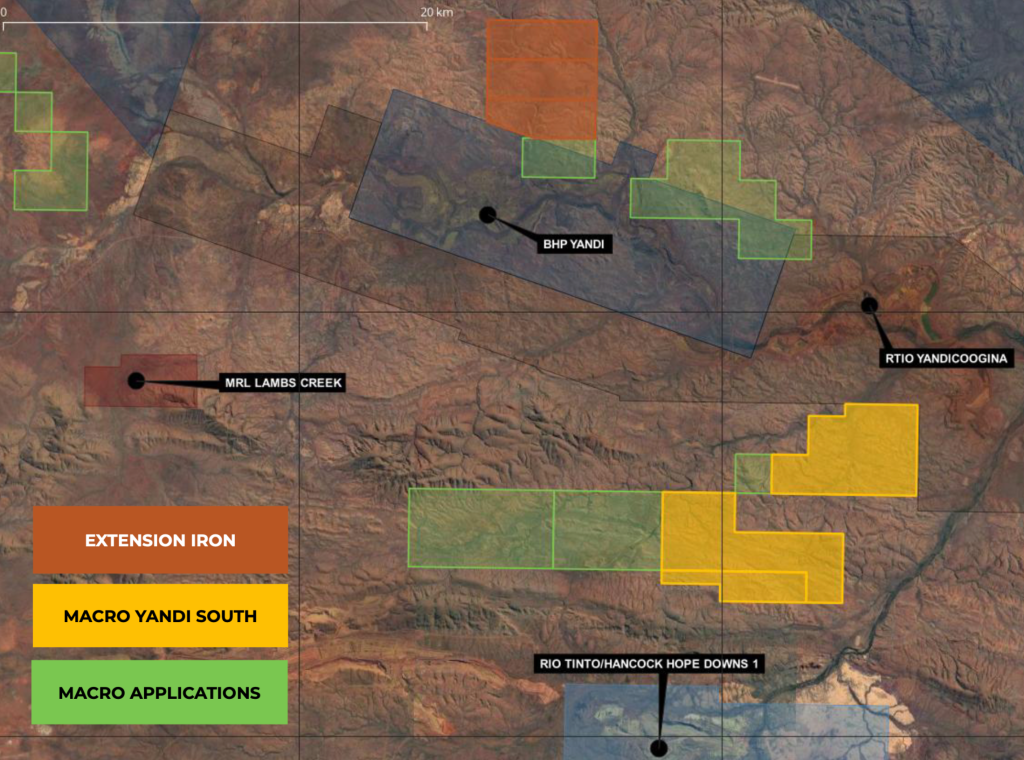
The newly acquired Yandi South is ripe for development. Existing estimates and mapping cover only about 10% of the tenure. If further applications are approved, the ground will cover over 100km².
It could be producing cash flow by this time next year.
Yandi South’s lease is enviably placed between both BHP and Rio Tinto territory. Macro could, potentially, leverage off this.
“There’s a lot of infrastructure in the region directly next to us that is underutilised,” Rushton points out.
“Those two parties have publicly said that they are looking to collaborate both with themselves and others to extend the life of those existing assets.”
The only question now is how much iron ore is at Yandi South.
Macro is now putting its final plans in place for infill and extensional drilling to define a 2012 JORC-compliant mineral resource estimate. Critical data from the campaign will then inform the Prefeasibility Study.
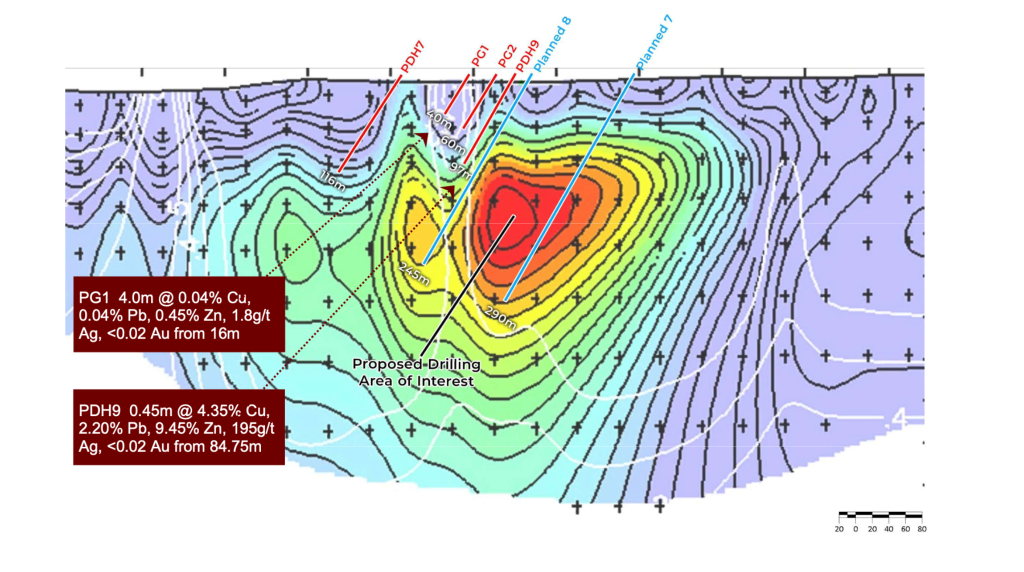
Macro plans to test how far the anomalies extend both down dip and along-strike. Based on geophysical indications, they appear to be far more substantive in scale than what has been proven to date.
Once this is in hand, Macro can progress commercial discussions and approvals to get Yandi South ‘dig-ready’ as fast as possible.
Signs are already indicating Yandi South hosts ‘high-grade’ iron. A preliminary review identified rock-chip samples grading as high as 66% iron.
Only drilling can confirm it, but the odds look very good.
Now, those early ‘high-grade’ rock-chip samples are important — not just for the value of the rocks, but for Macro’s future global positioning in the steel market.
When Macro picked up Yandi South, its proximity to Australia’s mining giants was one benefit. The other is the early numbers on the iron grade and what those details suggest.
The ingredients that withstand commodity cycles
Yandi South hosts both hematite and magnetite, the two most common types of iron oxide-bearing minerals.
In addition, the ore body setting is a mix of bedrock hosting banded iron ore formations (BIF) and channel iron ore deposits (CID).
These details matter to someone like Rushton, whose skill is to not just appreciate mineralisation, but also how geology and infrastructure play a critical part in the costs of running a mine.
BIFs often provide continuity, which means fewer surprises for an operator in the beneficiation stage.
CIDs often come with lower strip ratios, higher recovery numbers, and easier processing. They are well-suited to bulk mining methods, minimising the amount of drilling and blasting overall.
Hematite is often enriched with iron, offering cost savings when being processed because its structural purity is higher.
Meanwhile, magnetite brings its own advantages.
The mineral often has a higher iron content by weight. Less ore needs to be moved because there’s more mineral per tonne.
Its magnetic properties mean it suits low-impact mining and the somewhat more cost-efficient magnetic separation technique.
Further proving the right ingredients really are lurking in the rocks, this heady mix of minerals and rocks is displaying lower alumina and phosphorus content. Initial sampling shows alumina levels below 3.5%, as well as less than 0.1% phosphorus.
For Rushton, who is looking to build a mine — not just an exploration project — these are important data to consider.
Previously, Rushton has highlighted the importance of low alumina and phosphorus content when it comes to commercial conversations.
Specifically, the low percentage of impurities means that the iron product is marketable and has the “potential to blend” with neighbouring operations.
When you’ve spent years studying under the best in the industry — and then, as a leader, delivered a win to shareholders with a major multibillion mining behemoth — knowing the commercial mix needed at the exploration stage is what sets up a project for success.
These are all factors that add up to a project being able to withstand commodity price cycles.
Not buying into the bearish narrative around iron ore
Iron ore projects are built based on decades-long narratives, not flash-in-the-pan price movements.
“There is active market interest from China and Japan and trading houses from all over the world. Rio has come out and given quite a robust forecast on the supply driven market imbalance,” Rushton remarks.
“Then also, there’s a demand coming […] from other developing countries, predominantly India, that needs to be satisfied.
“As long as we make sure that we’re at the lowest cost quartile, our business will be robust no matter what.”
The World Steel Association’s October 2026 report highlighted that short-term weakness is just that — short term.
The report projects steel demand to pick up in 2027 and grow. It also noted that India’s steel consumption is likely to grow 8% next year and asserted that conflict in the Gulf region is likely to lead to a jump in steel orders, should the security situation be resolved.
Asian countries outside China are also still increasing their steel consumption.
Perhaps another wild card not fully factored into the iron ore-steel demand story is AI data centres, which are tipped to play a role in steel demand growth next year and beyond.
Yet just as the flywheel is central to Macro, the company understands the commodity cycle well. All its commodities wouldn’t be in one bulk container, so to speak.
Macro Metals would never go ‘all in’ on one resource, anyway, whether it be iron ore or gold or copper.
Reducing risk through commodity diversification
Macro Metals has exposure to gold, too. The company plans to commence drilling at its Gibraltar East Gold Project in Q2 2027.
It is also looking to process gold from old tailings, where the low capex investment and high Australian-dollar gold price make it very lucrative to do so.
The business is also investing in designing and building its own unique, modular gold treatment plant that can service smaller, satellite projects that can’t fund or access bigger mills.
“We’re in a number of discussions with providers [servicing] owners of ore who need a processing solution,” Rushton reveals.
“So that is the second source of revenue I see coming in the next 12 months from the gold industry.”
These, plus the mining services division, are the current four pillars of the business.
This diversification strategy is straight out of the Mineral Resources playbook as well.

Mining is a volatile and unpredictable industry.
The way to capture long-term gains is to use a spread of assets and opportunities, doing good work, and forming long-term and beneficial relationships.
That’s the secret of the mining flywheel.
If you let it go long enough, it can spin out cash for years, and potentially decades. Macro Metals is planning on it.
Write to Callum Newman at Mining.com.au
Images: Macro Metals


