

Global gold demand was largely unchanged year-on-year in Q2 2026 even as prices retreated from the record highs, according to the latest report from the World Gold Council (WGC).
Total demand, including over-the-counter (OTC) investment, held steady year-on-year at 1,269 tonnes in Q2. For the first half, demand rose 2% to 2,522 tonnes, valued at an estimated US$380 billion ($541 billion).
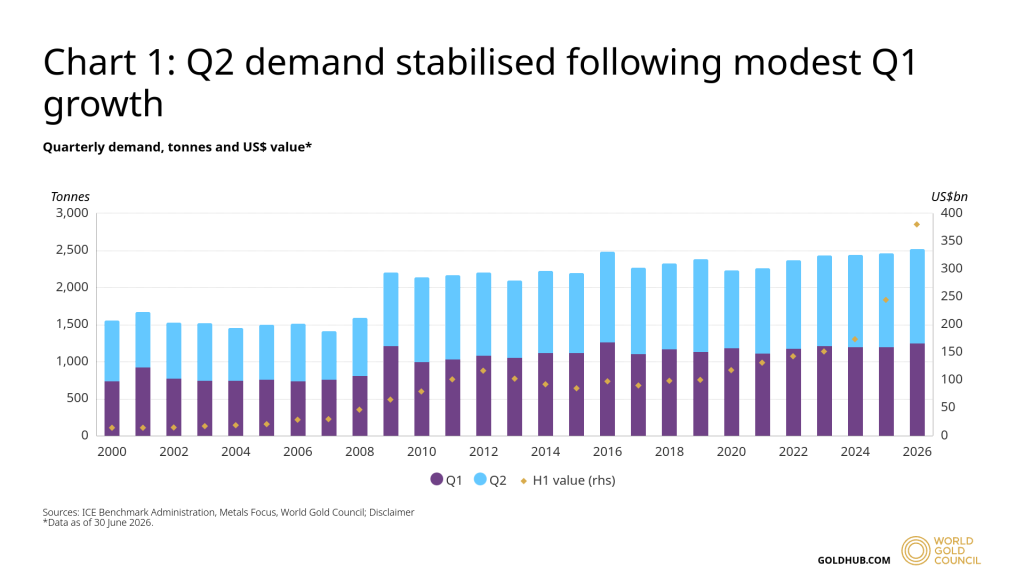
“Gold’s early-year rally reversed in the second quarter, with prices consolidating after correcting from record highs. But the market remained well supported, reflecting gold’s established role as a diversifier and store of value,” WGC senior markets analyst Louise Street says.
The London Bullion Market Association (LBMA) gold price averaged US$4,506.29 an ounce during the quarter, down 8% from the record average set in Q1 but still 37% higher than a year earlier, WGC notes.
Over the three months, gold prices fell about US$650 per ounce or 14%, as the conflict in the Middle East pushed energy prices higher and fuelled expectations that interest rates could remain elevated for longer.
Prices have since traded just above the key US$4,000 level ahead of the US Federal Reserve’s end-of-July policy meeting.
ETF demand eases
Investment demand for gold exchange-traded funds (ETFs), bars, and coins fell to 262 tonnes in Q2 as lower prices cooled the strong momentum seen earlier in the year.
The decline was driven mainly by ETF outflows of 45 tonnes during the quarter, although first-half ETF demand remained modestly positive at 18 tonnes.
“While gold ETF flows receded in step with prices, continued central bank buying, and growth in OTC investment contributed to total gold demand edging 2% higher across the first half of the year,” Street says.
Bar and coin investment remained relatively resilient, slipping just 3% year-on-year in Q2. First-half demand was still 21% higher than the same period last year, supported by exceptionally strong buying in the first quarter.
Meanwhile, OTC investment continued to strengthen, led by Asian investors. Demand reached 327 tonnes in Q2 and totalled 571 tonnes for the first half.
Central bank buying still robust
Central banks and other official institutions added a net 289 tonnes of gold to reserves during the quarter, a 62% increase from a year earlier as purchases accelerated across several markets.
Despite the stronger quarter, first-half buying remained below the elevated levels recorded in recent years because of weaker activity in Q1.
A central bank survey conducted by the WGC found that 45% of respondents intend to increase their gold holdings over the next 12 months, underscoring the metal’s continued importance as a reserve asset.
Mine supply rises
Total gold supply, meanwhile, was unchanged year-on-year at 1,269 tonnes in Q2 as higher mine output offset weaker recycling.
Mine production increased an estimated 2% to 966 tonnes, supported by new output from Canada and Chile.
Recycling, however, fell 6% despite elevated gold prices.
Investment to remain key driver
Looking ahead, the WGC expects investment demand to remain the primary driver of gold consumption through the second half of the year.
“Investment is likely to drive growth, however the demand mix could shift,” Street predicts.
“OTC activity and demand from Asian investors are expected to play an increasingly prominent role, while Western gold ETF interest may be more closely linked to real yields, US monetary policy expectations and the dollar.”
The Council also expects central bank purchases to remain strong, although likely below the record levels seen in 2025.
Jewellery demand is expected to remain under pressure from elevated gold prices, while mine production and recycling are both forecast to record modest growth, it adds.
Write to Jackson Chen at Mining.com.au
Image: National Bank Of Ukraine | Flickr