


Global iron ore prices are likely to remain between US$80 and US$100 per tonne over the next 12-18 months due to subdued demand and high supply, limiting earnings growth for major producers.
This is according to a May 2025 Moody’s Ratings report, which says China’s (A1 negative) structural decline in steel production will negatively affect global iron ore demand, as it imports more than two-thirds of global seaborne cargo.
“Increased output from major producers and new supplies from frontier markets will keep supply high, pressuring prices. However, even if prices drop below US$80 per tonne, major producers will continue to operate profitably because of their low production costs,” Moody’s reports.
“The demand for lower and higher grade iron ore is likely to diverge as cleaner steelmaking technologies become more prevalent.”
As the world’s leading steel producer, global iron ore demand largely depends on steel production from China. The country consumes more than 50% of the world’s iron ore and imports over two-thirds of global seaborne cargoes.
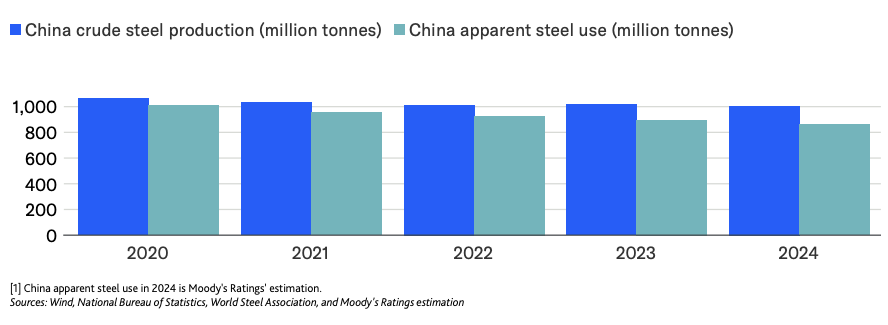
In 2024, Moody’s says China accounted for roughly 53% of the world’s total crude steel production.
“However, China’s property sector, which is the country’s largest steel consumer, has undergone a structural decline. New construction starts have significantly decreased in recent years, reducing demand for construction steel,” Moody’s reports.
“Although there has been growth in demand from the manufacturing and infrastructure construction sectors, along with a sharp rise in steel exports in 2024, it has not been enough to fully offset the decline from the property market. As a result, China’s crude steel production declined by 6% in 2024 from its peak in 2020, hitting a five-year low.
“This downturn has led to a reduced demand for iron ore. The country’s steel output has been declining since 2020 because of the protracted downturn in the steel-intensive property sector and the government’s mandate for zero annual growth in output from 2021 to limit carbon emissions.”
During the ‘two sessions’ meetings this year, the government called for addressing the structural supply and demand issues in key sectors such as steel, which Moody’s says could guide the steel industry to control steel production volume, and will likely result in lower productions over the next two years.

Despite potential stimulus from the Chinese government aimed at infrastructure investments and high-tech manufacturing sectors, which could temporarily increase steel demand, China’s steel demand and production is likely to decline over the next two years.
Moody’s notes this decline is primarily due to the continued suppression of domestic steel demand by the property market.
“However, the extent of this decline from the property sector is likely to narrow as we expect national contracted sales value in China’s primary property market will likely decline at a slower pace,” the ratings agency adds.
“Additionally, export demand is likely to decrease in 2025 as rising trade tensions may lead to tariffs on Chinese steel, increasing export costs and making exports less attractive for Chinese steelmakers.
“China primarily exports steel to countries in Asia-Pacific, with top destinations being Vietnam (Ba2 stable), Korea and Indonesia (Baa2 stable) in 2024. Several countries have already imposed or are considering tariffs and other protective measures against Chinese steel imports into their countries. If trade tensions escalate, more countries might adopt similar action.”
Global steel production was weak in 2024 and remains about 4% below the peak in global output in 2021.
According to the Department of Industry, Science and Resources (DISR) March 2025 Resources and Energy Quarterly, production is expected to be flat in 2025 then slowly pick up over the five-year outlook period, reaching just under 2 billion tonnes by 2030.
DISR expects growth in global steel production could be met using existing production capacity. Global crude steelmaking capacity exceeded global steel production by over 600 million tonnes in 2024.
“However, substantial new steel capacity — either under construction or planned — is expected over the outlook, with large-scale projects in Asia, North America, Europe and the Middle East. The OECD warns that excess capacity will become increasingly problematic in the next few years, putting further pressure on prices and steelmakers’ margins and distorting trade and markets,” DISR’s March 2025 Resources and Energy Quarterly says.
“Global industrial production is expected to gradually rise over the outlook, bolstered by a pickup in steel-intensive manufacturing, infrastructure and civil construction sectors in advanced economies.
“Demand for steel also fell sharply in 2024 and continues to be affected by the weakness in industrial output that has persisted since early 2023. Flat dwelling construction — due to declines in household purchasing power and tight financing conditions — also continues to depress steel demand in advanced economies.
“Global steel demand is forecast to recover over the outlook period, but with substantial divergence among major steel markets.”
Write to Adam Orlando at Mining.com.au
Images: Stock, Moody's & DISR