


This is the second in a two-part feature series.
This article is a sponsored feature from Mining.com.au partner Cazaly Resources Ltd. It is not financial advice. Talk to a registered financial expert before making investment decisions.
Cazaly Resources (ASX:CAZ) is formulating a multi-pronged strategy to capitalise on the transition to global decarbonisation.
In the first of this two-part series, Managing Director Tara French outlined how the $11.5 million market capitalisation company is advancing the Halls Creek Project in Western Australia, where the Bommie Porphyry Copper Prospect has been a significant focus.
However, the market is abuzz about Cazaly’s application for a new exploration licence located in the northern region of Namibia for REE and base metals in the vicinity of the world renowned Tsumeb Copper-Lead mine, and the Abenab Vanadium Mine.
While the base metals proposition in particular is quite compelling, the REE potential is exciting to say the least.
In rare company
Last week, Cazaly Resources reported it made an application for a new exploration licence located in the northern region of Namibia through its 95% owned local subsidiary company Philco One Hundred and Seventy Three. The remaining 5% interest in Philco is held by a local Namibian company controlled by historically disadvantaged Namibians.
In terms of global decarbonisation and moving towards net zero emissions, exposure to REE is significant for many reasons.
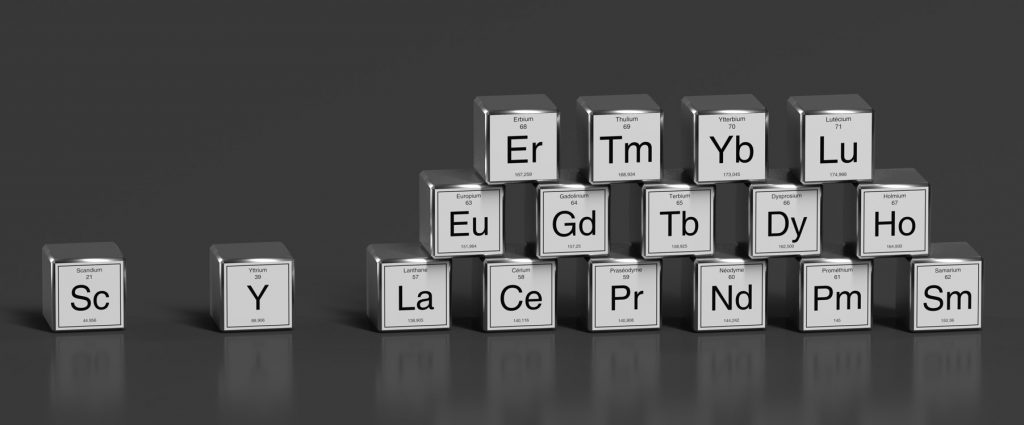
The REE group comprises 17 metallic elements: 15 lanthanides plus scandium and yttrium. The consumption of REE has increased significantly with the demand for renewable energy and electronic devices. REE spot prices have increased 35% since 2021 and are likely to remain strong as they are an essential component for the energy transition.
The United States Geological Survey has listed all REE on its 2022 Critical Minerals List, with the exception of promethium, however neodymium used in permanent magnets, currently has the highest demand. While China remains the dominant producer of REEs, continued investment in this sector globally must continue to reduce the supply risk and meet future demands.
The MD explains that while the process to have the applications granted may take time, Cazaly is confident of getting the greenlight given the importance of such an asset in these times.
“The Namibian Ministry of Mines and Energy (MME) aim to process applications within a 3-month period. While the MME are looking to streamline the process via an online system, for now the process is manual, and could take longer. We anticipate an update on progress in December.
“Should the application be successful, the project presents a fantastic opportunity for Cazaly to add value to our portfolio with potential base metal mineralisation and proven REE mineralised carbonatites”
Should the application be successful, the project presents a fantastic opportunity for Cazaly to add value to our portfolio with potential base metal mineralisation and proven REE mineralised carbonatites. To date our investigations, indicate that previous work in the area focussed more on the Abenab Vanadium Mine located to the south, and no further exploration work was completed on the carbonatites within the licence application area.”
The Abenab North Project lies in the Otavi Mountain Land region of northern Namibia located some 450km by road from the capital of Windhoek in a well-mineralised base metal province with historic production from several mines including Tsumeb, Kombat, Abenab and the Berg Aukas mines.
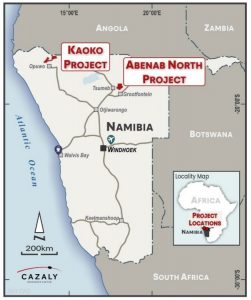
The region has ‘excellent’ infrastructure, which is well served by sealed roads, rail to port, high voltage power, telephone lines, and water. The Abenab North Project is close to major towns and mining processing facilities.
It’s an important application in which French says, will certainly be worth the wait. Aside from the REE potential, the project is also highly prospective for Tsumeb style base metal mineralisation.
“The project’s REE potential is evidenced by the multiple carbonatite intrusives on the licence area and from the results of limited drill intercepts including 45m @ 0.73% TREO to end of hole (including 4m @ 2.53%).
In addition to this the potential for Tsumeb style mineralisation adds further interest to the area’s total mineralisation potential.”
Gateway to north of Namibia
Tsumeb is known as the “gateway to the north” of Namibia.
French notes that Tsumeb is a world-famous Cu-Pb-Zn-Ag-Ge-Cd mine renowned for its wealth of rare and unusual minerals and was mined from 1897 to 1996.
“The Tsumeb deposit was mined for nearly 100 years from 1897 to 1996 producing over 30Mt of ore and reportedly was so rich that a percentage of the ore was sent straight to the smelter, called “direct smelting ore”.
“The Tsumeb deposit was mined for nearly 100 years from 1897 to 1996 producing over 30Mt of ore”
The Abendab North project has the same geological setting and some indications of potential mineralisation similar to Tsumeb.”
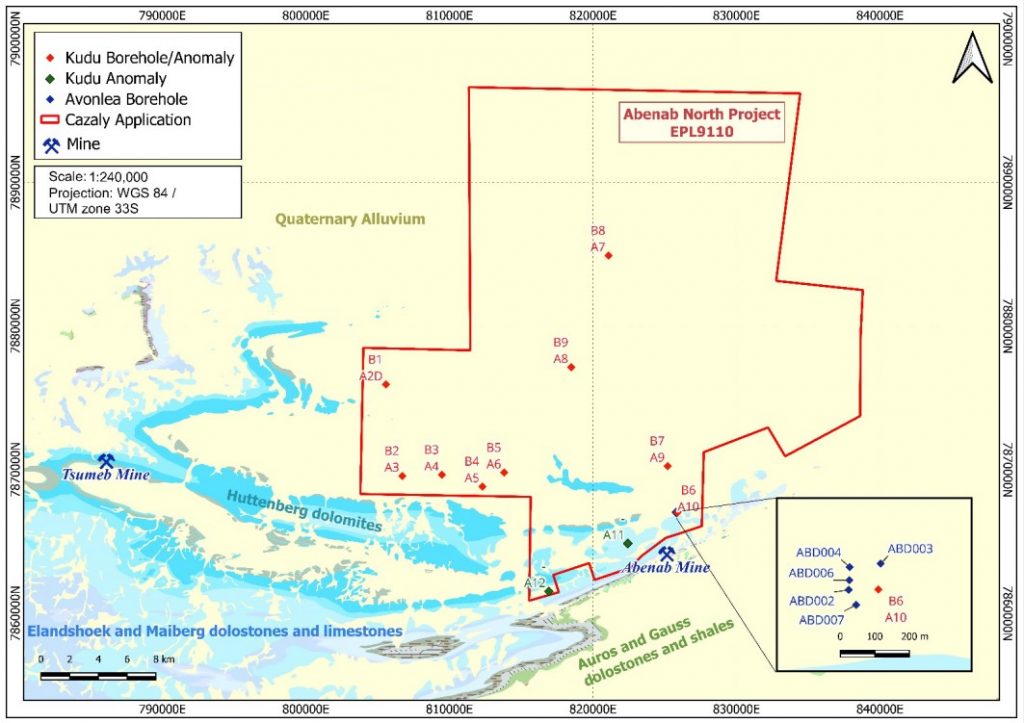
The exploration licence application, EPL 9110 Abenab North, has no competing applications and covers an area of about 790km-square. The project is located on the Neo-Proterozoic Damaran platform carbonate succession of the Otavi Group overlying basal clastic sediments of the Nosib Group, which in turn rest upon Paleo Proterozoic granitic basement.
French notes that the project is considered to be ‘highly prospective’ for base metal and rare earth element (REE) mineralisation as evidenced from the results of previous but limited exploration. In the early 2000s Anglo American (LSE:AAL) explored for base metal mineralisation in the area now covered by the EPL application. The program was short-lived however, and the ground was relinquished after the completion of a ground geophysical campaign.
In 2004, privately held Kudu Minerals applied for a portion of the ground abandoned by Anglo American also targeting Tsumeb style hydrothermal pipes. Kudu Minerals interpreted and modelled airborne and ground magnetic data, the results highlighted 9 targets for follow up drilling.
The drilling was aimed at testing these anomalies by drilling a single hole into each target into the fresh rock whilst two other targets, numbered 11 and 12, were tested by surface geochemistry only.
In 2010 Avonlea Minerals 9ASX:AVZ) gained access to the property and drilled into Anomaly 10 intersecting fresh carbonatite. Assays were ‘highly encouraging’ including 16.7m @ 0.66% TREO from 94.6m (including 1.2m at 1.89%) (ABD006), 19.9m @ 0.48% TREO from 65.5m (ABD006), 39.7m @ 0.55% TREO from 100.6m (including 3.6 m @ 1.22%) (ABD007) and 3.0m @ 1.19% TREO from 90.2m (ABD007 in a zone of poor core recovery). No further work was completed by Avonlea.
Creating value
As the company rounds out 2022 with positive news flow and encouraging results, 2023 is looking like it could be a year of creating value for Cazaly.
Aside from the REE potential, Cazaly is currently compiling and assessing the historical database in conjunction with available regional geological and geophysical datasets to plan its exploration programs while awaiting grant of the application at the Abenab North Project.
In addition, the company is progressing with a maiden resource estimation for the Bommie porphyry copper deposit at the Halls Creek Project. This is due for release before the end of this calendar year and studies continue to assess the geochemical nature of the deposit. Upon completion of the resource estimation and full geochemical review Cazaly will be in a position to determine the requirements for the next phase of work to progress the project.
Cazaly had $9m in cash and investments as of 30 September 2022 and currently has a market capitalisation of just under $13m. Given the company’s recent positive results, and recent news on the pending licence application for REE-base metals in Northern Namibia, French notes that Cazaly offers investors a plethora of value with its pipeline of works.
“I believe Cazaly’s current share price is not a reflection of our current assets nor the work we have completed to advance these projects. Cazaly has not conducted a capital raising since 2019, and therefore I believe are flying under the radar as an exciting investment opportunity.
With a maiden copper resource pending for our porphyry copper deposit at Halls Creek and our new REE application in Namibia the company has plenty of unlocked value to add.”
Write to Adam Orlando at Mining.com.au
Images: Cazaly Resources Limited & iStock