



Australian environmental technology developer Calix (ASX:CXL) has officially made the call to construct and operate a mid-stream demonstration plant under a joint venture (JV) with Australian lithium producer Pilbara Minerals (ASX:PLS).
Calix, which has a market capitalisation of $768.4 million, reports the boards of both companies have made a Final Investment Decision (FID) for the demonstration plant within the Pilgangoora Operation JV in Western Australia.
Speaking to Mining.com.au, Calix Chief Executive Officer (CEO) and Managing Director Phil Hodgson says the JV with Pilbara represents 2 like-minded Aussie companies ‘giving it a real crack’ to do some mineral processing onshore in Australia.
He says the process of purchasing long-lead-time items is already underway and will now pick up pace alongside detailed design work and, ultimately, the procurement and construction phase.
“That phase should see the plant constructed by about the end of the next calendar year. So, we’re into a phase of close to 17 to 17.5 months of intense engineering work, construction work, and then at the end of the next year, if we’ve got the plant complete by then, we’ll commence the commissioning process for the plant.”
“That phase should see the plant constructed by about the end of the next calendar year.”
The Pilgangoora JV is split 55% and 45% between Pilbara and Calix, respectively.
Calix reports the project is estimated to produce more than 3,000 tonnes per annum of lithium phosphate at full capacity, using spodumene concentrate feed purchased by the JV from Pilbara on commercial terms consistent with market pricing.
As manager of the JV, Pilbara will seek to sell all lithium phosphate produced from the demonstration plant on commercial terms to participants in the lithium supply chain.
Calix says budgeted construction costs for the project of up to $104.9 million will now be funded by both parties on a cost split of 79% to 21% for Pilbara and Calix, respectively, while the Australian government is contributing $20 million under the Modern Manufacturing Initiative (MMI) grant signed on 28 April 2023.
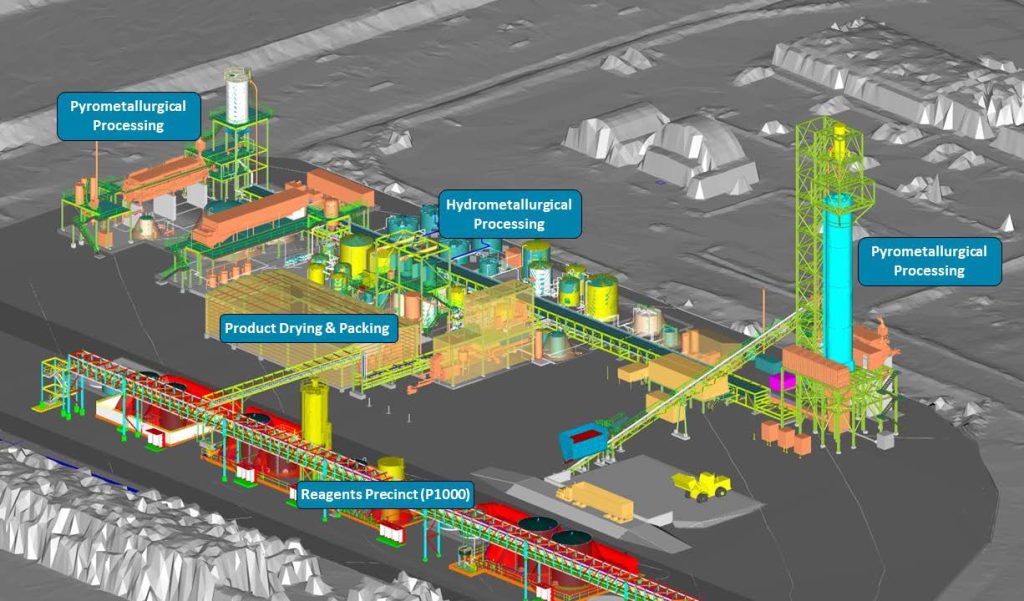
Calix says the project aims to demonstrate the potential to reduce carbon emissions intensity for the hard rock lithium supply chain through the creation of a ‘high-purity’ lithium-rich chemical salt using electric calcination that could be powered from renewable energy when available.
In fact, Life Cycle Assessment studies commissioned by Pilbara have calculated that when using 100% renewable electricity for electric calcination, the carbon emissions intensity of the spodumene calcination can be reduced by more than 90% compared to using coal as the primary source of thermal energy in rotary kiln calcination and by more than 80% compared to using natural gas.
If the calcination technology is demonstrated, Pilbara will have the right to licence the technology from the JV for use in its own potential mid-stream or downstream commercial-scale plants to produce lithium salts or chemicals, either at Pilgangoora or any future projects developed by Pilbara or in partnership. Both companies will also be able to commercialise the technology through an incorporated JV that will be able to licence the lithium processing technology to third parties globally, which could lead to additional revenues for the JV and its parties.
Hodgson tells this news service that processing spodumene domestically will become increasingly important in the future to make the most of more sustainable processing techniques.
“With our technology that we’re trying to develop with Pilbara here, our technology — our kiln — can be renewably powered. So that’s the big attraction.
“If we don’t act to drop the carbon footprint of the lithium derived from spodumene, we could see our own spodumene industry here in Australia under threat”
We’re in competition with salar brines sourced from South America, and Australia has overtaken South America in terms of its supply of lithium to the world.
However, salar brines have half the carbon footprint of a spodumene-derived lithium, and if we don’t act to drop the carbon footprint of the lithium derived from spodumene, we could see our own spodumene industry here in Australia under threat.”
Hodgson also tells Mining.com.au that the calciner technology can lower the carbon footprint of spodumene processing and bring value and jobs to the lithium supply chain.
“Australia has massive potential renewable energy resources, so I see this as a great example of what could be done across multiple industries: iron ore, aluminium, all sorts of things, rare earths, et cetera. Hopefully, this is the first step in many more to follow.”
Pilbara Minerals is an Australian lithium producer and operates the Pilgangoora Operation, which is described as the world’s ‘largest’ independent hard rock lithium operation.
Calix is an environmental technology company that specialises in industrial decarbonisation and sustainability, including carbon dioxide mitigation, sustainable processing, advanced batteries, biotechnology, and water treatment using its patented technology platform.
Write to Harry Mulholland at Mining.com.au
Images: Calix Ltd

